Floods and Droughts Research
Infrastructure
 Small
Grant Funding Call
Small
Grant Funding Call
Funding
Available
Grant size: Up
to 15,000 per project
Total funding:
45,000 (up to three projects)
Call opening: 9 March
2026
Deadline:
17:00, 20 April 2026 (early applications welcome)
As part of the Floods and Droughts Research Infrastructure
(FDRI) Project, funding is available for up to three new
research projects to advance hydrological modelling or field experimentation
within the Upper Tweed, Upper Severn, and Chess catchments. Each small grant,
up to 15,000, will support innovative approaches that engage with FDRI s
state-of-the-art field and digital technologies, helping to inform the ongoing rollout
of national hydrological infrastructure. This funding call is being
administered by Lancaster University as host of the FDRI Chief Science Advisor.
Background
FDRI is a 38 million
five-year capital investment in world leading hydrological research
infrastructure, which will feature a network of instrumented basins providing nationally
relevant data. The project will instrument the 139 km2 Upper
Tweed, 174 km2 Upper Severn and 105 km2 Chess catchments
with the latest technology as a focus or demonstrator for UK-wide initiatives
in hydrological modelling and field experimentation. Digital solutions will
underpin the observational infrastructure and facilitate data use.
The FDRI team has recently
appointed Catchment
Champions to encourage research engagement across the target
catchments. In parallel, they have released new long‑term,
quality‑assured data for the Upper Severn catchment. To
support the wider UK hydrological community, FDRI has supported the production
of a new dataset comprising of long-term discharge
records at a 15-min resolution for most publicly funded UK
river stations. This work has also contributed to an update of the CAMELS-GB dataset
that for the first time includes hourly rainfall and discharge for
most of those river catchments. Together, these initiatives create
opportunities for UK researchers to engage with the FDRI catchments, through
fieldwork and/or modelling, placing them in the broader context of UK hydrology
and addressing key research challenges. To support this engagement, FDRI is
offering small grants to UK researchers.
Aim of the Call
The purpose of this small
grant call is to encourage novel research that will inform the rollout of
FDRI s field and digital technologies and lay the groundwork for future major
funding programmes.
Eligibility
Applications are welcome
from both Early Career Researchers, defined as those within five years of
starting research, and established academics at UK universities/institutes.
Projects may focus entirely on modelling or involve experimental fieldwork, but
all proposals must make a clear link either to the hydrological behaviour of
the Upper Tweed, Upper Severn or Chess catchments, or to the advanced
technologies being developed for FDRI. Within this context, research may
explore hydrological modelling, hydrological processes including those relevant
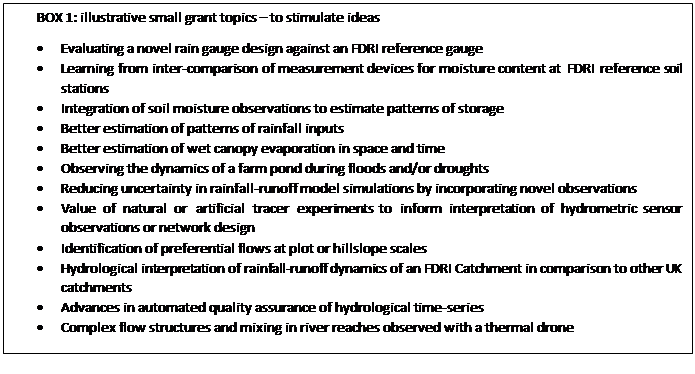
to water quality, or hydrological field technology. Examples of possible topics
are provided in Box 1 to stimulate ideas, but applicants are encouraged to
propose their own.
Individual Catchment Champions
and FDRI partner institutions (UKCEH, BGS, Bristol and Imperial) are ineligible
to apply for this call.
Funding and Resources
Each grant is worth up to
15,000 inclusive of VAT, with most resources expected to cover staff time and
institutional overheads, though equipment and travel costs may also be
included.
Application Requirements
Proposals should not exceed
four pages of A4 in total, including:
two pages for the science case including
justification, figures and references,
one page for resources detailing staff time
(hours, days or FTE), costs per person, institutional overheads, equipment and
travel (trips,
cost per trip and total),
one page summarising the curriculum vitae
of all team members.
Applications must be
submitted as a single PDF by email to chiefscienceadvisor-fdri@lancaster.ac.uk by
17:00 GMT on 20 April 2026.
Assessment
An independent panel of
hydrologists will assess bids based on: (1) scientific excellence and novelty,
and (2) relevance to FDRI s developing technology systems. By applying, you
agree for it to be shared for assessment purposes. Grants may run for up to
twelve months, though shorter projects are also welcome.
Grant Conditions
Award recipients will be
required to follow the Specific terms, conditions, and requirements
(attached). We expect to make three awards under this call, with the intention
that at least one will involve an Early Career Researcher.
Further information
For questions about the
scope of the small grant bids or details of FDRI s developing infrastructure,
contact the NERC Chief Science Advisor at chiefscienceadvisor-fdri@lancaster.ac.uk.
Award holders will be expected to share plans and headline findings with the
relevant Catchment Champions and may seek advice from the Chief Science Advisor
at any stage of the grant.

Terms,
conditions, and requirements
This award is subject to UKRI
Terms and Conditions of Grants Meeting terms and conditions for funding UKRI as
well as specific terms set out in this award letter.
Specific
Terms, conditions, and requirements
The following conditions
apply to this award:
i/
The funding is cash limited. The Awardee should inform Lancaster University of
any risk of overspend at the earliest opportunity.
ii/ The funding is either
Resource (recurrent expenditure) or Capital (limited to the procurement, build
or enhancement of assets) and spend should be charged accordingly.
Iii/ The Awardee is required
to participate in NERC assurance activity associated with this award. To
satisfy this requirement, unless otherwise agreed in writing, Lancaster
University will request a one-page end
of project report from the Awardee that shall include details of the final
project expenditure which shall be submitted to NERC following completion
of each project. Further information on assurance will be provided by Lancaster
as advised by NERC to meet NERC's requirements.
Iv/ Any risk of material
deviation from the funding profile should be relayed to Lancaster University
(consultancy@lancaster.ac.uk).
v/ The Awardee may not vary
the deliverables in the proposals unless prior agreement has been sought and
obtained from Lancaster University.
vi/ The Awardee will need to
invoice Lancaster University for the agreed amount.
vii/ Lancaster University is
to establish local governance to cover contract, restricted fund control,
budget expenditure, programme, quality, delivery, and risk as appropriate to
the size and nature of the project. Lancaster University will also ensure that
this requirement is flowed down to awardees, who will be asked to outline the
proposed local governance in their grant applications.
viii/ Lancaster University
is required to demonstrate how net zero targets, environmental sustainability
and equality, diversity and inclusion issues will be addressed which will
support delivery of the Proposals. Lancaster University currently has and will
continue to maintain appropriate institutional level policies, procedures and
reports to support this requirement, which shall be available to NERC upon
written request.
ix/ Where awards result in
assets, award holders are required to maximise the exploitation of the assets
to support high-quality research and innovation and to enable wider access
where appropriate.
x/ Where awards result in
assets, award holders must assist with any reporting or review requirements
requested by NERC up to eighteen months after the equipment becomes operational
or capital maintenance work has been conducted, including details of equipment
usage. Award holders must keep a record of all usage, providing details of the
user and scientific project, which must be made available to NERC.
xi/ Where awards result in
assets, NERC reserves the right to conduct asset validation and verification up
to eighteen months post award, which could include site visits to view the
equipment.
xii/ Awardees should
consider the equality impacts of their projects. Guidance on undertaking an
equality impact assessment is provided in Annex A.
Annex
A Equality Impact Assessment Guidance and Template (where applicable)
This document provides
guidance when completing an Equality Impact Assessment (EIA). The EIA template
can be found at the end of this document.
The Research Councils are
committed to promoting equality and participation in all their activities,
whether this is related to the work we do with our external stakeholders or
whether this is related to our responsibilities as an employer. As public authorities
we are also required to have due regard to the need to eliminate
discrimination, advance equality of opportunity, and foster good relations when
making decisions and developing policies. To do this, it is necessary to
understand the potential impacts of the range of internal and external
activities on separate groups of people.
What
is an Equality Impact assessment (EIA) and why do we need to complete one?
An equality impact
assessment (EIA) is an evidence-based approach designed to help organisations
ensure that their policies, practices, events, and decision-making processes
are fair and do not present barriers to participation or disadvantage any
protected groups from participation. This covers both strategic and operational
activities.
The term policy, as used
throughout this document, covers the range of functions, activities, and
decisions for which your organisation is responsible, including for example,
strategic decision-making, arranging strategy & funding panels, conferences,
training courses and employment policies.
The EIA will help to ensure
that:
We understand the
potential effects of the policy by assessing the impacts on separate groups
both external and internal.
Any adverse impacts are
identified, and actions identified to remove or mitigate them.
Decisions are transparent
and based on evidence with clear reasoning.
When
might I need to complete an EIA?
Whether an EIA is needed or
not will depend on the impact that the policy may have and relevance of the
activity to equality. The EIA should be done when the need for a new policy or
practice is identified, or when an existing one is reviewed. Depending on the
type of policy or activity advice can be sought from either your HR team, your
Equality, Diversity and Inclusion team, your Peer Review Policy team, or their
equivalents.
Ideally, an EIA should form
part of any new policy, event or funding activity and be factored in as early
as one would for other considerations such as risk, budget or health and
safety.
Who
is responsible for completing and signing off the EIA?
Depending on the nature of
the policy, event or funding activity, the responsibility of who should
complete the assessment, who should be consulted, and who should sign off the
EIA will vary. Ultimate responsibility on whether an EIA is required, and the
evaluation decision(s) made after completing the EIA lies with the Senior
Responsible Officer, budget holder, project board or the most relevant senior
manager. Further advice is available from your Equality, Diversity &
Inclusion contact.
What
is discrimination?
Discrimination is where
someone is treated less favourably or put at a disadvantage because of their
protected characteristic. The separate groups covered by the Equality Act are
referred to as protected characteristics: disability, gender reassignment, marriage
or civil partnership status, pregnancy and maternity, race, religion or belief,
sexual orientation, sex (gender), and age.
Discrimination is usually
unintended and can often remain undetected until there is a complaint.
Improving or promoting equality is when you find ways to remove barriers and
improve participation for people or groups with a protected characteristic.
Building
the evidence, making a judgement
In cases of new policies or
management decisions there may be little evidence of the potential effect on
protected characteristic groups. In such cases you should make a judgement that
is as dependable as possible. Consultation will strengthen these value
judgements by building a consensus that can avoid obvious prejudices or
assumptions.
Consultation
Consultation can add
evidence to the assessment. Consultation is particularly important and key to
proving that organisations are meeting the equality duties, but it also needs
to be proportionate and relevant. Considering the degree and range of consultation
will safely guard against groupthink by involving a diverse range of
consultees. These are the key considerations, to avoid over-consultation on a
small policy or practice and under-consultation on a significant policy or an
activity that has the potential to create barriers to participation.
Provisional
Assessment
At the first stages, you may
not have all the evidence you need so you can conduct a provisional assessment.
Where a provisional assessment has been conducted, there must be plans to
gather the required data so that a full assessment can be completed after a
reasonable time. The scale of these plans should be proportionate to the
activity at hand. When there is enough evidence a full impact assessment should
be prepared. Only one EIA should be created for each policy, as more evidence
becomes available the provisional assessment should be built upon.
Valuing
Differences
EIAs are about making
comparisons between groups of employees, service users or stakeholders to find
differences in their needs and/or requirements. If the difference is
disproportionate, then the policy may have a detrimental impact on some and not
others.
Evaluation
Decision
There are four options open
to you:
1/ No barriers or impact
found; therefore, activity will go ahead.
2/ You can decide to stop
the policy or practice at some point because the evidence shows bias towards
one or more groups.
3/ You can adapt or change
the policy in a way which you think will eliminate the bias, or
4/ Barriers and impact
found, however having considered all available options carefully, there appear
to be no other proportionate ways to achieve the aim of the policy or practice
(e.g., in extreme cases or where positive action is taken). Therefore, you are
going to go ahead with caution with this policy or practice knowing that it may
favour some people less than others, providing justification for this decision.
In most cases, where
disproportionate disadvantage is found by conducting EIAs, policies and
practices are usually changed or adapted. In these cases, or when a change has
been justified, you should consider making a record on the project risk
register.
Equality Impact
Assessment
|
|
Question |
Response |
|
1. Name of policy/funding activity/event being assessed. |
|
|
|
2. Summary of aims and objectives of the
policy/funding activity/event. |
|
|
|
3. What involvement and consultation has been done in
relation to this policy? (e.g., with
relevant groups and stakeholders) |
|
|
|
4. Who is affected by the policy/funding activity/event? |
|
|
|
5. What are
the arrangements for monitoring and reviewing the actual impact
of the policy/funding activity/event? |
|
|
|
|
Protected |
Is there a potential for positive
or negative impact? |
Please explain and give examples of any evidence/data
used |
Action to address negative impact (e.g., adjustment to the policy) |
|
Characteristic Group |
||||
|
Disability |
|
|
|
|
|
Gender
reassignment |
|
|
|
|
|
Marriage or civil partnership |
|
|
|
|
|
Pregnancy and maternity |
|
|
|
|
|
Race |
|
|
|
|
|
Religion or belief |
|
|
|
|
|
Sexual
orientation |
|
|
|
|
|
Sex (gender) |
|
|
|
|
|
Age |
|
|
|
|
Evaluation:
|
|
Question |
Explanation / justification |
|
|
Is it possible the proposed policy or activity or change in policy or activity could discriminate or
unfairly disadvantage people? |
|
||
|
Final Decision: |
Tick the relevant box |
Include
any explanation / justification required |
|
|
1. No barriers identified; therefore, activity will proceed. |
|
|
|
|
2. You can decide to stop the
policy or practice at some point because the data
shows bias towards one or more groups |
|
|
|
|
3. You can adapt or change the
policy in a way which you think
will eliminate the bias |
|
|
|
|
4. Barriers
and impact identified, however having considered all available options
carefully, there appear to be no other proportionate
ways to achieve
the aim of the policy
or practice (e.g.,
in extreme cases
or where positive action is taken). Therefore, you are going
to proceed with caution with this policy or practice knowing that it
may favour some people less than others, providing justification for this decision. |
|
|
|
\smallgrantcallfeb26.pdf
February
2026