

1
2
3
4


065 Cueva de Cofresnedo
Enaso VN52289637 Alt. 235m Length 375m Depth 34m
Updated 19th February 1999; 16th September , 31st December 2000; 3rd Feb, 7th, 27th October, 16th November 2001; 3rd, 8th, 15th June 2002; 18th January, 8th, 26th November 2003; 6th November 2005
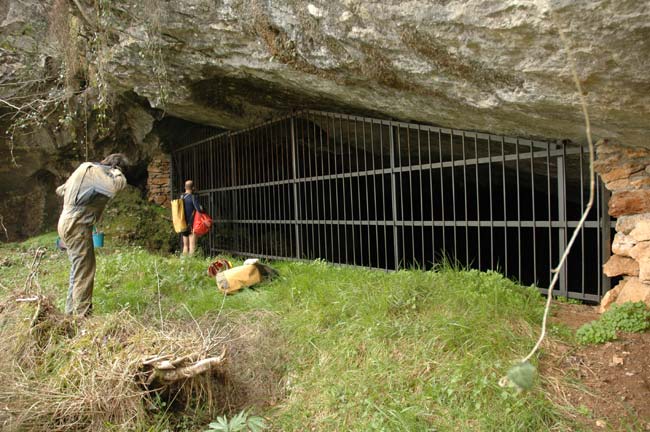
The cave was due to be gated early in 2001 and the steelwork was finally installed in December 2002. The Acanto web site (by the Federación de Asociaciones para la defensa del Patrimonio Cultural y Natural de Cantabria) has a section on Arte Rupestre esquemático-abstracto. Cofresnedo is one site with some detail about the black marks, along with an interactive survey.
The cave is basically one large passage with plenty of calcite formations. The cave ends at a calcite slope which meets the roof. One of the best archaeological cave sites in the area: human remains (of 2 adults and 2 juveniles), pottery (742 fragments - minimum of 16 vessels), paintings and Iron Age artefacts have all been discovered. The cave contains some 40 schematic-abstract paintings. Smith Peter, 1998b shows the positions and sketches these markings and they are further discussed in Muñoz Emilio et al, 1995 and Ruiz Cobo Jesús and Smith Peter et al, 2001. There are also a number of animal remains and wall scratchings.
Among the important objects which have been found are a copper arrowhead, an iron dagger and axe, a decorated copper plate, a high-tin-content bronze bead, a copper nail, a punic glass bead, a bone bead and a copper-alloy object with two holes, making this cave one of the most important Iron Age sites in the north of Spain.
Small fragments of medieval pottery have also been found. In 1994, a calcited straw or reed basket was described. This is near the end of the cave and is well trodden and half destroyed. Just beyond the basket, possible ancient barley was recognised in December 2003.
As part of a major revision, a trial dig in the entrance by Spanish
archaeologists (September 2000) has revealed an Upper Palaeolithic level
with flints and animal bones. In the small alcove (G4) where the juvenile
lower jaw was found, more teeth and bones have been found along with a couple
of pieces of pottery. Human bone has been dated to around 3410BP - a factor
in suggesting a Bronze Age burial . Ruiz Cobo Jesús and Smith Peter
et al, 2001 details all the finds and discusses the possible sequence
of occupation. Pottery found in 1963-4 and 1980-1 is found
here.
Further work during 2001
has disclosed many remains; these will be displayed on-line in due course.
Ortiz describes several Stenasellus cf. virei Dollfus and a male
Lithobius sp.
Morlote Jose M et al, 1995 describes Cofresnedo as one of the Iron
Age sepulchral caves in the area.
(Matienzo archaeology article). Photos of some
of the archaeological finds can be seen
here.
In June 2002, C14 dates for Cofresnedo were revealed (pers comm
13/6/02). "The Paleolithic deposit is about 31,000 BP or Aurignacian,
and that's OK. The Mesolithic shell midden on the wall in the entrance is
truly Mesolithic, but the bones in the chamber with the iron dagger are Bronze
Age! That one's going to need some explaining away."
Ruiz Cobo Jesús and Smith Peter, 2003 has the results of the
archaeological work carried out since 1996. This is now the definitive work
about the cave with many photos, line drawings and surveys. The book also
puts the finds in the context of other caves and deposits in the area.
References: Fernández Gutiérrez et al, 1966
(survey and photo); Kendal Caving
Club and Manchester University Speleological Society, 1975
(survey); Penil J et al, 1981;
Smith P, 1981c (photo); Manchester University Speleological Society, 1982
(survey); Cox G, 1973; Mills L D J and Waltham A C, 1981 (survey); Smith
P, 1981a; Corrin J S and Smith P, 1981; Corrin J, 1983c; Smith P and Munoz
E, 1985 (survey); anon., 1983b (logbook); material in file; Smith P, 1985
(survey and photo); Pinto A and Canales F, 1985 (survey); Smith P, 1983;
Ortiz E, 1968; anon., 1993c (Easter logbook); anon., 1993b (logbook); anon.,
1994b (logbook); Neill A, 1994; anon., 1995a (Easter logbook); anon., 1995c
(logbook); Morlote Jose M et al, 1995; Muñoz Emilio et al, 1995; Smith
Peter, 1998b (survey); Smith Peter, 1998a (photo); Fernández Ortega
F, Valls Uriol and Maria del Carmen, 1998 (photo); anon., 2000c (Summer logbook);
anon., 2000d (Christmas logbook); Corrin Juan, 2001; anon., 2001c (Summer
logbook); Ruiz Cobo Jesús and Smith Peter et al, 2001 (includes drawings,
surveys and photos); Fernández Ibáñez Carmelo, 2001
(includes dagger drawing);
Acanto
web site; pers comm (email 13/6/02); anon., 2002b (summer logbook); anon.,
2002d (Christmas logbook); Corrin Juan, 2003a (photo); Corrin Juan, 2003b
(photo); Ruiz Cobo Jesús and Smith Peter, 2003 (photos, line drawings
and surveys); Corrin Juan, 2003c; González Luque Carlos, 2003;
Castaños Ugarte Pedro Ma, 2003; anon., 2005b (Easter & summer
logbook)
Entrance picture : distant
looking out
gated entrance
Underground picture(s): Families outing
Graffiti
large passage at entrance
Digital pictures by Juan Corrin. Click to enlarge.
A1-B4: Roy Mundy installing the iron work to gate the entrance. December
2002.
1 |
2 |
3 |
4 |
|
| A |
|
|
|
|
| B |
|
|
|
|
Digital pictures by Juan Corrin. Click to enlarge.
A1-B3: Red wall markings.
1 |
2 |
3 |
|
| A |
 |
 |
 |
| B |
 |
 |
 |
Scanned slides by Frank Addis taken in 1983. Click to
enlarge.
A1: Looking out of the entrance.
A2-B3: Formations.
1 |
2 |
3 |
|
| A |
 |
 |
 |
| B |
 |
 |
 |
Detailed Survey :
| 1965 | known cave | low res | high res |
| 1975 | known cave | low res | high res |
| 1975 | on area map | low res | high res |
Archaeological discoveries:
various pictures and links
Line Survey :
On area survey :
Survex file :


