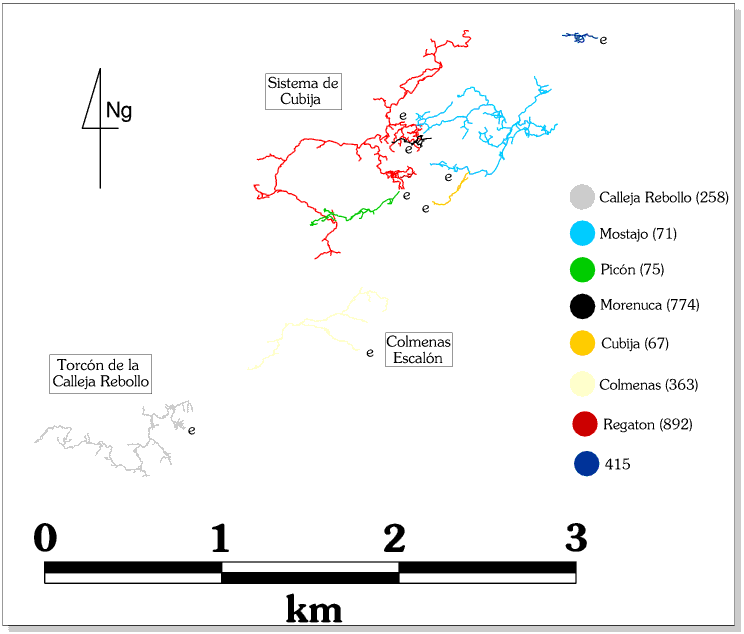
075 Simas del Picón
Cubija VN50129686 Alt. 300m Length 1441m Depth 87m
A surface survey has the entrance at grid VN50119684 Alt. 304m; GPS (in rain)
puts the site at 5017(6)9683(0)
Updated 5th March 2000; 14th May , 17th September 2000; 23rd February 2001
There are two entrances each being a pitch (26m, 15m). The lower 15m pitch is best laddered. Both land in a most impressive passage, some 20 to 30m wide.
After 50m a flowstone floor and boulder slope heading west runs down to a choke. Several small passages lead off on the left hand wall. At the end of this passage a draughting flat out slot leads to a chamber where a drop to the left under a loose rubble slope leads to a streamway. This ends at a diggable choked slot. A chamber to the left enters a draughting choke.
A slope up over boulders leads to a balcony to the left where a crawl leads to a passage ending in an unexplored tight inlet. The higher level runs off in two directions. The easterly direction leads to a climb down onto boulders at the entrance(?) The westerly direction leads to a 30m diameter chamber, Sala GES, with a choked slot down at the far side. 75m of smaller passage has a drop which can be bypassed by an unsurveyed low passage on the right hand wall. At the foot of the drop small holes to the left enter a small chamber with an excavated sandy crawl which enters Mega Bat, a decorated chamber and continuing passage to pitches of 9m (bolts in roof) and 7m (bolts to the right). This ends at a strongly draughting slot with a chamber or pitch beyond - very committing but possible for a midget.
The main passage continues through the large Sala de los Bloques. At the far side the southern, left branch ends at an undescended shaft of about 8m in a rift some 30m high. In April 1994, the Association Spéléologique Charentaise climbed up some 15m around the side of the pit to reach a 40m diameter aven and a calcite slope which closed in after 50m.
The most northerly high level level passage ended at a stal choke which was pushed into the 1993 extensions and doubled the caves length. (The choke itself may conceal a chamber / passage which would be the continuation of the main passage. At Easter 94 a rift on the left hand side was pushed to a bouldery chamber and a maze of rifts, chambers and chokes. At one point a calcited choke is seen, This is possibly the other side of the original passage in the old cave. A survey is needed of this section).
A squeeze through stal drops immediately into a well decorated, walking sized passage that continues under a fine false floor until, after a short climb, the large sandy-floored Main Junction is reached.
To the left, a climb leads into a section of phreatic passages until a 6m pitch is reached. This may be free-climbed via a crawl into a chamber nearby. At the base of the climb a small rift leads to a very steep, hading rift with a small, tight climb. A slight draught is present. The climb down was pushed at Easter 1994 for a further, unsurveyed 10m, until it became too tight. Half way down this rift an "aven" top can be seen. This drops as an 8m ladder pitch to a tube spiralling down to a strongly draughting 5cm wide gap.
Straight on from Main Junction leads to a sand slope and the head of a 21m pitch. At the base a steeply inclined sand and boulder slope descends to a narrow rift, through a couple of digs to a 10m high and 12m diameter chamber with a boulder floor and some interesting mud formations. The draught comes from a mud covered slope and a small slot which was dug to another chamber and passage which ended at a complete mud blockage after a very nice sediment bank and a cracked mud floor. The deepest point in this series is 87m below the entrance.
A route upwards from the base of the pitch passes under large formations to an 8 x 4m chamber with a possible dig at one end and a climb at the other which will probably lead to the passages beyond the traverse.
A lined traverse over the 21m pitch has a tricky move half way round and then enters a well decorated passage to a draughting boulder choke in two passages. A descent down a steep boulder slope leads to a mud climb in a mucky, large chamber which has not been done. This series has lots of pretties including huge helictites.
The drop at the "end of the passage beyond the traverse" descends for 30m to a muddy choke in the floor.
The draughting dig at the right hand end of the sandy traverse was dug under an obstructing flake to a flat out, easy dig in sand.
An obvious, large solutional aven on the right hand side of the old cave, about half way in, has been climbed and closes down at the top. Various climbs were attempted in summer 2000.
References: Ullastre-Martorell J, 1975 (survey); Corrin J S
and Smith P, 1981; Smith P, 1981b (survey); anon., 1984 (logbook); material
in file; anon., 1993b (logbook); Neill Alasdair and Jackson Keith, 1993 (survey);
Corrin J, 1994a (survey and photo); Corrin Juan, 1995b (survey); anon., 1994a
(Easter logbook); anon., 1994b (logbook); Neill A, 1994; Corrin J, 1994b
(survey); García José León, 1997 (survey); anon., 2000b
(Easter logbook)
Entrance picture : from a distance
close up
Underground picture(s): formations
'93 Extensions 1
2
Detailed Survey : 1:1000
Line Survey :
On area survey : on North Vega System
survey; no detail
Survex file :