
My Research
Here you can find links to all the research I have done so far as an undergraduate, MRes, and PhD student. This includes my STOR-i summer research project, undergraduate dissertation, reports for various MRes modules, and a description of my PhD project. In time, this page will be updated with my PhD work.
PhD
My project is in partnership with BT. My Lancaster supervisors are Chris Kirkbride, Luke Rhodes-Leader, and Rachel McCrea. From BT, I am supervised by Matthias Kearn. Below is an overview of my project.
BT is the UK’s largest broadband provider. One of the key priorities of its sustainability strategy is to reduce the energy consumption of its networks. In BT’s fixed broadband network, the bandwidth is always fixed at a constant maximal quantity, regardless of the quantity of broadband traffic. This ensures that there is sufficient bandwidth to cope with spikes in demand which might occur at the time of a world cup or when a new video game is released. As a result, a great deal of energy is wasted in providing more bandwidth than is needed during the majority of the time when such spikes in demand aren’t occurring. As broadband technology develops, allowing for the possibility of more flexibility in broadband provision, there is a need for policies for varying broadband capacity in order to reduce energy consumption whilst still meeting demand and satisfying customer quality of service requirements.
The primary aim of this project is to use simulation analytics as a tool for developing policies for adaptively varying bandwidth over time. In simulation analytics, we apply data analytics techniques to simulation sample paths in order to explore the time dependence of the system. We plan to develop different types of policies:
- Static policies, wherein we use bandwidth traffic predictions to set a fixed capacity pattern ahead of time.
- Dynamic policies, in which the bandwidth capacity could vary in real time in response to demand levels.
To assess the impact of these policies in reducing energy consumption in contrast with the energy needed to produce and install the equipment required to implement these dynamic policies, we will consider the policies we develop in the context of a Life Cycle Assessment framework.
MRes
The MRes year of the STOR-i programme involves research on a wide range of active research areas in statistics and operations research. In the first term of the course, we took part in four ‘sprints’ in which we were given a topic to research on the Monday morning, and in groups we presented our research on the Thursday afternoon. Topics for these sprints included MCMC, changepoint detection, dynamic programming, and the Travelling Salesperson Problem. We then wrote individual reports on a sprint of our choosing; my report on a variation of the Travelling Salesperson Problem can be found below. The second and third terms of the course involved writing both a technical and non technical report on two subjects from a list of Research Topics, which include statistical ecology, Bayesian & computational statistics, transport and logistics, and stochastic modelling and optimisation. Below you can find my research topic reports on multi-armed bandits and extreme value theory. In the fourth term, we will chose our PhD topics and write a research proposal, which forms the dissertation for the MRes.
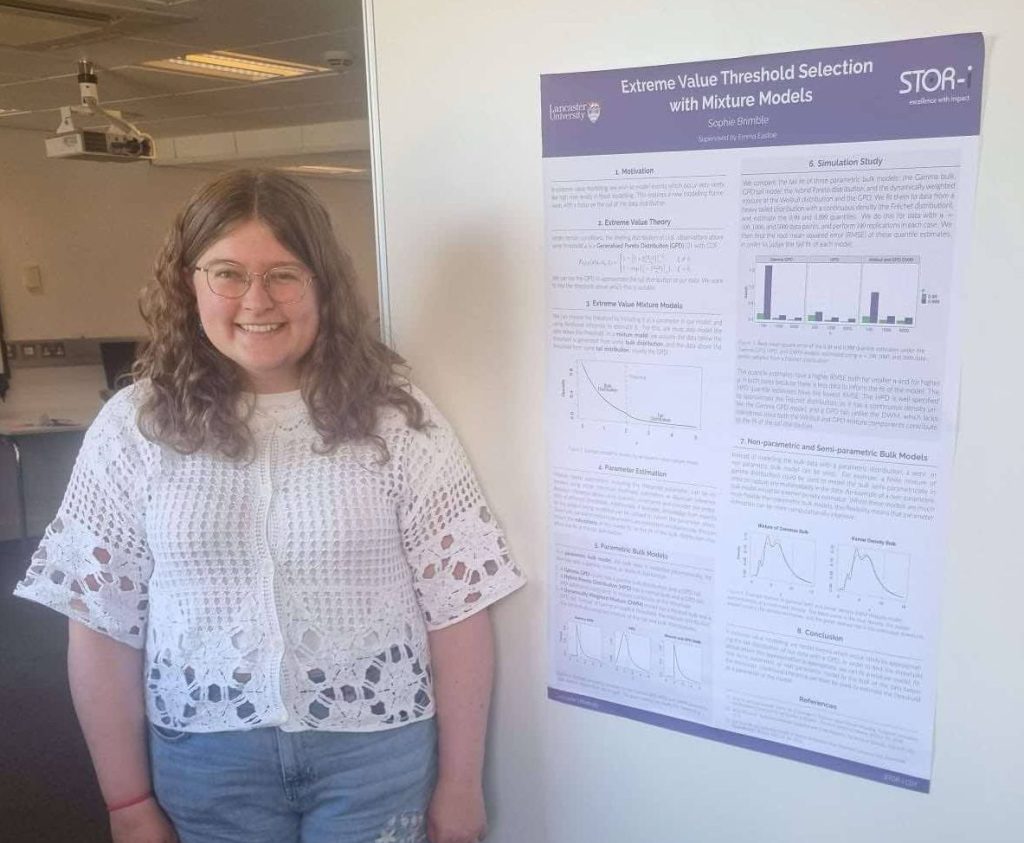
Extreme Value Threshold Selection with Mixture Models
STOR-i MRes Technical Report and Poster, supervised by Emma Eastoe, Lancaster University, 2025.
In extreme value modelling, we wish to model events which occur very rarely, like high river levels in flood modelling. This requires a new modelling frame-
work, with a focus on the tail of the data distribution.
The Generalised Pareto Distribution can be used to approximate the distribution of such tail data, however in order to use likelihood inference to estimate the threshold above which this approximation is suitable, we must model the whole of the data. This motivates extreme value mixture models.
Wrestling the Multi-Armed Bandit: Optimising Patient Allocation in Clinical Trials
STOR-i MRes Non-Technical Report and Presentation, supervised by Peter Jacko, Lancaster University, 2025.
The Multi-Armed Bandit Problem is an established problem in Operations Research, which can be used in a Clinical Trials setting to allocate patients to treatment arms.
This report looks at variations of the Dynamic Programming solution to this problem as Clinical Trials allocation methods, comparing them to the traditional Randomised Control Trial allocation.
A Review of the Fixed Destination Multiple Depot Multiple Travelling Salesperson Problem
STOR-i Mres Sprint Report, supervised by Burak Boyaci, Lancaster University, 2025.
This is a literature review for the Fixed Destination Multiple Depot Multiple Travelling Salesperson Problem, a variation of TSP where we have multiple salespeople based at multiple depots, all of whom must visit at least one node before returning to their original depot.
Undergraduate
Below are some links to research I did whilst I was an MMath student at Durham University. This includes the research project I did on as a STOR-i Summer Research Intern, and my undergraduate dissertation on natural language processing.
Topic Modelling for Text Data
Master’s Dissertation supervised by Jonathan Cumming, Durham University, 2024.
Topic modelling is an area of natural language processing in which we assume that in text data, there is an underlying latent topic variable. Each topic is a set of semantically related words, and text data is generated by sampling words from these different topics.
This report describes and evaluates several different topic modelling methods, and finally applies them to the Jane Austen novels to determine whether there is a difference in the underlying topics in the novels.

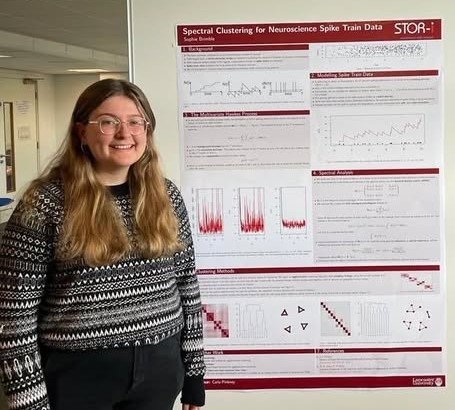
Spectral Clustering for Neuroscience Spike Train Data
STOR-i Summer Internship supervised by Carla Pinkney, Lancaster University, 2023.
The brain processes information via an interconnected network of neurons, and brain activity can be measured at the neuron level. Spike train data is data representing the firing patterns of individual neurons. It is of interest to understand the dependencies between the firing patterns of different neurons.
This project explored the use of coherence and partial coherence, which measure indirect and direct relationships between neurons respectively, to perform a clustering algorithm on the spike train data with the aim of quantifying the dependencies between neurons.