Style control - access keys in brackets
3.1 Some examples
Typical functions of two, three or four variables are:
Such functions arise constantly in applications to real-world problems. Usually, represents a point in space and (if present) represents time. But mathematically, the variables are just neutral numbers: a function of three variables is just a function on , the set of all ordered triples .
Geometrical representation. The equation defines a surface in three dimensions. We can try to draw it (which isn’t always easy!), or we can draw the contours in the -plane, as is done on maps (as shown below). The contours are therefore “implicitly-defined functions” as described in the previous section.
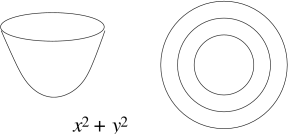
If is a function of three variables, then for each , the equation again describes a surface: these are called the level surfaces of . The previous example is the special case where and . A simple case: is a plane.
Of course, following the formulation of a parametrized curve given in the previous section, we ought to be similarly precise about what a surface is. Indeed, we can define a parametrized surface in as a continuous map , where is an appropriate set. The problem is defining what an ‘appropriate set’ is. We won’t go into the definition of such a set; in this course, any “reasonable” choice of can be considered acceptable.
Parametrized curves and surfaces are particular examples of vector-valued functions. Similarly, we could define vector-valued functions in or .
Example 3.1 Suppose an object of mass is at the origin. The gravitational force exerted on a unit mass at position is:
Here the formula is well-known from Newtonian mechanics; the expression is a unit vector towards the origin. The force is a vector-valued function, depending on but undefined at .
Example 3.2 Suppose the object of mass has position at time . Then the gravitational force exerted on a unit mass at position and time is:
This is a vector-valued function which depends on and (and is undefined at the point at time ).
Generally, we shall assume that our functions vary continuously except perhaps at isolated points. The following example shows the sort of thing that can happen near a discontinuity.
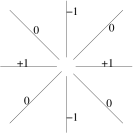
Example. Let except at . On each straight line , has the constant value (in particular, 1 on the -axis and on the -axis). We could define a surface in , but it’s quite hard to visualize the surface near the -axis !