Style control - access keys in brackets
12.4 Likelihood Examples: discrete parameters
One case where differentiation is clearly not the right approach to use for maximisation is when the parameter of interest is discrete.
TheoremExample 12.4.1 Illegal downloads
A computer network comprises of computers. The probability of one of these computers to store illegally downloaded files is , independent for each computer. In a particular network it is found that exactly one computer contains illegally downloaded files. Our parameter of interest is .
What is a suitable model for the data?
What assumptions are being made?
Are these assumptions reasonable?
What is the likelihood of ?
Let be the number of computers in the network that contains illegally downloaded files. Then is
Note that the possible values can take are . We can sketch the likelihood for a suitable range of values:
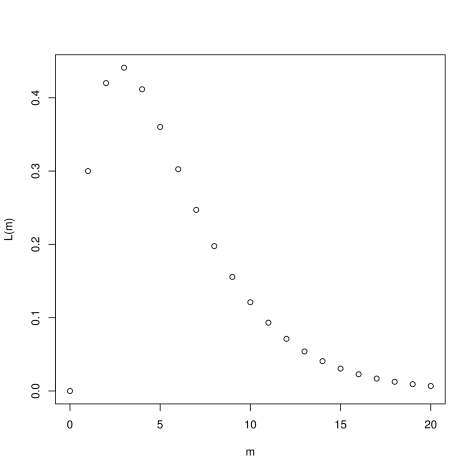
From the plot, we can see that the MLE for is . Alternatively, from the likelihood we have
The likelihood is increasing for , which is equivalent to .
To maximize the likelihood, we want the largest (integer) value of satisfying this constraint, i.e. , hence .