Style control - access keys in brackets
Solution:
-
a
There are 3 types of component, each giving rise to a constraint on :
-
1
,
-
2
,
-
3
,
as the components each need to have valid probabilities. The third inequality is sufficient for the other two and gives .
-
1
-
b
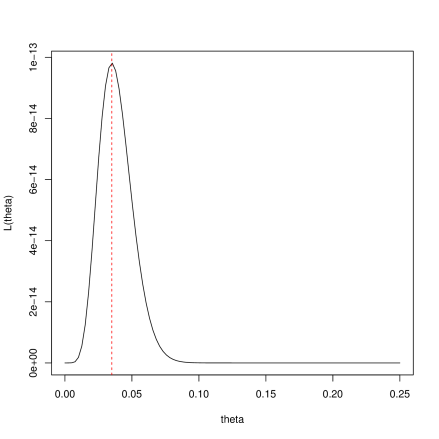
Given the data, the likelihood is
For the sketch note that and the function is concave and positive between these two with a maximum closer to than .
-
c
To work out the MLE, we differentiate the (log-)likelihood as usual. The log-likelihood is
Differentiating,
A candidate MLE solves , giving .
Moreover,
so this is indeed the MLE.
-
d
The observed information is
So a confidence interval for is
As is within this confidence interval there is no evidence of this batch being sub-standard.