Seaweed Mobilities Day was an invited event that brought together 18 people to explore seaweed mobilities and to imagine ways that we could work together in the future. The project was a network building collaboration between the School of Arts and Centre for Mobilities Research at Lancaster University, with Deco Publique and funded by AHRC Impact Acceleration.
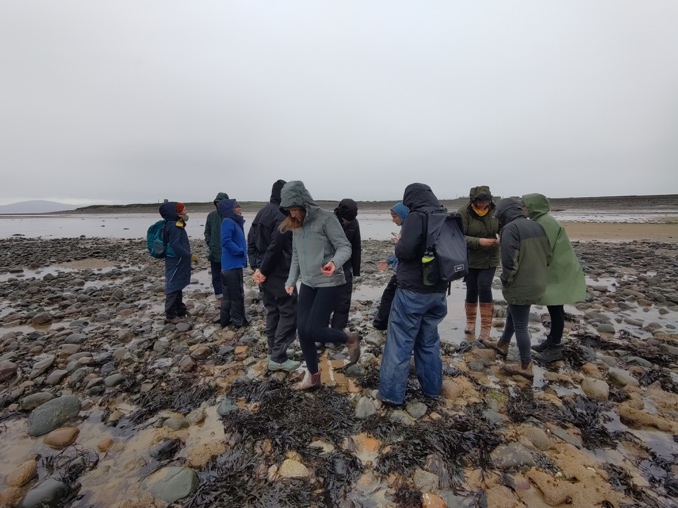
November 14th 2025 was wet and windy. We met in a car park on Walney Island near Barrow and then gathered on the beach in an area where honeycomb worms have built structures that mussels, cowries, and seaweeds have settled in. The experts amongst us pointed out the variety of seaweeds there. At 11am an eerie siren sounded, the nearby BAE Systems testing their ‘Public Nuclear Safety Alert’. We paused to consider other potential environmental alerts. On our way out we noticed a piece of a sargassum that is invasive in the UK and a small Kelp with holdfast knotted with fishing line and epiphytes.
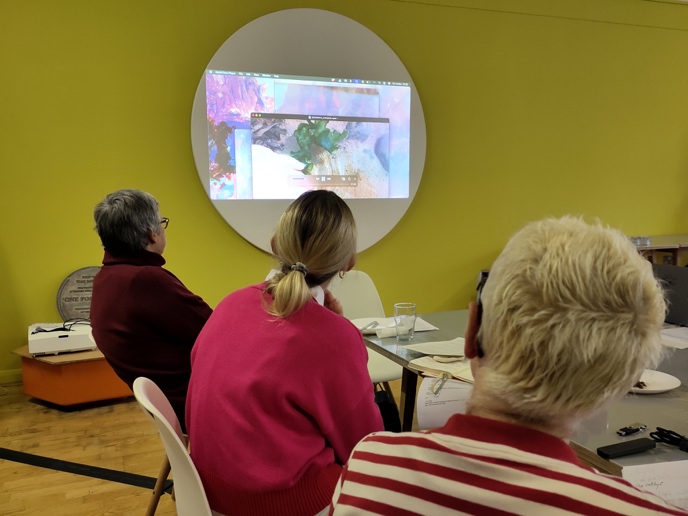
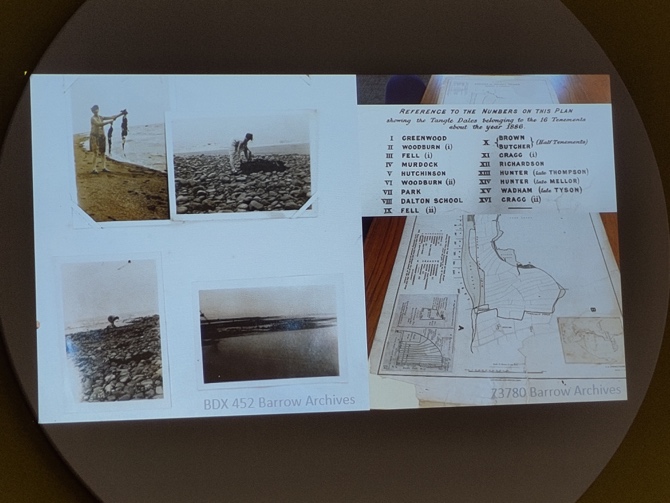
The afternoon was hosted at Art Gene in Barrow and began with Lynne Pearce introducing mobilities research and how it is relevant to seaweed, Jen Southern’s tour of photographs of the Morecambe Bay seaweeds and the infrastructures they grow on, followed by an illuminating Q&A with Michele Stanley, a seaweed expert from the Scottish Association for Marine Science.
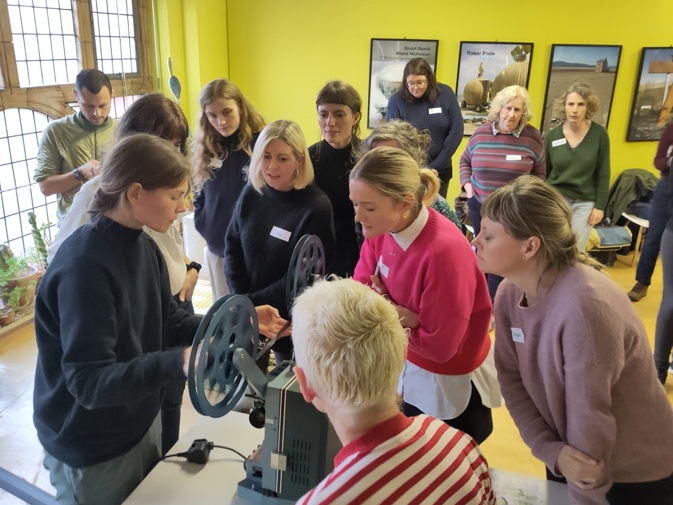
5 artists shared their rich as diverse works with seaweed: Amy Dickson, Jamie Jenkinson, Debbie Yare, Miranda Hill and Maddi Nicholson. They invited us to eat seaweed picked around this coast and consider its proximity to nuclear power stations; to watch films of dancing porphyra; to observe how quickly seaweed anchors on newly introduced rocks in a tidal zone; and invoke the rights of seaweed alongside the rights of water. At the end of the day we collaboratively wrote a seaweed mobilities manifesto as a record of our thoughts and conversations.
Themes included the resilience of seaweed, and its vulnerability to climate change. The mobilities within its own life cycle, how its spores anchor on substrate, and how it is mobile around the world through shipping and as food. We honoured the history of women working with seaweeds, particularly Kathleen Drew Baker known as the ‘Mother of the Ocean’, whose research led to a renewal of Japanese commercial seaweed production.
‘… there is so much exciting work being done on and with seaweed. I already knew it was super important in an ecological point of view, but seeing it through each others eyes and the way people are working with it, really installs some hope. The sense that seaweed isn’t just a resource but a storyteller. Hearing marine scientists and artists side-by-side helped me realise mobility, currents, tides, migration, shapes every strand of it. That connection between science and creativity has stayed with me.’ (participant feedback)