Data Science and AI Institute @ Lancaster

We aim to set the global standard for a truly interdisciplinary approach to contemporary data-driven research challenges. The Data Science and AI Institute @ Lancaster (DSAIL) has over 350 members and has raised £56 million in research grants.

An abstract diagram of networks

Linked icons

Data motif

Data Science and AI @ Lancaster (DSAIL)

The Data Science Institute is preparing for an important next step. From January 2026, we will be updating our name to Data Science and AI @ Lancaster (DSAIL), reflecting more clearly the Institute’s growing role as a focal point for artificial intelligence research, education and engagement across the University and beyond. You will see this new identity rolling out across our communications, events and online presence in the new year, but the core mission remains the same: to support and connect Lancaster’s data science and AI community.

Data Science and AI at Lancaster builds on the University’s longstanding strengths in computational and data-driven research. This environment is enriched by a broad interdisciplinary community of researchers working across fields including environmental science, health and medicine, sociology and the creative arts. Through the Data Science and AI Institute @ Lancaster (DSAIL), Lancaster is creating a world-class institute that sets the global standard for a genuinely interdisciplinary approach to contemporary data-driven research challenges. The Institute focuses on the foundations of data science and artificial intelligence, alongside a number of cross-cutting thematic areas.

DSAIL@Lancaster aims to be internationally recognised for its distinctive end-to-end interdisciplinary research capability — spanning infrastructure and fundamentals, globally relevant application domains, and the social, legal and ethical questions raised by data science and AI. By connecting expertise across disciplines, the Institute provides a focal point for research, education and engagement in data science and artificial intelligence across the University and beyond.

We are working to create a world-class Data Science and AI @ Lancaster Institute (DSAIL) that sets the global standard for a truly interdisciplinary approach to contemporary data-driven research challenges. DSAIL aims to have an internationally recognised and distinctive strength in being able to provide an end-to-end interdisciplinary research capability - from infrastructure and fundamentals through to globally relevant problem domains and the social, legal and ethical issues raised by the use of Data Science.

The Institute is initially focusing on the fundamentals of Data Science and AI including security and privacy together with cross-cutting theme areas consisting of environment, resilience and sustainability; health and ageing, data and society and creating a world-leading institute with over 350 affiliated academics, researchers, and students.

Our data science, AI, health data science and business analytics programmes have launched the careers of hundreds of data professionals over the last 10 years. Students from our programmes have progressed to data science roles at Amazon, PWC, Ernst & Young, Hawaiian Airlines, eBay, Zurich Insurance, the Co-operative Group, N Brown, the NHS and many others - please look at our Education pages for further details of the courses on offer.

AI for science with DSAIL logo

AI for Science Workshop — Showcasing AI Across Lancaster

Monday 30th March | 10:00 AM – 3:00 PM | LUMS Lecture Theatre 3

Deadline for submissions Friday 6th March

Attend: Register for AI for Science Workshop

Artificial intelligence is rapidly changing how we do science: how we collect data, build models, run experiments, design materials, interpret results, quantify uncertainty, and translate findings into real-world impact. This workshop brings together colleagues from across Lancaster to share practical examples of AI for Science—from early-stage ideas to mature projects—and to build connections that can turn good work into collaborative programmes and fundable bids.

Whether you want to learn what others are doing, stress-test an idea, find collaborators, or showcase your work, this is a structured, campus-wide forum focused specifically on the opportunities for scientific discovery with AI.

What to expect

  • Short, focused talks (10–15 minutes): Lightning-style presentations from academics, PDRAs and PhD students on how AI is enabling scientific research and discovery.
  • What worked (and what didn’t): Each speaker will briefly cover (i) the core problem, (ii) the AI method(s) used, (iii) what was learned/achieved, and (iv) limitations—data issues, compute constraints, evaluation challenges, reproducibility, governance/ethics, etc.
  • Poster + networking session (over lunch): A lively, informal opportunity to circulate, ask questions, and identify overlap across projects. Posters are strongly encouraged.
  • Breakout discussions: Facilitated small-group sessions to identify shared needs (data, tools, compute, evaluation, governance), collaboration opportunities, and concrete next steps—particularly towards future external funding and cross-faculty initiatives.
  • Practical takeaways: A curated set of themes, candidate collaborations, and an initial “opportunity map” for AI for Science activity at Lancaster.

Call for presenters (talks + posters)

We are actively seeking short talks (10–15 minutes) on any activity that fits “AI for Science” in the broadest sense. This includes methodological work, applied case studies, infrastructure/tooling, or evaluation and governance approaches that enable scientific progress.

Examples of suitable topics include (not limited to):

  • AI for scientific discovery (new hypotheses, new materials, new mechanisms, new insights)
  • AI for simulation and scientific computing (surrogates, emulators, PDE learning, accelerators)
  • AI for experiments and measurement (automation, control, adaptive/active learning, lab/field workflows)
  • AI for data assimilation and inverse problems (uncertainty quantification, calibration, causal inference)
  • AI for earth and environmental science, climate, ecology, biodiversity, geoscience
  • AI for health, medicine, life sciences, imaging, genomics, epidemiology
  • AI for engineering, energy systems, manufacturing, sensors, robotics
  • AI for evaluation and robustness in scientific settings (ground truth scarcity, dataset shift, validation)
  • Responsible and trustworthy AI for scientific practice (reproducibility, data governance, ethics)

Poster displays: If you have a poster we will provide space for displays and discussion during the lunch session. We can also cover the cost of printing the poster.

Who should attend

  • Academic staff and researchers working in, or curious about, AI-enabled science
  • PDRAs and PhD students with AI-for-science methods or applications
  • Research software engineers, data specialists, lab/technical teams, and professional services colleagues supporting research
  • Anyone interested in building cross-disciplinary collaborations around scientific AI

Provisional schedule (10:00 AM – 3:00 PM)

  • Provisional schedule (10:00 AM – 3:00 PM)

  • 10:00 – 10:15 Welcome and aims for the day (DSAIL)
  • 10:15 – 11:15 Lightning talks (10–15 minutes each) + structured Q&A
  • 11.15 - 11.30 Coffee break
  • 11:30 – 12:30 Lightning talks (10–15 minutes each) + structured Q&A
  • 12:30 – 1:15 Lunch + poster session + networking
  • 1:15 – 2:15 Breakout sessions (theme-led groups; capture opportunities and blockers)
  • 2:15 – 2:45 Report-back from groups (short summaries, candidate collaborations)
  • 2:45 – 3:00 Close: Wrap-up and next steps.

Light refreshments will be available throughout the day. Lunch will also be provided, please indicate dietary requirements via the Eventbrite registration.

How to get involved

  • Attend: Register for AI for Science Workshop
  • Presentation submission now closed
  • Poster: Indicate in your registration that you would like to bring a poster (and whether you need DSAIL to pay the printing charge)

Latest News

Research Assistant – Integrity Theme Events - closing date 26th March

We are recruiting a Research Assistant to support the launch of the Integrity theme, which will be centred on HackaCon: The AI-Generated Conversation Hackathon.

HackaCon

This is a first-of-its-kind remote hackathon inviting participants to create convincing AI-generated audio of an incriminating conversation between two target speakers. This red-teaming exercise will explore the fraud, misinformation, and evidential risks posed by synthetic conversational audio. The event will double as a research data collection exercise and an engagement initiative, with expected interest from finance, cybersecurity, intelligence, justice, and the wider public. You will help make this real.

Apply here

Pay Rate: £17.33 per hour plus £2.09 holiday pay Hours: 8hrs per week

Closing date: 26th March

Interview Date: 31st March 2026

Start Date: April 2026 (with RTW completed)

End Date: 11th December 2026

N8CIR logo

DSAIL is pleased to announce the N8CIR internships programme for 2026

This programme is aimed at 2nd and 3rd year undergraduates interested in investigating research software engineering as a career, and we are offering up to 4 8-week positions starting on the 15th June with a £3500 stipend for the period.

Please go to the N8CIR website for project details and the application process, and contact the relevant supervisors ahead of the application deadline of 13th April. Candidates will then be invited for an interview process at which the recipients of the internships will be selected.

Contact j.carradus1@lancaster.ac.uk if you have any questions.

Call for EPSRC Doctoral Landscape Award (DLA) PhD Studentship Proposals

Data Science and AI Institute @ Lancaster (DSAIL) — Call for EPSRC Doctoral Landscape Award (DLA) PhD Studentship Proposals

Deadline for submission: 17:00 (BST), 16th April 2026

Maximum length: 3 pages (see Section 5 for format rules)

Contact for queries: dsail@lancaster.ac.uk

1. Context and Purpose

Lancaster University has received an EPSRC Doctoral Landscape Award (DLA) allocation for 2025–2027. This internal call invites DSAIL-affiliated academics to submit high-quality project proposals to recruit outstanding doctoral candidates for an October 2026 (or later) start.

The overarching aims of this call are to:

  • Ensure projects are clearly within the EPSRC remit.
  • Maximise the collaborative element expected by the DLA (defined as a cash and/or in‑kind contribution from at least one non-academic partner who is actively involved in the project).
  • Champion cross-disciplinary research in line with the DSAIL mission; such proposals will be prioritised in the internal selection process.

click on show more for full application details

2. Available Studentships & What They Cover

Each EPSRC DLA studentship provides:

  • 3.5 years of Home tuition fees and stipend at the UKRI minimum rate.
  • £1,000 per annum Research Training Support Grant (RTSG).

Up to 30% of the total EPSRC DLA studentships across the Faculty may be offered to Overseas candidates, subject to Faculty approval to ensure the overall cap is not exceeded. If you intend to target an Overseas student, please flag this clearly in your proposal.

3. EPSRC Remit and Eligibility

Projects must sit squarely within the EPSRC remit (Engineering & Physical Sciences). If your topic is borderline, you must justify the EPSRC alignment explicitly. Interdisciplinary proposals are encouraged, provided the core research questions and methods remain predominantly within EPSRC scope.

Supervisory teams must include at least one member of DSAIL. Cross-departmental teams are strongly encouraged. Early Career Researchers are encouraged to apply and may co-lead proposals with appropriate mentorship.

4. Collaborative Requirement (Doctoral Landscape Award)

EPSRC expects at least 25% of studentships funded through the DLA to include a substantive collaborative component. For this call, you are strongly encouraged to embed a collaboration from the outset. Collaboration is defined as:

Working with one or more external non-academic partners who take an active role in the direction and outputs of the doctoral project and provide cash and/or in-kind contributions.

There is no minimum monetary value stipulated, but proposals should articulate:

  • The partner organisation(s) and their sector.
  • Nature and scale of contributions (cash, data, staff time, facilities, placements, etc.).
  • Planned mechanisms for steering/project governance (e.g. quarterly meetings, joint supervision).
  • Expected mutual benefits and impact pathways.

If collaboration cannot be confirmed before submission, outline a credible plan and timeline to secure it during the studentship.

5. Proposal Requirements (MAXIMUM 3 PAGES)

Submissions must not exceed three A4 pages (minimum 11pt font, standard margins). A separate reference list (optional, max ½ page) will not count towards the limit.

Please structure your proposal using the following headings:

  1. Project Title
  2. Supervisory Team (names, departments/schools, roles; indicate ECR status where relevant)
  3. EPSRC Remit & Fit (succinct justification)
  4. Rationale & Objectives (key research questions, novelty, expected contributions)
  5. Methodology & Data/Resources (core methods, datasets, infrastructure)
  6. Collaboration Plan (partner(s), contributions, engagement model; or plan to secure)
  7. Cross-Disciplinary Elements (how the work spans disciplines and why this matters)
  8. Impact & Alignment with DSAIL/University Strategies
  9. Student Development & Training (planned skills training, placements, cohort activities)
  10. Equality, Diversity & Inclusion Considerations (brief statement on inclusive recruitment and supervision)

Optional: References (½ page max).

Submissions that fail to comply with the page limit or required headings may be returned without review.

6. Selection Criteria

Proposals will be assessed by a DSAIL panel (augmented as needed for domain expertise) using the following criteria:

  1. Fit to EPSRC remit (pass/fail).
  2. Quality and novelty of the research (scientific excellence, clarity of objectives).
  3. Strength and credibility of the collaborative element (partner engagement, contributions, governance).
  4. Cross-disciplinarity and alignment with DSAIL’s mission (breadth/ depth of disciplinary integration).
  5. Feasibility and supervisory capacity (methods, resources, training environment, track record/mentorship plan).
  6. Impact potential (academic, industrial/societal, REF alignment).
  7. Student experience & development (training, placements, cohort activities).

Where proposals are otherwise equal, those demonstrating stronger cross-disciplinary reach and/or collaboration will be prioritised.

7. Submission Process

  • Format: Single PDF, 3 pages (plus optional references).
  • File name convention: DSAIL_DLA26_Surname_ShortTitle.pdf.
  • How to submit: Email the PDF to dsail@lancaster.ac.uk with subject line: “DSAIL EPSRC DLA Proposal 2026 – [PI Surname]”.
  • Deadline: 17:00 (BST), 16th April 2026. Late submissions will not be considered without prior agreement.
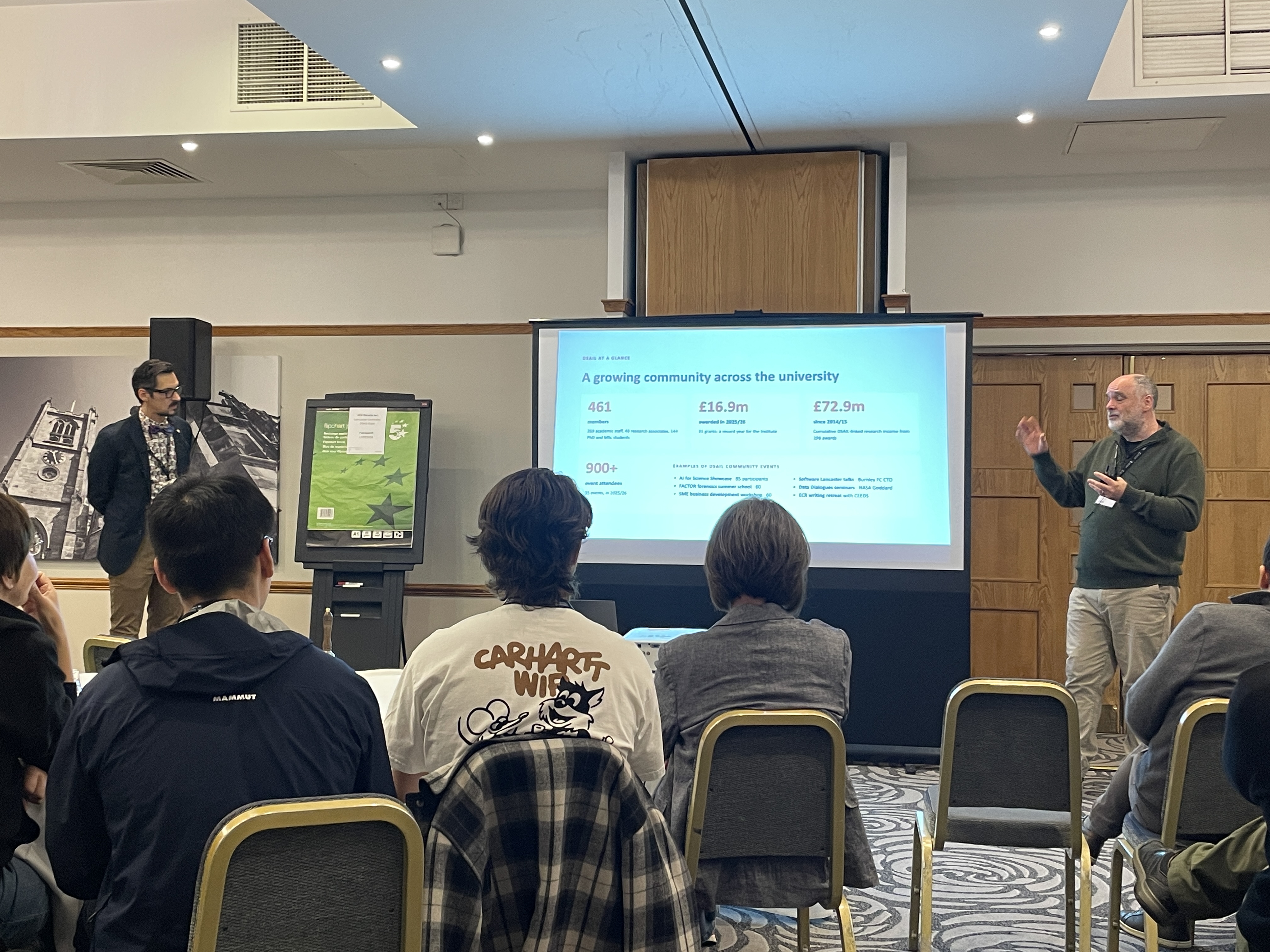
A crowd siting watching a presentation

Data Dialogues - 2026

Data Dialogues is an informal, discussion-driven event where members of the DSAIL and the broader university community share insights into their work, spark interdisciplinary conversations and explore potential collaborations. The focus is on interactive engagement rather than formal presentations—so no slides (or just a few, if needed)! Instead, the idea is to introduce your work in an accessible way, followed by an open discussion and Q&A with attendees.

Get fresh perspectives and think about new ways of approaching your own research, meet new people and explore potential research collaborations. Come be part of the DSAIL community!

22nd April -

6th May - George Brown (Forensic Linguistics) - The Uses and Abuses of Synthetic Voice Data

20th May - Speaker from NASA Goddard Space Flight Center/Catholic University of America - tbc

3rd June -

17th June

Let us have your suggestions for speakers for the summer term :) - dsail@lancaster.ac.uk

Events

Research Themes

Data Science at Lancaster was founded in 2015 on Lancaster’s historic research strengths in Computer Science, Statistics and Operational Research. The environment is further enriched by a broad community of data-driven researchers in a variety of other disciplines including the environmental sciences, health and medicine, sociology and the creative arts.

  • Creativity

    The Creativity theme researches how generative AI is transforming creative processes and reshaping notions of authorship and ownership, while also working to enable transdisciplinary inquiry through the use of creative methods to push the boundaries of data science and AI research.

  • Environment

    The Environment theme aims to develop new understanding and innovative solutions to the dual crises of climate change and biodiversity loss, which are inextricably linked. This time-critical mission requires close cross-disciplinary collaboration between ecologists, environmental scientists, computer sciences, statisticians, social scientists, and many others.

  • Foundations

    The Foundations theme covers the three main areas of data science, operational research, computer science and statistics. It blends the skills of researchers in these areas, to address challenges arising from industry and research.

  • Health

    The Health theme covers several areas of health, data science and AI from across the university, including biomedical, digital health technologies, health economics, medical imaging and health-related security, among many other areas.

  • Integrity

    The Integrity theme explores how societies can build trust, transparency, justice, fairness, accountability, and resilience in an era where AI and data-driven technologies evolve faster than the ethical processes, governance structures, and safeguarding interventions meant to oversee them.

Upcoming Events