MARS is committed to nurturing the next generation of mathematical innovators, developing their knowledge and skills to solve real-world challenges and help shape the future of AI.
Each year, we’re offering the brightest and best Lancaster University mathematics undergraduate students the opportunity to join our Summer Internships Scheme.
This scheme offers a unique opportunity for our mathematics undergraduates to work alongside our talented MARS academics and postgraduate researchers, gaining first-hand experience of cutting-edge research and an invaluable insight into the world of academic and applied innovation.
Internships for summer 2026
The MARS Summer Internships Scheme gives undergraduate students a taster of what it is like to do research. You will have supervisors who will design the research project and meet with you regularly to discuss it, as well as opportunities to interact with staff and PhD students in the department.
The Internships will take place in the summer vacation before your final year of study and will last for eight weeks.
Students will be employed as interns during the period of their internship. All students undertaking internships will receive payment equal to at least the national living wage.
Student interns are expected to be on campus at least two days a week during the period of their internship.
We are no longer taking applications for our 2026 Summer Internships Scheme but check back in 2027 when we will have more internships available.
Eligibility
The scheme is open to Lancaster University students, registered for an undergraduate degree programme in the School of Mathematics Sciences, who are on track to obtain a first class or 2:1 degree.
Students must be in their penultimate year of study (i.e. in the second year of a three-year degree, or in the third year of a four-year degree). Students who are currently in their final year and who will have completed their degree by the summer are not eligible.
Students who are planning to defer their examinations are not eligible.
Summer internship projects 2026
accordion
Supervisors: Professor Bill Oxbury and Professor Chris Sherlock
Extreme weather events affect the economy and national infrastructure. These impacts, modelled as random variables, interact in complex ways and create system-wide costs for economic activity, ecosystems and human life. Capturing these interactions is a central challenge in modern risk analysis.
This internship will work with JBA Group to estimate the cost to the UK rail network of an extreme rainfall event. Rail infrastructure, such as bridges, will face different levels of stress depending on location and flood levels. Vulnerability will vary by age and structure. Failures at different points will create different costs depending on network position and passenger numbers. Locations are not independent: they may sit along the same route, serve alternative routes for the same journeys or lie within the same river basin with correlated flood risks.
The aim is to translate climate models into models of economic risk to the rail network and identify where interventions, such as upgrades or replacements, would most strengthen resilience.
Applicants should have strong statistical modelling skills and be willing to use parallel computing to handle large datasets.
Supervisors: Gabriel Diaz-Aylwin and Dr Henry Moss
This project asks when gradient-based optimisation remains valid once smooth parameter dependence is lost. Many modern approaches to optimisation and scientific machine learning obtain parameter sensitivities by differentiating a physical model. This can be done either by differentiating through the numerical solver, or by deriving an adjoint equation from the underlying PDE. Both viewpoints rely on the same assumption: that the solution of the physical system depends smoothly on its parameters, so gradients are well defined and informative for optimisation, control, or design.
However, many nonlinear PDEs of scientific interest are not smooth with respect to their parameters. As parameters vary, these they can pass through bifurcations where solution branches merge, split, or disappear. As a result, different ways of computing sensitivities - finite differences, differentiation through numerical solvers, or continuous adjoints may become unstable, disagree, or fail to provide meaningful gradient information.
This project studies that breakdown. It considers a small collection of nonlinear PDE models with known bifurcation structure and compares how different gradient computations behave as bifurcation points are approached. The goal is to understand when gradient-based optimisation can be trusted, and when it cannot.
This is motivated in part by applications in differentiable physics and scientific machine learning. One example is the plasma equilibrium problem modelled by the Grad-Shafranov equation in magnetic-confinement fusion, where optimisation and control rely on dependable sensitivities. Indeed, the project could culminate in such a study of the Grad-Shafranov equation.
Supervisors: Dr Eduard Campillo-Funollet, Robert Graham and Dr Alice Peng
Partial differential equations (PDEs) provide useful models of real-world systems, but solving them in real-time is still a challenge. For example, we would like to use a PDE to model the yield of a pyrolysis reactor, so we can adjust the temperature of the reactor to optimise the yields. It only takes a few seconds for the reactor to process the material, yet it will take a few minutes to solve the PDE model! By the time we would get the results, it would be too late.
Neural networks are now used to provide faster solutions to PDEs, and in settings where the geometry is important, we can exploit the symmetries in the PDE to design even better solvers. The successful candidate will develop a method to perform real-time simulations of a pyrolysis reactor, based on existing PDE models and building on existing collaborations with industry. We will impose geometry constraints in physics-informed neural networks, and study the predictive performance of the model based on real-data. We will be using Python as the main programming language during the internship.
No previous knowledge of partial differential equations or neural networks is necessary.
Supervisors: Dr Henry Moss, Professor Chris Nemeth and Abiel Talwar
Diffusion models have emerged as a powerful class of generative models capable of producing high-fidelity perceptual data, such as images and videos, from noise. While these models can generate high-resolution samples that are nearly indistinguishable from the training data, they are often expensive to train and sample from. Flow models have recently been proposed as an equivalent yet more mathematically elegant alternative, constructing simple probability paths that transform noise directly into data. This formulation leads to a simpler training objective and has enabled flow-based approaches to replace diffusion models in the state of the art, as demonstrated by Stable Diffusion 3. Recent work has further shown that flow models are remarkably robust to perturbations in both training data and model architecture, suggesting that their strong generative performance does not rely solely on memorization of detailed datasets.
This project will first develop a solid theoretical understanding of flow models, followed by practical implementation in PyTorch, and will culminate in an empirical investigation of their robustness and generalization properties under controlled perturbations.
Supervisors: Arthur Fearn-Rice, Professor Chris Jewell and Dr Alice Peng
The project investigates how the choice of short-range repulsion mechanism, together with velocity alignment, influences the emergent collective dynamics of cell migration.
Active matter theory studies systems of self-driven units such as cells, animals or synthetic particles. Self-propelled swarming systems are commonly explored using models such as the Boids model and the Vicsek model. In these frameworks, individuals adjust their direction of motion to align with nearby neighbours, often leading to coordinated group movement. Similar alignment behaviour has been observed in collectively migrating cells.
Cell movement also comes as a result of mechanical cell-cell interactions. When cells come into close contact, they exert short-range repulsive forces that prevent overlap and influence how cells move away from one another.
The main aim of the project is to implement and compare different forms of the repulsive force within a model that incorporates both velocity alignment and mechanical cell-cell interactions, and to investigate how these choices influence the emergent collective dynamics.
The project combines mathematical modelling, computation, and data analysis within a biologically motivated framework inspired by wound healing and collective cell migration. There will be opportunities to implement and extend the model in Python (support can be provided if needed), perform computational experiments to explore parameter dependence, and apply statistical and sensitivity analysis to quantify changes in emergent behaviour.
Students will engage with relevant mathematical biology literature to understand the biological motivation for different interaction laws, and will be encouraged to investigate any interesting behaviours or patterns that arise during the modelling process using their mathematical expertise.
Supervisors: Dr Jixiang Qing, Professor Chris Nemeth and Mike Thomas
Many scientific and industrial datasets are recorded as sequences of images or video rather than traditional numerical time series. Examples include microscopy footage, satellite imagery, and industrial camera systems. While rich in information, these datasets can be difficult to analyse using conventional statistical or machine learning approaches designed for structured time-series data.
This project will explore how image sequences can be converted into structured time-series signals that can then be analysed using established time-series techniques and tools such as the Reliable Insights Platform. The student will develop a simple end-to-end pipeline demonstrating the workflow: image sequence → feature extraction → derived time series → analysis.
The emphasis will be on efficiently identifying interpretable features that capture meaningful changes over time. These may include object counts, motion estimates, pixel intensity statistics, or other measurable image characteristics.
Once the time-series signals are extracted, the student will explore applications such as multivariate anomaly detection, forecasting, or soft-sensor development. The project will highlight how explainable time-series modelling can complement image processing techniques to provide transparent and interpretable insights from visual data.
The outcome will be a prototype pipeline and demonstration using example datasets.
Working alongside academics and PhD students on diffusion models was the highlight of my summer. The environment was incredibly supportive. Participating in research groups and collaborating on a paper made me feel like a valued member of the team rather than just a student. It completely changed my perspective on research and led me to apply for the MARS PhD programme.
Internship projects 2025
We welcomed our first cohort of summer interns in 2025 who worked on a range of projects aligned with MARS research areas:
Uncertainty quantification for ML interatomic potentials
Ricky Chan worked with Dr Maciej Buze to develop better ways of measuring uncertainty in machine learning models that simulate atomic behaviour. Their approach uses approximation theory to reveal when predictions may be unreliable, leading to safer and more trustworthy tools for discovering new materials.
Improving accuracy of point source model for diffusion approximation
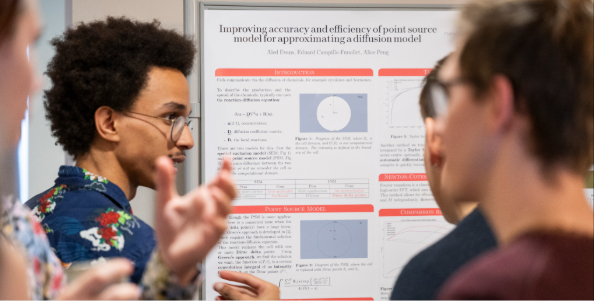
Aled Evans worked with Dr Eduard Campillo-Funollet and Dr Alice Peng to improve models that simulate how cells release and spread chemical signals. They tested numerical methods to make a simplified point source model more accurate, helping it better match detailed simulations while remaining efficient to run.
How do diffusion models generate images?
Henry Oldroyd worked with Dr Henry Moss to explain how modern diffusion models generate images. Their project shows how these models add and remove noise, reconstruct images, and use special interpolation techniques to blend ideas smoothly, helping us better understand and control AI-generated imagery.
Fitting COVID-19 data with SIR models
Amy Robinson worked with Dr Jess Bridgen and Dr Lloyd Chapman to use SIR epidemic models to study how COVID-19 spreads. They estimated the infection and recovery rates that determine the average number of people one infected person infects helping to assess how harmful an outbreak may be.