PhD Research
Supervised by: Gabriel Wallin (Lancaster University), Rachel McCrea (Lancaster University), and Matthew Thomas (British Red Cross).
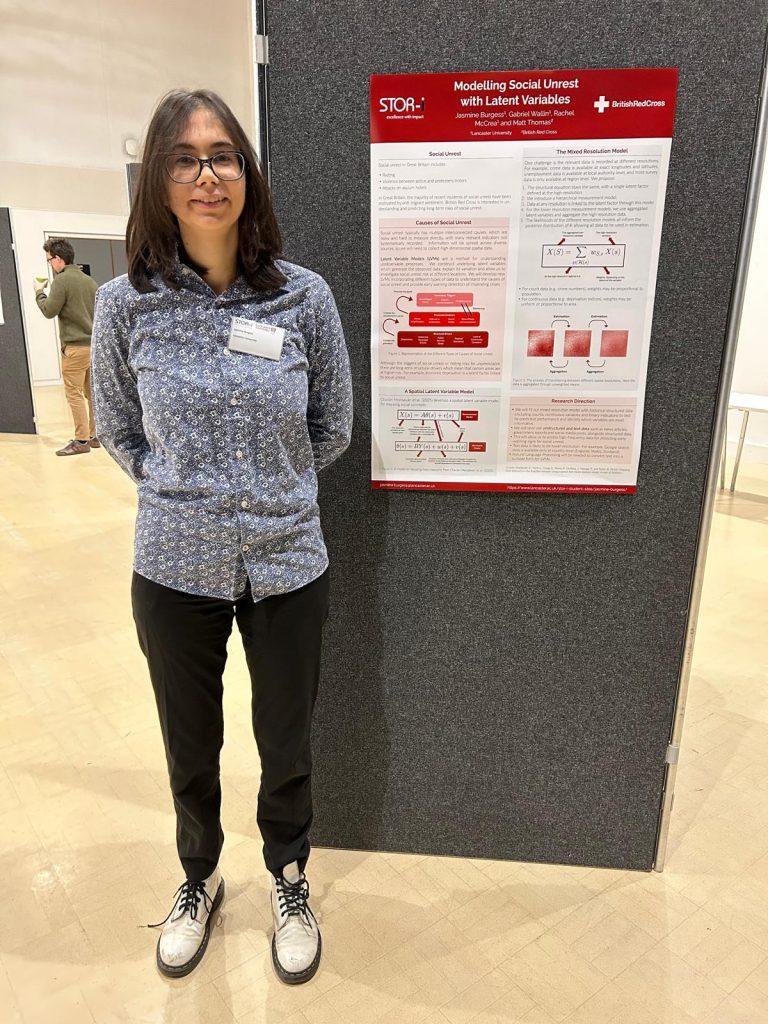
Humanitarian issues typically have many interconnected causes, which are noisy and hard to measure directly, with relevant indicators not systematically recorded. Information may be spread across diverse sources, including traditional data sources such as crime statistics, conflict, and socioeconomics indices, and unstructured data sources including government reports, news articles and social media posts. To utilise this unstructured data, Natural Language Processing methods will be needed to convert text into numerical data for use in statistical models such as Latent Variable Models (LVMs). LVMs provide a method for understanding high-dimensional data, by identifying a small set of unseen variables which generate the observed data and explain its variation. These latent variables are defined as functions of the observable variables; supervised rotation techniques allow interpretation of concepts such as community resilience or economic deprivation. We will develop new LVMs incorporating different types of data, including textual data, to understand the causes of complex humanitarian issues and provide early warning detection of impending crises.
My first application area will be modelling social unrest risk in Great Britain. Even though the triggers of social unrest or rioting may be hard to predict, there are long-term structural drivers of social unrest which mean that certain areas are at higher risk. For example, economic deprivation is a latent factor that will be linked to social unrest. Existing spatial LVMs exist but are not suited to real data in this context, because data is recorded at different spatial resolutions and frequencies. By developing more flexible spatial LVMs, we will strengthen understanding of the risks of social unrest, so intervention can be targeted better.
Past Research
Beyond Catastrophe Theory: Ecological Modelling with Non-Linear Dynamical Systems
Supervised by: Eduard Campillo-Funollet (Lancaster University)
It is generally assumed that ecological systems will respond gradually to slow changes in their environment, however this has been observed to not always be the case; for example, lake, coral reef and woodland ecosystems shift rapidly between different regimes. In ecology, a regime is the characteristic behaviour of an ecosystem; being able to understand, model and even predict abrupt regime changes is an important problem for environmental preservation and agriculture.
I conducted a literature review of catastrophe theory, demonstrating its use in ecological modelling and explaining some of the criticism it historically provoked. These criticisms were largely addressed by stochastic catastrophe theory, an extension of catastrophe theory which is used in modern ecological applications. I then investigated a relevant application and demonstrated the potential opportunity of using changepoint analysis alongside stochastic catastrophe theory.
Offline Changepoint Detection Using Modifications on Binary Segmentation
Supervised by: Idris Eckley (Lancaster University)
I conducted a literature review of offline changepoint detection methods, focusing on algorithms making improvements to binary segmentation, as opposed to dynamic programming algorithms. I hope to return to changepoint analysis in my PhD research, using changepoint detection as an early-warning detection mechanism.
Irrationality and Transcendence: An Introduction to Modern Number Theory
Supervised by: Dan Evans (Durham University)
I conducted a thorough literature review of transcendental number theory, including classes of irrational numbers; methods from Mahler, Hermite and Roth; and Beuker’s method for the irrationality of zeta(3), and examining how it could be extended to prove the irrationality of zeta(5).