

Seapower has always been linked to geopolitics. And now, with the growing importance of the control of waterways and the global maritime supply chain becoming the subject of intense international competition and disputes, the stakes are higher than ever. Lancaster’s Professor Basil Germond has become the trusted voice on the host of issues and implications involved.
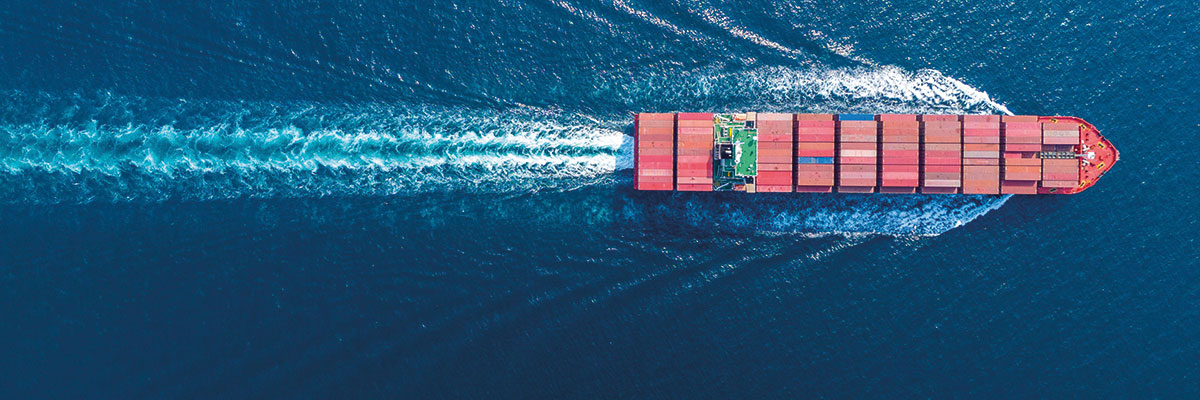
“When I speak about the sea, it is never just about water,” explains Professor Basil Germond. “It is about power, vulnerability, climate, infrastructure, supply chains, and geopolitics. It is about the quiet but decisive ways maritime spaces shape the world and the urgent need to understand how insecurity at sea cascades into insecurity on land.”
His research on seapower, maritime security, climate risks, and naval futures has increasingly placed Basil at the centre of national and international policy debates, meaning he’s in demand as an advisor to the UK parliament and government on why and how what happens at sea matters profoundly for national security, economic resilience, and global stability.
“Most recently, for example, I provided expert oral evidence to the House of Commons Environmental Audit Sub‑Committee, where I set out how Russia’s war of aggression has destabilised Arctic governance, disrupted scientific collaboration, and reshaped strategic competition in what’s known as the ‘High North’. In that testimony, I emphasised the UK’s comparative advantages as both a maritime and scientific power and recommended strengthening scientific cooperation, preserving polar research, and deepening Western coordination in Arctic governance.”
Early warnings
Basil was invited by the EU Council Presidency to brief the Council’s working group on the EU Maritime Security Strategy (MSS) where he presented his research into how climate change acts as a multiplier of maritime insecurity, generating new risks — from maritime criminality to environmental degradation — which challenge traditional enforcement and governance mechanisms.
“As well as providing advice for maritime domain awareness and maritime security capacity-building, I emphasised the importance of early warnings and recommended the working group further develop ocean awareness and support research that could predict where climate change's impacts on maritime security would be most salient.”
Lancaster’s reputation as an institution capable of connecting climate risk analysis with national security has been strengthened by Basil’s contributions to the consultation process and the drafting of the 2022 UK National Strategy for Maritime Security, giving advice on the implications of climate change for maritime insecurity and the need to integrate environmental foresight into security planning.
Great-power competition is intensifying at sea. Malign actors are exploiting instability in ways that undermine regional and global resilience.
“A major development has been my appointment as Visiting Fellow at the Royal Navy Strategic Studies Centre (RNSSC), the Royal Navy’s internal think tank. This appointment recognised a long‑standing collaboration that includes producing commissioned reports on climate change and maritime security (2023), the future of uncrewed fleets (2024), contributing to the RNSSC’s publication, The Royal Navy in the Polar Regions (2024), and developing a practical toolkit for understanding and mitigating climate change’s impacts on the navy’s assets, operations and interests.”
The former Head of the RNSSC, Captain Kevin Rowlands, has described the collaboration as “invaluable” for helping the Navy understand the evolving risks at sea and devise strategies “to deal with both the causes and the symptoms” of maritime insecurity.
Knowledge for resilience
Wider public understanding of the importance of maritime affairs is critical. With this in mind, Basil contributes accessible pieces of analysis — on topics like Iran and the Strait of Hormuz, China’s newest aircraft carrier, and the growing relevance of hybrid warfare at sea — to The Conversation as a way of reaching large global audiences. He’s been used as an expert commentator by the range of major international news outlets, including The Economist, Observador, BBC, ABC, NBC, LBC, France 24. Interview topics have covered everything from Red Sea insecurity to Russia’s naval footprint in the Mediterranean.
At the core of each of these activities is a commitment to ensuring academic research plays a meaningful role in informing policy decisions during a period of profound uncertainty.
“The maritime domain is undergoing rapid transformation,” said Basil. “Climate change is redrawing coastlines and reshaping operating environments. Great Power competition is intensifying at sea. Technological advances, from autonomous systems to new sensing and surveillance capabilities, are restructuring naval warfare, doctrines and maritime governance. Malign actors are exploiting instability in ways that undermine regional and global resilience. The UK, with its maritime heritage and scientific expertise, is uniquely positioned to lead in addressing these challenges. My work helps policymakers recognise this and equips them with rigorous, evidence‑based analysis to act accordingly.
“As I continue to deepen policy partnerships, expand collaborative research with public stakeholders, and engage international audiences through commentary and analysis, I remain committed to bringing Lancaster’s expertise to the spaces where decisions are made. In doing so, I hope to contribute to a more secure, resilient, and strategically aware future for the UK and its partners.”

About the author
Basil Germond is Professor of International Security in Lancaster University’s School of Global Affairs and Co-Director of the University research institute Security Lancaster. A recognised authority on seapower and maritime affairs, his research examines maritime security, strategy and geopolitics, naval power, ocean governance, climate-related insecurity, critical undersea infrastructure, and the maritime dimension of UK defence. Professor Germond provides expert advice to public bodies and serves on a range of expert panels. He is a Royal Navy Visiting Fellow, a Fellow of the Royal Geographical Society, and a Senior Fellow of the Higher Education Academy. His books include Seapower in the Post-modern World and The Maritime Dimension of European Security.
Professor Basil Germond's profile