

An exhibition of sacred art from traditions across Asia at the British Museum has raised important issues over whether religious artefacts which continue to have a powerful meaning should be treated as museum exhibits — as well as exactly how particular objects were ‘acquired’ by imperial officials. Chakravarthi Ram-Prasad, a Distinguished Professor of Comparative Religion and Philosophy, and Vice-President (Humanities) of the British Academy, takes a closer look.
The British Museum’s Ancient India, Living Traditions exhibition of 2025 brought together exhibits on the sacred art of Hinduism, Buddhism and Jainism. It also encompassed the spread of the devotional art of these traditions to other parts of Asia.
The exhibition spoke to religious identity and relationships. Buddhism and Jainism distinguish themselves from the vast surrounding traditions that together we call Hinduism; but they have close kinship with it in practices, beliefs and iconography. Museums that have presented sculptures in isolation have usually not attempted to narrate this complex history.
Not all the items displayed, some going back 2,000 years, were of purely historical interest. There were representations of traditions that are continuously living in a way the gods of ancient Egypt or classical Europe are not.
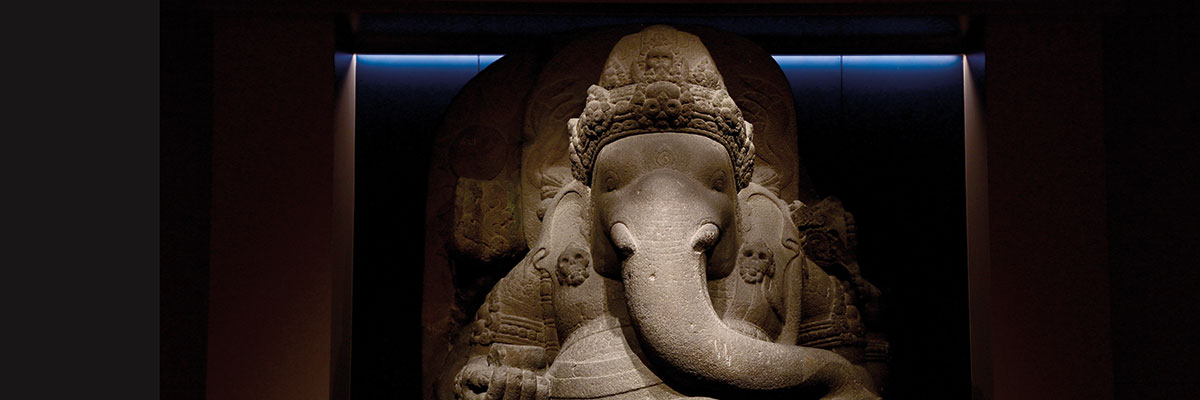
The most instantly recognisable example for visitors of such living ancient tradition was likely to have been the statues of the elephant-headed deity Ganesha. Visitors could see a rare and valuable 4th century sandstone Ganesha on show. They could also see a small bronze version of that ancient Ganesha that is like the kind you would find in people’s home and to which a quick prayer would be addressed every morning.
The question of how to respect that sense of the sacred while still mounting an exhibition is a moral and aesthetic challenge that few museums (including those in India) have started to address. It’s not uncommon to see such pieces wrenched from the reality of their continued practice and presented in secular art displays. Here, however, the curators have tried to make connections between “statues” on display and “icons” in temples and homes.
Finally, there’s the problematic history of the imperial museum and its need to reckon with its past. Most objects on display in the exhibition, and The British Museum more widely, have been presented with scarcely any acknowledgement of how they came to be acquired. The exhibition did, at least, make an earnest effort to tackle most of these issues.
Not just objects
The spaces of the exhibition were structured to be respectful of the historical and contemporary sensitivities of Buddhism and Jainism. This was signalled through subtle changes of colour and the placement of translucent drapery, allowing for transitions between distinct Jain, Buddhist and Hindu displays.
At the same time, conceptual and sensory commonalities were powerfully conveyed. The first space focused on nature spirits and demi-deities that are shared across all the ancient traditions. The air was filled with the sound of south Asian birds and musical instruments. The explanatory labels drew attention to the percolation of iconographic features between traditions, for instance, those between the Buddha and the Jaina teachers, or the direct inclusion of the deity of learning (Sarasvati) in both Hindu and Jain worship.
Also well presented was a final space on the spread of south Asian iconography to central, east and southeast Asia. This is a long story that needs its own telling, but can only be hinted at through some beautifully chosen figures.
It’s the curators’ use of a community advisory panel of people who practice such traditions today that gave the information its sensitivity. Their inclusion in the exhibition’s production could be seen in a marked mindfulness that the content and symbols of these inert objects are alive and sacred to hundreds of millions.
For example, one Ganesha from Java in Indonesia drew attention to different elements of his iconography. There was the trans-continentally stable depiction of his having a broken tusk (which, as Hindus will know, he is said to have broken off to write down the epic Mahabharata). But this Ganesha also held a skull, which is unique to the Javanese version. The label gently pointed out that “various communities understood and worshipped him differently”.
The combination of community engagement and creative presentation not only conveyed a sense of respect for the traditions, but also elicited a respectful response from visitors. Those from within the tradition will have noted with satisfaction the description of a symbol or icon. Those from outside the traditions were invited to look at the exhibits with the same attention and care as they might in a cathedral.
I saw a pair of young Indian Americans looking at a fossilised ammonite from Nepal that is taken as a symbolic representation of god for worshippers of Vishnu. They animatedly compared it to the one in their own diasporic home.
Elsewhere in the exhibition, I caught an elderly English couple stood in wondering silence in front of a drum slab from the famous 1st century BC Amaravathi Buddhist site in south India. This slab was carved just before figural representations of the Buddha rapidly gained in popularity. Here, there are symbols associated with him, but the Buddha himself was represented by the empty seat from whence he has gone.
To say something was “collected” by a major general “while serving in the East India Company army” is hardly facing up to the question with which the exhibition boldly begins: “How did it get here?”
Signalling future directions
One potential interpretive danger lies in the emphasis on continuity between past objects and present realities. Hindus today from social backgrounds that did not have the privilege of reaching back to high sacred art might ask where they sit in the smoothed out historical narrative. More broadly, there was no acknowledgement of the complexity of Hindu identity and its formation across centuries, regions, social strata, languages and theologies.
The weakest part of this exhibition’s generally innovative retelling was the faint-hearted way in which it obliquely acknowledged the dubious acquisition process of the British Museum. To say something was “collected” by a major general “while serving in the East India Company army” is hardly facing up to the question with which the exhibition boldly begins: “How did it get here?”
The exhibition offered a powerful visual narrative of the multi-spiritual traditions of ancient India, mounted with sensitivity to their living communities today. Its immersive presentation was appealing, and the story it told was respectful and innovative.
However, the tasks of honest self-representation and difficult conversations on reparation remain. Within that larger imperative, Ancient India, Living Traditions was a step in the right direction. It is a direction towards addressing context, responsiveness and engagement that museums can no longer ignore.
This article was first published in The Conversation.
About the author
Chakravarthi Ram-Prasad (Ram) is a Distinguished Professor of Comparative Religion and Philosophy in the School of Global Affairs. He has formerly been Faculty Associate Dean for Research and Deputy Dean.
Ram is a Fellow of the British Academy, and currently its Vice-President for Humanities. He also sits on the Council of UKRI's Research England and on the Academic Panel of the Leverhulme Trust.
Ram’s research has been broadly in the area of comparative thought, where he studies classical Indian texts in Sanskrit (and occasionally in Pali and Tamil) in engagement with Western and other traditions. Some of the topics he has explored are: the nature of knowledge and the external world; the relationship between self and God; theories of consciousness; emotions, body and society; religion and identity; and the relationship between religions.
Ram usually teaches on Hinduism, Buddhism and Christianity in global context, as well as more generally on religion in relation to gender, state, conflict and political theory. He is particularly interested in fostering undergraduate and postgraduate research on comparative religion and philosophy. In keeping with the strongly collaborative nature of the School, this is often done with colleagues who are experts in, e.g., Islam or Chinese thought.
Professor Chakravarthi Ram-Prasad's profile