

Digital collections and methods have opened up a new universe of insights into our understanding of history, leading to important evidence and lessons for scholars and policymakers. Digital Humanities researchers Dr Zoë Alker and Dr Katherine McDonough work at the forefront of spatial, visual, and textual analysis. Zoë’s work centres on visualising historical criminal records, while Katherine’s focuses on historical maps and newspapers.
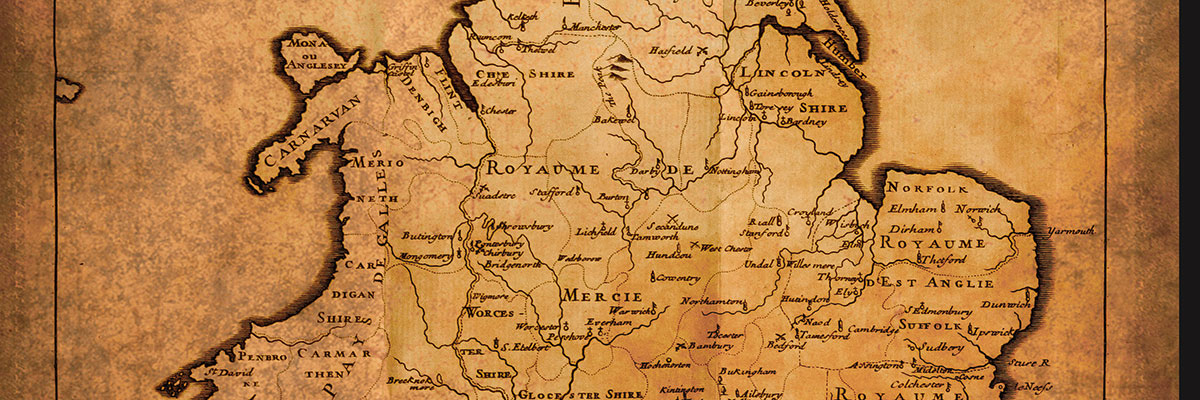
The digitisation of historical sources of all kinds, visual, oral and written, has opened up a new kind of access to many periods and places of the past. Huge amounts of data can now be mapped and analysed to identify trends and connections that would otherwise have been unseen, and to recover the voices of people that might otherwise have been left unheard or misrepresented.
Digital approaches now frequently complement traditional methods in humanities subjects like History: allowing for more collaboration between researchers from across the humanities, as well with the social and natural sciences. Integrating computational skills into research also shapes how the humanities are taught. Lancaster has been at the forefront of these developments, led by the work of Distinguished Professor Ian Gregory (Associate Dean for Research for the Faculty of Humanities, Arts, and Social Sciences). The University is host to major spatial humanities and text analysis projects that have shaped the now mature field of the Digital Humanities: this expertise is integrated into both Lancaster’s BA and MA in History as well as the MA in Digital Humanities.
Bodies of evidence
Dr Zoë Alker is a historian who works at the forefront of historical social data science: an interdisciplinary approach that brings together digital humanities, data science, social sciences, and history to analyse large-scale historical data and connect past inequalities to present-day concerns.
She has led on developing open access digital archives that give the public direct access to digital resources on the history of modern Britain. This has included the Data Mining Convict Tattoos project, based on 75,688 descriptions of tattoos, on 58,002 convicts in Britain and Australia from 1793 to 1925.
“Far from being a secret criminal code shared amongst the notorious ‘criminal classes’ as Victorian observers claimed, these records allowed us to see — for the first time — that historical tattooing was not restricted to sailors, soldiers and convicts, but became a growing and accepted phenomenon in England over the course of the nineteenth century,” said Zoë. “A form of ‘history from below’, tattoos provide an important window into the lives of the working classes, whose voices are often obscured from the historical record, giving us an intriguing opportunity to understand the identities, fashions and sentiments of ordinary, working people in Victorian London.”
Computational methods such as record linkage, data mining, and visualisation combined with close historical analysis, have allowed me to move between the big picture and individual lives: what I describe as a macroscope approach, revealing patterns that would otherwise remain invisible.
Another piece of work, Skin and Bone: Interdisciplinary Analysis of Accidents, Injury and Interpersonal Violence in London (1760-1901), merged convict, hospital and osteoarchaeological data and documents on 87,903 injury records on almost 40,000 Londoners. The analysis was used to reveal signs of the physical impact of the Industrial Revolution on people’s bodies.
“Computational methods such as record linkage, data mining, and visualisation combined with close historical analysis, have allowed me to move between the big picture and individual lives: what I describe as a macroscope approach, revealing patterns that would otherwise remain invisible.”
Current projects include a study of deaths in prison custody between 1750 and 1950, mining the data available in coroners’ inquests, prison registers and the census to reconstruct the social profiles of those who died to track the long-term patterns in terms of social inequalities; and research into femicide, revealing how lethal violence against women was shaped by structural inequalities, and often minimised or misrepresented in historical records.
Mapping the impact of machines
In 1801, the British Ordnance Survey began a mass exercise in mapping Britain and Ireland, leading to tens of thousands of sheets of maps at a one inch to one mile scale.
“Thanks to the National Library of Scotland and its work on scanning and ‘stitching’ together the OS maps there is now a single resource, we can fly over the landscape like a bird,” explained Dr Katherine McDonough in the Living with Machines docuseries, viewable on YouTube. Katherine was formerly a Lecturer in Digital Humanities at Lancaster University and a Senior Research Fellow at The Alan Turing Institute, and is now assistant professor in the Department of History at Carnegie Mellon University. “But the challenge remains in terms of having to navigate the maps sheet by sheet. We looked at how digital tools could be used to link the maps with other data and include relationships between local, regional, and national spatial patterns. In other words: using maps to ask and provide answers to cultural, intellectual, environmental, social, and political history questions.”
The result has been MapReader, a software tool that has been trained to recognise text and features on maps, whether that’s an area of woodland or farmland or housing, allowing for a mass of detail of changes to be analysed over time. MapReader was developed as part of Living with Machines, a research project based at the Turing that has been rethinking the impact of technology on the lives of ordinary people during the Industrial Revolution. Census data on people’s occupations was combined with map data relating to the development of the railway infrastructure from the mid-19th into the 20th century to explore the impact of the railways on people’s lives.
“This allowed us to look for the first time at groups of people that have previously been excluded from histories of the railways and their impacts,” said Katherine. “For the people who lived in poorer neighbourhoods far away from new stations but close to the noise and smoke of the tracks and rail yards there were still opportunities for working as railway inspectors, signalmen, railway coach and wagon makers, and in other train-related jobs.”
The MapReader tool — which was awarded the Roy Rosenzweig Prize for Creativity in Digital History by the American Historical Association — has also been used for work in collaboration with UK National Parks and the National Library of Scotland on the Landscape Change and Conservation with the MapReader project. The team used Lancaster’s High-Performance Computing resources to create historical environmental data derived from digitised 19th and 20th century OS maps. This enables park staff to better understand how landscapes have changed over time in the Peak District and South Downs, providing a historical baseline to inform plans for improving biodiversity.
Dr Zoë Alker
Dr Zoë Alker joined Lancaster University in 2022 as Lecturer in Historical Social Data Science, where she has researched and taught the digital history of crime, justice and punishment in Britain, 1750-1950. She was previously Lecturer at the University of Liverpool (2016-2022). Her interdisciplinary work, spanning history, criminology and digital humanities, is particularly interested in the opportunities of merging convict records with other sources about the historic population, most recently coroners’ inquests and even osteoarchaeological data. Her work has produced large-scale open-access archives, including Digital Panopticon, Convict Tattoos and Skin and Bone, giving the public free and searchable access to some billion words of primary sources. She most recently led the British Academy/Leverhulme-funded Skin and Bone project, tracing the injuries of almost 40,000 Londoners, 1760-1901. She is now developing the first large-scale, nationwide historical examination of deaths in prison custody with Dr Richard Ward (Exeter) and writing a monograph on femicide and misogyny in Victorian England. She is Chief Editor of the Routledge SOLON Explorations in Crime and Criminal Justice book series, and liaises with public institutions including Inquest, Prison Reform Trust, and Howard League for Penal Reform, and her research has featured in the BBC, The Times, CNN and the Smithsonian.
Dr Zoë Alker's profile
Dr Katherine McDonough
Katherine McDonough’s research and teaching spans multiple fields, from eighteenth-century France and nineteenth-century Britain to broader histories of information and infrastructure. A Fellow of the Royal Historical Society, she spends most of her time thinking about roads, railroads, gazetteers, encyclopedias, and maps. Her research applies computational methods to examine social, political, cultural, and environmental histories of these technologies. Katherine was previously based in the UK at The Alan Turing Institute, London, then at Lancaster University (2023-26) where she was Lecturer in Digital Humanities, History Department. She was a member of the Living with Machines project, the Machines Reading Maps project, and the Data/Culture project. A leader in the emerging field of computational map studies, Katherine is director of the MapReader software project, which won the American Historical Association's Roy Rosenzweig Prize for Innovation in Digital History in 2023. AHRC Impact Acceleration funding from Lancaster supported a collaboration with UK National Parks to develop new historical land cover datasets for climate change and biodiversity activities in UK Protected Landscapes. Katherine’s book manuscript, Public Work: Making Roads and Citizens in Eighteenth-Century France, has received support from the Mellon Foundation, the John Carter Brown Library, the Smithsonian Libraries, and the National Science Foundation. Katherine collaborates with colleagues in France, the US, and the UK on projects that explore the histories and futures of spatial information, including a period as a fellow at the Collegium de Lyon in 2025 for the GEODE project.