

Over recent decades, more than 20,000 people around the world have been the victims of accusations of witchcraft and ritual attacks. Professor Charlotte Baker has led work pushing for change via the United Nations, NGOs and governments, but why are so many cases still not being prosecuted?
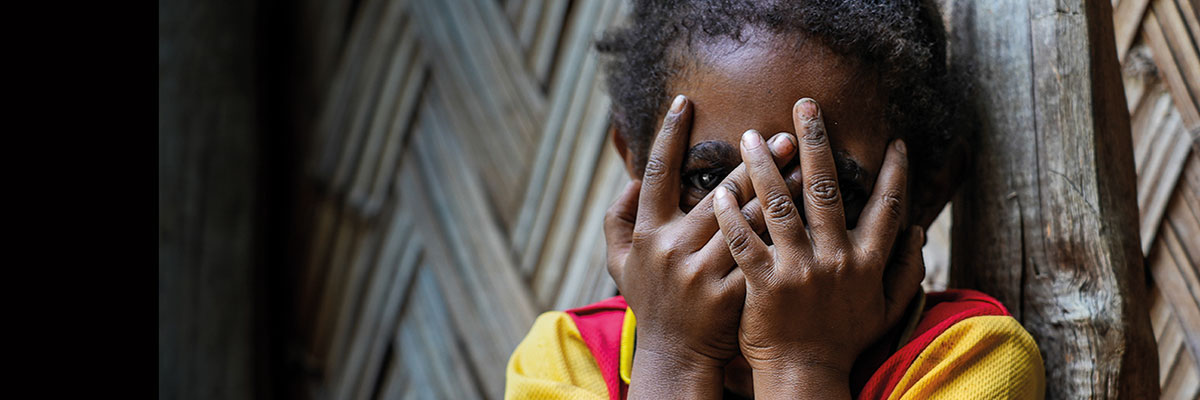
Witch hunts continue to be a feature of local cultures around the world, the result of a tangle of beliefs that involve barbaric rituals, including beatings, torture, banishments and the amputation of limbs.
“People accused of being witches have been set on fire, tortured and murdered. Evidence suggests that widowed and divorced women, as well as children, the elderly, and people with disabilities, particularly those with albinism (the genetic condition that leads to a lack of colour in skin, eyes and hair), are particularly vulnerable,” explains Charlotte Baker, a Professor of French and Critical Disability Studies in the School of Global Affairs.
The International Red Cross has highlighted the trade in body parts of people with albinism, for example, reporting a ‘going rate’ of $75,000 for a 'full set’ of body parts.
Campaigning and evidence-gathering work at Lancaster played a major part in the United Nations Human Rights Council passing a Resolution in 2021 calling for the elimination of harmful practices relating to accusations of witchcraft. Charlotte and the team (with former UN Independent Expert on Albinism, Ikponwosa Ero, international human rights barrister Kirsty Brimelow, and Lancaster University honorary graduate and human rights advocate Gary Foxcroft) first brought their work to the attention of the UN in September 2017 when they organised a Witchcraft and Human Rights Expert Meeting at UN headquarters in Geneva.
A new resolve
There are now 15 countries with legislation that addresses harmful practices relating to accusations of witchcraft and ritual attacks. The UN resolution itself led to legislative changes in South Africa, Ghana, Nigeria, Papua New Guinea and Pakistan. Many countries are using their general criminal laws to prosecute harmful practices related to witchcraft accusations; and some others have brought in legislation to prevent the activities that create or exploit the fear around witchcraft, such as the ‘diviners’ and so-called ‘witch doctors’.
In 2025, the African Court of Human and People’s Rights made a landmark ruling against the government of Tanzania for not upholding the rights of people with albinism, and ordered the implementation of a national action plan and awareness campaigns, including stronger legal protections against violence and discrimination and financial compensation for victims of attacks.
The available data from 12 of the 15 countries revealed only nine countries had used the law to prosecute cases.
In spite of the resolution, and evidence of some steps towards progress, a new global review by Charlotte and her team, alongside the Australian National University, has highlighted how law changes in themselves aren’t enough.
The available data from 12 of the 15 countries revealed only nine countries had used the law to prosecute cases. Courts, the wider justice system and the media often had not been referencing beliefs in witchcraft as a feature of the cases: instead the crimes are only described in general terms as ‘murder’ or ‘assault’, making tracking of the number of cases difficult. In some countries, the beliefs in witchcraft are also still considered to be a mitigating factor in terms of sentencing.
Why a new legal framework is needed
“Our report has underlined the important role of legislation and criminal law in combatting the human rights abuses that are taking place. But it’s clear that laws alone are not enough to change attitudes and behaviours,” said Charlotte. “There’s evidence that criminalising witchcraft practices can actually send out confusing messages, either obscuring the causes of violence or encouraging the use of beliefs in witchcraft as part of a defence case. And that means weak and vulnerable marginalised groups continue to be victimised in horrific ways.”
In conclusion, the report authors have called for a comprehensive legal framework to address the violence, one which is victim-focused and takes into account the full context of attitudes and beliefs.
With this in mind, Charlotte and the International Network Against Accusations of Witchcraft and Associated Harmful Practices is continuing with its campaign calling for action worldwide to bring about lasting change, including more consistent and effective legal action and prosecutions.
Campaign activity in recent years has included an international conference and an exhibition of photographs relating to accusations of witchcraft, touring locations in Australia, Papua New Guinea, the US, India, Nigeria and Ghana: ‘Witch Hunts Now: A Human Rights Catastrophe in Photographs’.

About the author
Charlotte Baker is Professor of French and Critical Disability Studies in the School of Global Affairs at Lancaster University. She is Associate Dean for Engagement for the Faculty of Arts, Humanities and Social Sciences, Co-Lead for the Faculty Health Research Hub, and Associate Director of Engagement for the Lancaster University Africa Research Hub.
Charlotte’s interdisciplinary research focuses on disability and stigma in sub-Saharan Africa, particularly albinism, human rights, harmful practices and accusations of witchcraft. She has led major collaborative projects including the AHRC-funded Disability and Inclusion in Africa project and the Wellcome Trust-funded Albinism in Africa project. Her research and engagement with international partners contributed to UN Resolution 47/8 on the elimination of harmful practices related to accusations of witchcraft and ritual attacks.
Charlotte is Director of the International Network Against Accusations of Witchcraft and Associated Harmful Practices and a member of the UK NPCC Witchcraft, Spirit Possession and Ritual Attacks Working Group. She teaches French and Francophone studies, African literatures, and Critical Disability Studies at undergraduate and postgraduate levels, and supervises postgraduate research.
Professor Charlotte Baker's profile