Facilities

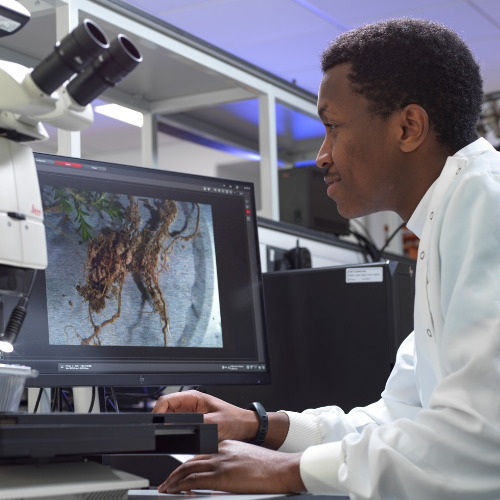
A student using a microscope to look at soils

Research Facilities

The Centre for Sustainable Soils Research Facilities are equipped with all the necessary equipment and machines for studying plant-soil interactions and soil biogeochemistry.

The laboratory supports the research of up to seven Professors and Lecturers, approximately 50 research staff and students, as well as undergraduate and master's projects. The group focuses upon plant-soil interactions, soil and ecosystem biogeochemistry, macronutrient cycles and greenhouse gas emissions.

We additionally have access to mobile lab equipment, used for on-site fieldwork.

Hazelrigg Weather Station

Hazelrigg Weather Station

Our Hazelrigg Weather Station has been recording daily weather observations since 1966, providing a continuous, very high-quality record. This record is included in world climate reports and in the analysis of long-term trends by the World Meteorological Organisation.

Our site also has a range of additional field equipment managed by research group based both within LEC, and the wider University.

Hazelrigg Weather Station
Colt Park

Colt Park

Colt Park Meadows is a long-term grassland diversity restoration experiment, set up in the Ingleborough National Nature Reserve, Yorkshire Dales in 1989. We have been using the site to test how grassland diversity restoration influences ecosystem services, especially the storage of carbon in soil, and how soil biota influence plant diversity restoration. We are currently exploring how grassland diversity restoration influences the resistance of soil processes to drought, which is likely to become more frequent in this area.

Alpine Grasslands, Tyrolean Alps

Alpine Grasslands, Tyrolean Alps

Alpine grasslands store large amounts of carbon and nutrients, harbour much biodiversity, and provide food, fodder and clean water. However, they are also experiencing rapid climate and land-use change. As part of a NERC-funded project with colleagues from the University of Innsbruck, Bangor University and Technical University of Munich/ Helmholtz Centre, Munich, we have established a network of high-alpine field sites across three valleys in Austria. We aim to test how climate and land use change affect soil microbial community composition and functioning, and the consequences for biogeochemical cycling. Our main site at Vent (2470m) has a long-term snow, drought, and vegetation manipulation experiment where we are testing how climate change impacts microbial communities and biogeochemical cycles.