Real-world application
Partnering with government, industry, and academia, MARS is driving mathematical and AI innovation across four key domains: cyber security, engineering, environment and health.


Partnering with government, industry, and academia, MARS is driving mathematical and AI innovation across four key domains: cyber security, engineering, environment and health.

The growth of large language models, generative and other forms of AI is transforming the cyber security landscape. These innovations provide powerful data driven approaches to detect and respond to threats; but AI also provides tools for the attacker.
By harnessing mathematical modelling techniques and AI methods, MARS is strengthening approaches to cyber defence. Working closely with government and industry partners, our research will tackle key security challenges, large scale data analysis, the deployment of AI methods on non-standard data types, and anomaly detection in high-volume data streams.
MARS complements, and expands on, Lancaster University’s sector leading research in cyber security. In 2022, Lancaster launched the £19m Data Cyber Quarter and has been recognised by the National Cyber Security Centre as an Academic Centre of Excellence in both cyber security research and education. It is also home to the Cyber Security Research Centre.

Innovations in AI and mathematics are revolutionising engineering and materials science. Cutting-edge approaches like physics-informed machine learning, digital twinning and inverse materials design are enabling rapid discovery of novel materials, sustainable solutions, and smarter engineering processes. Data-driven methods and advanced mathematical frameworks are being used by academic and industry to solve complex challenges faster and more efficiently.
Working closely with the School of Engineering and Materials Science Lancaster, MARS is creating mathematical frameworks to model complex interdependent systems and developing robust mathematical and computational methods to optimise materials simulation at the atomic, molecular, and particle scales.
Through collaborations with industry partners, applied MARS research is paving the way for advances in engineering, materials manufacturing, and additive manufacturing.
Advanced mathematical tools for developing stronger, more resilient materials
Advancing technological development through symmetry-aware AI

Data, mathematics, and AI tools are increasingly being harnessed to address complex environmental and ecological challenges. From climate modelling and ecosystem analysis to pollution tracking and natural hazard prediction, advanced analytical tools are driving sustainable solutions; while interdisciplinary approaches are unlocking new insights into our planet’s most pressing issues and guiding impactful decision-making.
MARS is combining the development of sophisticated mathematical models with advanced machine learning techniques to tackle large-scale environmental challenges. Our research is predicting ice sheet melt, transforming understanding of atmospheric oxidisation, modelling the spread of invasive species and exploring how artificial intelligence can be harnessed to manage environmental risks.
Capitalising on Lancaster University’s leading research in environmental science, MARS is partnering with the Lancaster Environment Centre, UKCEH (UK Centre for Ecology & Hydrology) and JBA Consulting. These academic and non-academic collaborations will provide a foundation for MARS to co-develop next generation mathematics for understanding the effects of climate on the built and natural environment.
Data-driven insights for invasive species control

Accelerating scientific discovery with machine learning

AI-powered earth observation for rapid climate action

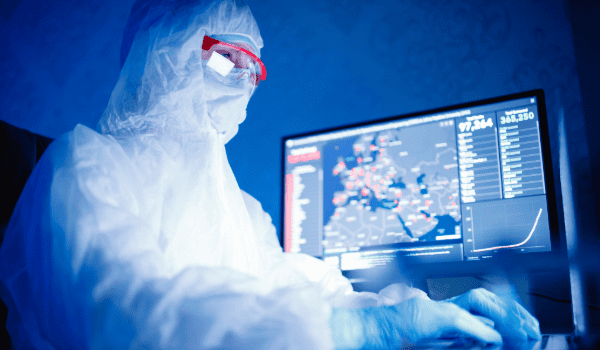
The use of AI and data-driven solutions is beginning to reshape the UK health sector, improving efficiency, speeding up diagnosis, and enabling more personalised patient care. AI tools in development are capable of analysing large volumes of medical data to identify infection spread, support earlier detection of disease and enable a timelier, and more thorough, understanding of health risks.
Through collaborations with organisations such as the NHS, UKHSA, and Hitachi Vantara, MARS is applying AI-based mathematical and stochastic modelling to tackle some of the most pressing issues in healthcare. From developing methodological toolkits for analysing biochemical networks and frameworks for controlling hospital outbreaks, to using state-of-the-art mathematical and computational methods to support personalised treatments for depression and wound healing, our research is driving innovations that translate into better patient outcomes and more resilient healthcare systems.
MARS is also increasing the research capacity of Lancaster University’s Health Innovation Campus, a £41 million flagship investment, focusing on translational health research.
Transforming systems biology through mathematical innovation

Model-based methods for controlling hospital outbreaks

Creating personalised treatments for depression

Advanced mathematical models for timely outbreak response
Personalised wound healing with mathematical modelling