Events and training

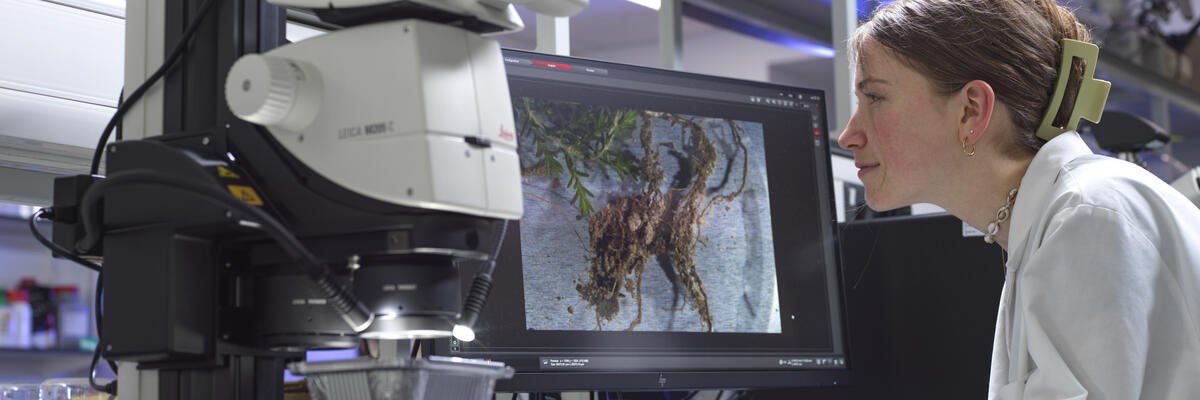
A student examining soil through a microscope

Our training

All of our students will receive opportunities for training and career development throughout the course of their studies. Your training needs will be identified through an annual Training Needs Assessment process, to be completed in the Autumn of each year of study. This process will help you and your supervisor to identify the training that will help you in both your research and personal development, preparing you for your future career either in academia or industry.

Training is offered in a variety of formats - both online and in person - and offerings will be delivered either internally or by external partners. Although you will be able to select bespoke options in any year if necessary, there will be an overarching focus to each year matched with your current study stage.

Foundations

Training for the Masters by Research students will be tailored to your specific needs based both on your experiences to date, and the skills that will best prepare you to be a successful student member of the programme.

Bespoke offerings

  • Peer mentoring with existing PhD scholars
  • Monthly skills development series delivered by internal and external personnel aimed at building research skills, knowledge and confidence
  • Regular drop-in sessions with members of the Programme Leadership Team to discuss issues and support needs

Given the varied fields our MRes students will come from, we also encourage you to audit third-year undergraduate and Master's level modules to help you develop your foundational knowledge.

Interdisciplinary development

Interdisciplinary PhD projects present particular challenges to both students and supervisors and require skills that have not necessarily been learnt through traditional routes. Hence, in the first year the training focus will be on building the knowledge base necessary to combine divergent disciplines, ontologies, and epistemologies without sacrificing rigour, and developing skills necessary to navigate tensions while working with people who may hold divergent perspectives or adopt different approaches.

Bespoke offerings

  • Introduction to interdisciplinary collaborations
  • Systems thinking
  • Philosophy of science

Academic knowledge and research practice

In the second year, the training focus will shift to advancing your knowledge and confidence with key concepts, data, and methods across disciplines and scales, and supporting you as you get to grips with your interdisciplinary research.

Bespoke offerings

  • Qualitative (or quantitative) methods development
  • Participatory research
  • Dealing with diverse data (supported by our Centre of Excellence in Environmental Data Science)

Writing and communication

As you start to increasingly focus on reporting your findings and developing your thesis, the training focus will support developing your writing and communicative practices throughout the course of your third year. You'll be encouraged to attend our sessions on 'Communicating with confidence', 'Getting published', and 'Writing for non-academic audiences' in order to develop your skills in these areas.

Bespoke offerings

  • Writing retreats

Impact and engagement

In your final year, the training focus will centre on delivering impact and engaging actors, considering the multiple pathways by which food system change can be delivered, and developing career pathway skills. Training will include: ‘Impacting policy’, ‘Community-based action’, and ‘Entrepreneurial thinking’.

In this year, you will also be offered the opportunity to partake in postdoctoral preparation activities.

Allied training opportunities

All of our students can also benefit from the well-established training events and materials offered by the Lancaster Environment Centre, Management School, and School of Social Sciences, as well as University-level courses.

With the Lancaster Environment Centre as the lead department, our students will also enjoy the support of the Environment Centre PGR Training Lead, who oversees training needs and delivery for the interdisciplinary research programmes undertaken within the department and will work closely with the Doctoral Programme Training and Cohort Leads. Our students will be able to attend a range of departmentally delivered research and development skills courses (including data analysis, time management, and presentation skills).

Additionally, our students will also have the opportunity to audit third-year and taught Master's modules, and attend the departmental weekly seminar series.

Events

Annual symposium

Each summer, we will hold a 3-day Annual Symposium dedicated to one of our three themes. The three days will comprise a Research Day, an Action Day and a Reflection Day, and all of our students and current supervisors will be encouraged to attend.

Research Day

The Research Day will bring together all students and supervisors across the cohorts to share their research ideas and progress, helping build and strengthen cross-cohort connections and confidence for presenting research. Short talks and posters for Year 1 and 2 students will be complemented by longer presentations from Year 3 and 4 students. There will be the opportunity for students to propose roundtable and/or panel discussions, and for external guest speakers.

Action Day

The Action Day will take students out of the academic environment and situate them within a real-life food systems initiative
or challenge, providing the opportunity to gain first-hand insights and build team-working skills and connections. Potential itineraries for the Action Day include a range of region-based activities, such as considering safe and resilient food systems through the lens of Morecambe Bay's shrimping industry, exploring regenerative farming and restoration projects on the nearby Lowther Estate, or examining reparative food systems via local initiatives such as the mental health charity "Growing Well".

Reflection Day

Finally, the Reflection Day will be devoted to interactive workshops that reflect on the learnings of the past two days. Our students will be asked to consider their own research in the light of the challenge experienced, and connect their knowledge, experiences, and expertise to develop ideas about how to support a food system transition that delivers for nature and people.