
Our research
MARS research spans a range of applications. From predicting climate events and managing disease outbreaks to the development of sustainable and trustworthy AI, we are delivering next-generation mathematics that has real-world impact.


MARS research spans a range of applications. From predicting climate events and managing disease outbreaks to the development of sustainable and trustworthy AI, we are delivering next-generation mathematics that has real-world impact.

Innovative research from MARS Professor Andrew Baggaley is using mathematical modelling tools to predict Oak Processionary Moth spread, reducing its negative ecological and public health impacts.
Oak Processionary Moth (OPM) is an invasive pest that damages oak trees and poses risks to human health. First identified in London in 2006, it has since spread to surrounding counties in South East England. Richmond Park, a protected site of ecological and public importance, has experienced particularly severe outbreaks. Effective control requires not only understanding current infestation locations but also anticipating future spread and severity.

MARS Senior Lecturer, Dr Murad Banaji, is developing a powerful new toolkit for analysing the complex dynamics of biochemical networks.
Many biological processes are driven by networks of chemical reactions. These networks often control how cells behave - for example, by ‘switching’ from one state to another in response to a signal, or by generating oscillations where outputs change periodically. When these signalling process go wrong, they can lead to diseases such as cancer, Type 2 Diabetes and Alzheimer’s.
MARS Lecturer, Dr Jess Bridgen, is developing an innovative system to help hospitals detect and control infections before they spread.
Hospital-acquired infections are a significant burden to health systems world-wide, and are associated with increased morbidity and mortality. Effective hospital infection control requires a detailed understanding of the role of different transmission pathways, yet identifying exactly where and how infections spread within the complex structure of healthcare settings presents a unique statistical and computational challenge.
New research from MARS Lecturer, Dr Maciej Buze, is creating powerful mathematical tools to better predict how materials behave at the atomic level.
Understanding how tiny imperfections, or defects, form and move within materials is crucial for improving everything from electronics to structural integrity of materials. Defects can influence a material's strength, durability, and functionality, making this research particularly relevant for industries like aerospace, manufacturing, and technology. However, studying these defects at the atomic level is challenging because the energy landscapes involved are highly complex and full of twists and turns. Traditional simulation methods often struggle to navigate this complexity efficiently.

MARS Lecturer, Dr Ryan Doran, is developing new techniques that will pave the way for controlled studies of quantum turbulence.
Turbulence – the complex and seemingly chaotic motion of fluids – is one of the most important and least understood phenomena in physics. It plays a central role in systems ranging from atmospheric flows and ocean currents to industrial mixing and even the flow of blood in arteries. Despite its importance, turbulence remains difficult to predict because it involves many interacting structures across different length and time scales. Studying turbulence in simplified, highly controllable systems is therefore essential for uncovering the basic physical principles that govern it.

MARS Lecturer, Dr Catherine Drysdale, is using cutting-edge mathematical techniques to model brain and hormone interactions improving treatment pathways for people with depression.
Depression affects one in six people in the UK and is the leading cause of ill-health and disability worldwide. Despite decades of research, accurately predicting treatment response to interventions, such as antidepressants or therapy, remains a significant challenge. Many endure a painful cycle of trial and error, waiting months or even years to find an approach that works.
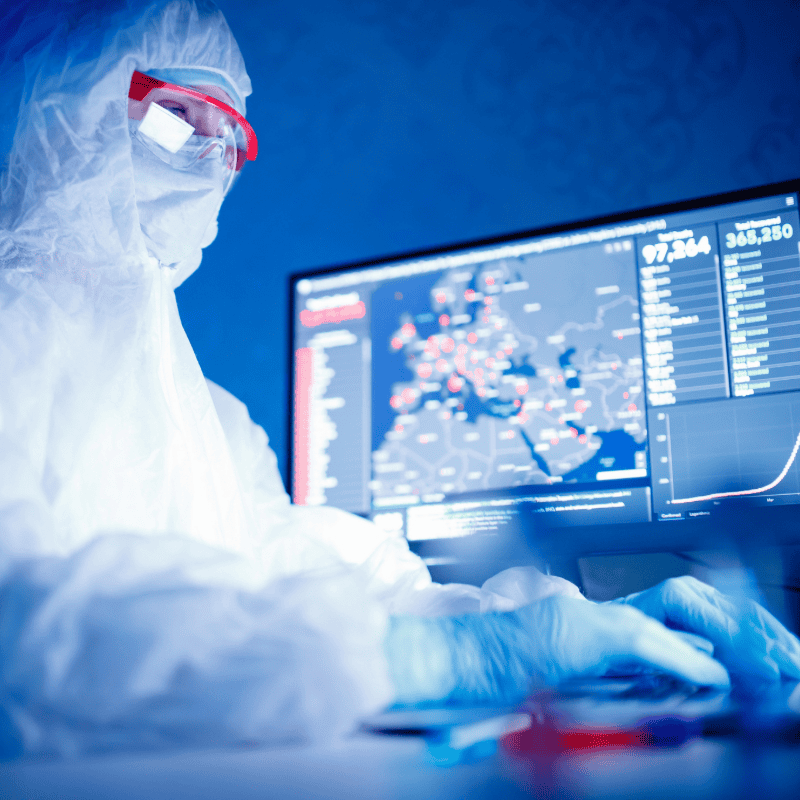
Head of MARS, Professor Chris Jewell, is developing state-of-the-art statistical and AI methods to improve real-time understanding of infectious disease outbreaks.
Disease outbreaks, such as seasonal flu, the COVID-19 pandemic, and measles affect people of all ages, genders, and nationalities. Health services must respond quickly and effectively to prioritise care for the most severe cases, manage the social and economic impacts, and ultimately save lives.

MARS Reader, Dr Henry Moss, is revolutionising scientific experimentation with smarter machine learning models.
Machine learning (ML) has dramatically transformed how scientists approach experimentation, especially in domains like drug discovery, materials science, and engineering. Yet, there remains a need for smarter ML models to accelerate the pace of scientific innovation, particularly in areas where experimentation is technically and financially costly.

MARS Professor Chris Nemeth is converting raw satellite and sensor feeds into early-warning signals for a warming world.
As the impacts of climate change accelerate, the need for timely, accurate environmental data has become critical. To manage risk and make effective decisions - from preventing greenhouse gas leaks to forecasting sea-level rise - real-time, reliable information on the Earth’s rapidly changing systems is urgently needed.

State-of-the-art research from MARS Lecturer, Dr Alice Peng, is pioneering a patient-centred approach to wound healing.
Despite extensive research into wound healing, many aspects remain poorly understood. Even when patients receive the same diagnosis, their healing processes can vary significantly. Subtle variations, often too small to detect manually, can have a major impact on recovery.

MARS Lecturer, Dr Jixiang Qing, is developing mathematically rigorous methods to help scientists collect data more efficiently.
Running experiments costs time and money. In drug discovery, a single reaction can take days. In engineering, one simulation might run for hours. Scientists must decide carefully which experiments or conditions to investigate, but the most informative options are not always obvious at the start – they only become apparent after some initial results are obtained. Collecting the right data is essential, yet figuring out which data will be most useful is a major challenge.
New research from MARS Lecturer, Dr Matthias Sachs, is developing machine learning models to accelerate atomic-scale simulations for real-world application.
Machine learning (ML) is increasingly being used to predict and understand macroscopic properties of atomistic systems. This is especially impactful in fields such as materials science, computational chemistry and engineering, where it supports the development of new materials, drug discovery, and clean energy technologies.

MARS Lecturer, Dr Mher Safaryan, is developing new algorithms and theoretical tools to optimise the performance of modern AI systems.
From smartphone assistants and medical imaging to online translation and climate modelling, modern AI systems rely on training large models using vast amounts of data. While these systems can be highly accurate, they are also expensive to train and run, requiring large data centres that consume significant energy and memory. This limits where and how AI can be deployed, especially in settings such as hospitals or on mobile devices.

MARS Senior Research Associate, Dr Xinyi Wu, is using mathematical methods and machine learning to increase the accuracy, efficiency and reliability of computational simulations of complex materials.
Many everyday consumer products, from cosmetics to medicines, rely on complex fluids and soft materials, such as emulsions, surfactants and polymers. These materials are also vital in a wide range of biological and industrial processes, yet understanding how they behave at the molecular scale is challenging. Computational simulations that model every atom are expensive, while simpler models may miss important physical behaviour. This project aims to develop mathematical and data-driven methods that make the simulations more accurate, efficient and reliable.