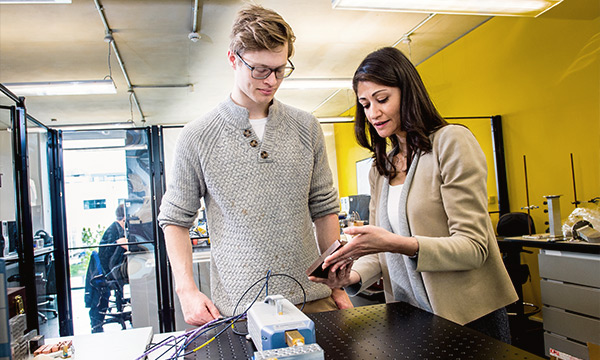
We offer a range of PhDs funded by different sources, such as research councils, industries or charities. Here you will work with internationally respected academics, post-doctoral research associates and technicians.
To apply for a funded PhD, please read the advertised project information carefully as requirements will vary between funders. The project information will include information such as funding eligibility, application deadline dates and links to application forms. We will only consider applicants who have a relevant background and meet the funding criteria.
Browse our current PhD opportunities
accordion
PhD Project Description
The rapidly evolving field of microfluidics, in which fluids are manipulated at a microscopic scale, finds many applications in industries, ranging from the pharmaceutical to the oil industry. Most ubiquitous fluids are non-Newtonian and complex such as paints, blood, inks and personal-care products are just a few examples. It also raises curiosity to understand the behaviour of micro- and nano-particles in confinement and under flow that is widely used in various industrial applications, including drug delivery, cosmetics, food, medical diagnostics, environmental remediation, energy and agro-based industries. The technique of controlled manipulation of colloidal particles using microfluidics as a tool in lab-on-a-chip has unlocked opportunities to overcome many limitations of conventional technologies such as the requirement of multiple preparation steps, long processing times and large sample volumes.
The project aims to develop and optimise innovative strategies to control the motion and spatio-temporal distribution of micro/nano-particles in complex fluids in a microfluidic environment. The candidate will design and fabricate microfluidic devices and characterise the flow/particle interaction through optical microscopy methods. There will be exposure to several experimental techniques for the synthesis and characterisation of functional particles and undertaking proof-of-concept studies to identify prospective applications of the developed microfluidic systems - especially for drug delivery and point-of-care diagnostics.
This is an opportunity for a self-funded student, tos start at a standard start date (April, October or January).
Informal enquiries and how to apply
For informal enquiries, please contact Dr Naval Singh n.singh1@lancaster.ac.uk. Candidates interested in applying should send a copy of their CV together with a personal statement/covering letter addressing their background and suitability for this project to Dr Singh.
Lancaster University is inviting applications from undergraduate students for a full-time, paid summer internship supported through the UKAEA Fusion Internship Scheme. This is a UK-based, 8-week summer internship in a fusion-related discipline. The internship is intended to provide hands-on experience and skills development relevant to future careers, while increasing awareness of opportunities within the fusion sector.
Internship project
The internship will be hosted at Lancaster University within fusion-related robotics research activities. The successful student will contribute to a defined summer project relevant to robotics for challenging environments connected to fusion applications.
The project is expected to involve supervised work in areas such as:
remote robotic operation and manipulation
sensing, experimentation, and system testing
data collection, analysis, and technical evaluation
project documentation and research presentation
The internship is intended to provide real-life project experience in an active research environment, helping the student develop practical skills, technical confidence, and broader awareness of fusion-related engineering challenges.
At the end of the internship, the student will be required to produce a poster detailing their project, learning, and experience. The poster will be presented at a showcase event in September 2026 at UK Atomic Energy Authority, Culham.
Internship details
Duration: 8 weeks
Hourly rate: £14.24 including holiday pay
Location: Lancaster University, UK
Period: Summer 2026, starting from Monday 1 June
Eligibility
Applicants must:
be studying an undergraduate course at a UK university
be returning to their studies after completion of the internship
have the legal right to work in the UK and be able to receive public funds
Applications are invited for a fully funded PhD studentship in the School of Engineering, Lancaster University, hosted by the Data Science and AI Institute (DSAIL) and funded by an EPSRC Doctoral Landscape Award. The project will develop a decision-theoretic shared-autonomy framework for safety-critical remote robotics, enabling robotic systems to adapt the allocation of authority between human operators and autonomous agents under uncertain communication conditions.
Supervisory team: Dr Ziwei Wang (Engineering / DSAIL, Lancaster University) and Professor Qiang Ni (School of Computing and Communications / DSAIL, Lancaster University).
PhD project description: Remote robotic systems are increasingly used in safety-critical environments such as nuclear decommissioning, infrastructure inspection, offshore energy and hazardous industrial operations. These systems depend on effective shared autonomy between human operators and robotic agents. However, real deployments often involve degraded communication, including latency, packet loss and bandwidth fluctuation, as well as changing operator states such as fatigue, overload or reduced readiness to intervene. Existing shared-autonomy approaches often treat these issues as external disturbances or rely on binary switching between teleoperation and autonomy, which limits robustness in realistic operating conditions.
This PhD will develop a new framework for communication-aware shared-autonomy allocation. The student will investigate how operator condition, network quality and task context can be represented in an uncertainty-calibrated allocation state, and how this state can be used to determine when the robot should follow human commands, restrict its action space, increase autonomy, or enter a conservative recovery-oriented mode. The project will combine AI, probabilistic modelling, robotic control and human-robot interaction, with validation through simulation, digital twins and embodied robotic experiments.
The student will be based in the School of Engineering and embedded in Lancaster’s Data Science and AI Institute. They will work across robotics, AI and communications, with access to Lancaster robotics facilities, including remote manipulation platforms, human-robot interaction interfaces, simulation environments and mobile robotic systems. The student will also be part of the DSAIL doctoral cohort, which brings together AI and data-science PhD students from across the university through cohort training, research events and interdisciplinary networking.
Training and skills: Supervision is interdisciplinary, spanning robotics, AI, wireless communications, human-robot interaction and safety-critical systems. The student will develop skills in probabilistic and uncertainty-aware machine learning, multimodal human-robot interaction data analysis, communication-aware autonomy, ROS/ROS2 robotic programming, digital-twin validation, constrained control and experimental robotics. Outputs from the project are expected to target leading robotics, AI and cyber-physical systems venues.
Application details: The successful candidate will hold, or expect to obtain, at least an upper-second-class honours degree, and ideally a Master's, in Engineering, Computer Science, Robotics, Artificial Intelligence, Control, Communications, Data Science or a closely related quantitative discipline. Strong programming skills in Python, MATLAB, C++ or similar are expected. Experience or strong interest in robotics, machine learning, probabilistic modelling, human-robot interaction, control systems, communication networks, ROS/ROS2, robotic simulation or safety-critical systems would be advantageous.
Funding details: This 3.5-year full-time studentship covers UK Home tuition fees, a tax-free stipend at the UKRI minimum rate for 2026/27 (£22,780 p.a.), paid subject to satisfactory progress, and a Research Training Support Grant (RTSG) of £1,000 per year for research-related expenses, conferences and training. Additional cohort training and interdisciplinary research opportunities are provided through DSAIL.
The studentship is primarily available to home applicants. Exceptional international applicants may be considered subject to eligibility, institutional approval, and confirmation of how any fee difference would be covered.
How to apply
Please apply through the official Lancaster University application process. Instructions for applying through the University can be found at the Lancaster University Admission Portal. Applicants should include:
* An academic CV, including the names and contact details of two referees, at least one of whom should be academic.
* A two-page personal statement / cover letter explaining your motivation, relevant experience and readiness for undertaking this PhD project.
* Academic transcripts.
* Evidence of technical work where available, such as a code portfolio, GitHub repository, robotics or machine-learning project, dissertation, coursework project or publication.
* For the Lancaster University application, in place of a Research Proposal, you may upload a copy of this advertisement.
Dates
Application deadline: TBC
Provisional interview date: TBC
Studentship start date: 1 October 2026
Informal enquiries: Prospective applicants are warmly encouraged to get in touch before applying. Please contact Dr Ziwei Wang z.wang82@lancaster.ac.uk for informal enquiries about the project, the supervisory team or the application process.
About the Project
Overview and background
The extraction of energy from the wind yields the formation of low-speed regions (wakes) behind wind farms (WFs). Wakes are particularly persistent offshore [2], and were recently shown to affect the heat exchange between sea and atmosphere, due to reduced convective heat transfer close to the sea surface [1]. With worldwide offshore wind capacity en-route to achieve 2,000+ GW already by 2050, WF wakes may alter ocean dynamics and marine ecosystems to extents comparable to anthropogenic climate change [2]. Evaluating wakes’ environmental impact credibly requires regional- to mesoscale climate simulations with high-fidelity WF parametrisations at temporal and spatial resolution beyond present supercomputers’ capabilities. Using Graphics Processing Unit (GPU) computing [3], this project will develop the code infrastructure to support these simulations on exascale machines, demonstrating prototype physical investigations using the developed technology.
Methodology
Two community codes for short-to-long term climate modelling are considered: the Weather Research and Forecasting (WRF) model [4], and the Model for Prediction Across Scales (MPAS) [5]. The codes feature similar models of atmospheric physics, but use different numerical methods. WRF uses structured grids with nested domains to increase resolution in WF wake regions, whereas MPAS uses a single unstructured Voronoi grid with controllable local refinement. WRF has state-of-the-art WF parametrisations [6,7] but little GPU work reported; MPAS uses GPU acceleration but has little work reported on WF parametrisation.
This research aims at combining the strengths of both codes to develop a reliable exascale-scalable code for the considered problem. The choice of the baseline code for the project’s core development and demonstrations will follow the teaser projects (TPs) below, which offer hands-on training in climate modelling, wind farm aerodynamics and distributed-memory and GPU parallel computing, and assess the codes’ strengths. Following the TPs, the student will focus on specific topics, e.g. improving the overall code GPU framework or optimising the parallelised WF model in existing GPU framework, depending on the code selected.
The TPs will share one test case, to compare the two codes’ predictive capabilities and computational performance (execution speed) without GPU acceleration. The GPU development work will be performed on Lancaster University’s HEC cluster and the Bede supercomputer [9].
Teaser project 1 (TP1): WRF-based. To investigate and optimise the predictive capabilities of the two WF parametrisations [6,7] in WRF, analyses (TC1) of the North Sea area containing two real WFs [10] will be performed. The capabilities of both models to predict wind turbine (WT) and WF wakes will be optimised using regression methods for the models’ parameters, and lidar and satellite wind speed measurements to steer the optimisation. Measured WT power will also be used in the process, as this parameter is affected by wakes. A second test-case (TC2) without WFs will be used to perform parallel profiling studies of WRF, identifying the code’s computationally most intensive parts and familiarising with its structure. These analyses will identify the code sections that would benefit most from GPU acceleration. TC2 will also be used to cross-compare the predictive capability of WRF and MPAS, assessing it by comparing predicted near-sea surface wind speed maps to measurements from satellites and lidars. Boundary and initial conditions for TC1 and TC2 will be taken from the ERA5 global climate reanalysis [8].
Teaser project 2 (TP2): MPAS-based. First, TC2 will be set up and analysed without GPUs to cross-compare the computational speed and prediction capabilities of wind speed field of MPAS and WRF. Then, more comprehensive TC2-based parametric analyses of the performance of MPAS using different numbers of CPUs and GPUs will be undertaken to study the dependence of the computational performance of the hybrid parallelisation on the CPU and GPU counts, and determine the largest achievable acceleration and the corresponding optimal ratio of GPU and CPU counts - an information paramount for exascale porting. These analyses also enable familiarising with the MPAS structure, knowledge needed to optimally merge wind farm models with the MPAS GPU infrastructure.
TP1 Objectives:
A) Familiarise with WRF: assess predictive capabilities of 3D wind fields with/without WFs; analyse/optimise best suited WF parametrisation: B) Assess computational performance and estimate potential of GPU acceleration.
TP2 Objectives:
A) familiarise with MPAS: assess predictive capabilities of 3D wind fields; investigate performance of hybrid CPU/GPU parallelisation; B) Investigate optimal integration of WF model into GPU framework.
Funding Notes
The Scholarship is part of the ExaGEO Doctoral Training Programme funded by the National Environment Research Council. Further information is available at View Website.
Interdisciplinary Safe Shared Autonomy for Ageing Care with Humanoid Robots (G1-CARE)
Supervisors: Dr Ziwei Wang (Engineering); Dr Elmira Yadollahi (SCC); Professor James Taylor (Engineering); Professor Plamen Angelov (SCC)
Project description: This PhD will develop and validate a safety-assured shared-autonomy framework for a superstar humanoid robot (Unitree G1) targeted at ageing-care workflows (see Figure). The premise is simple: if humanoids are to be accepted in healthcare environments, they must be able to work safely near people, handle everyday objects reliably, and degrade gracefully when perception or communication is imperfect, without placing an unreasonable cognitive burden on staff. The work will be organised around a small set of clinically relevant, low-risk, high-frequency tasks that map directly to care settings, including safe object handover, item retrieval from shelves/trolleys, tray handling, and rehabilitation session setup (e.g., positioning items, presenting tools, preparing a simple station).
These tasks will be implemented on the real G1, with performance judged against explicit safety and usability criteria. Technically, you will build an end-to-end pipeline:
(1) Practical perception + intent inference for care-like scenes. You will fuse multimodal signals (e.g., arm/hand motion cues, gaze and/or speech) with camera perception to infer target object, grasp choice, timing, and handover intent. Vision-language grounding will be used pragmatically: to link verbal instructions to objects/affordances, surface hazard cues, and provide interpretable feedback to the operator. Critically, you will quantify uncertainty and design gating, so autonomy only escalates when perception is reliable; otherwise, the system falls back to safe, operator-led behaviours.
(2) Skill learning and shared autonomy that staff can actually use. You will collect demonstrations using a natural, contact-free teleoperation interface, learn reusable primitives (reach, grasp, handover, fetch-and-carry, tray handling), and organise them into a compositional skill graph. Where appropriate, policies will be refined in simulation under the same safety constraints before transfer to hardware using domain randomisation/residual learning. The shared-control arbitration will be explicitly risk-aware, with transparent override and predictable behaviour around humans.
(3) Human-centred evidence, not just a demo. You will co-design evaluation protocols with ageing-care stakeholders and assess the system using: contact forces/stability margins, task success/time, learning curves, and standard human factors measures such as NASA-TLX and acceptance ratings, complemented by short qualitative feedback. Ethics, accessibility and data governance will be embedded from the start to make outcomes credible for translation.
Outputs will include a reproducible G1 digital twin + safety layer, multimodal interaction datasets (where appropriate), and a benchmark task suite with evaluation protocols and demonstration videos.
General eligibility criteria: Applicants would normally be expected to hold a minimum of a UK Honours degree at 2:1 level or equivalent in a relevant degree course.
Project specific criteria: We welcome applicants from Engineering, Computer Science, Natural Sciences or related disciplines. Essential: strong programming skills (especially Python) and Motivation to work across robotics + AI (hands-on, iterative, experimental). Desirable: experience with ROS2/robot simulation, control, machine learning, perception, or human-centred experimentation. You should be motivated by real-world impact in healthcare and committed to safe, inclusive research practice.
Studentship funding: A tax-free stipend will be paid at the standard UKRI rate; £20,780 in 2025/26. This is a fully funded studentship of 3.5 years for UK/Home students.
Enquiries: Interested applicants are welcome to get in touch to learn more about the PhD project. Please contact Dr Ziwei Wang (z.wang82@lancaster.ac.uk) for more information.
Dates
Deadline for candidate applications: 31 May 2026
Provisional Interview Date: June 2026
Start Date: October 2026
Further reading:
D. Ames, X. Xu, J. W. Grizzle, and P. Tabuada, “Control Barrier Function Based Quadratic Programs for Safety Critical Systems,” IEEE Transactions on Automatic Control, vol. 62, no. 8, pp. 3861–3876, 2017.
D. Argall, S. Chernova, M. Veloso, and B. Browning, “A Survey of Robot Learning from Demonstration,” Robotics and Autonomous Systems, vol. 57, no. 5, pp. 469–483, 2009
G. Billard, S. Calinon, and R. Dillmann, “Learning from Humans,” in Springer Handbook of Robotics (2nd ed.), B. Siciliano and O. Khatib, Eds. Springer, 2016, ch. 74, pp. 1995–2014.
Driess et al., “PaLM-E: An Embodied Multimodal Language Model,” in Proceedings of the 40th International Conference on Machine Learning (ICML), PMLR, vol. 202, pp. 8469–8488, 2023.
Zitkovich et al., “RT-2: Vision-Language-Action Models Transfer Web Knowledge to Robotic Control,” in Proceedings of The 7th Conference on Robot Learning (CoRL), PMLR, vol. 229, pp. 2165–2183, 2023.
G. Hoffman, “Evaluating Fluency in Human–Robot Collaboration,” IEEE Transactions on Human-Machine Systems, vol. 49, no. 3, pp. 209–218, 2019.
You will receive a generic acknowledgement in receipt of successfully sending the application documents.
Please note that only applications submitted as per these instructions will be considered.
Please note that, if English is not your first language, you will be required to provide evidence of your proficiency in English. This evidence is only required if you are offered a funded PhD and is not required as part of this application process.
SATURN-CDT PhDs
The EPSRC Centre for Doctoral Training (CDT) in Skills And Training Underpinning a Renaissance in Nuclear (SATURN) is a collaborative CDT involving the Universities of Manchester, Lancaster, Leeds, Liverpool, Sheffield and Strathclyde will work towards building the skills base needed to support the UK’s net zero targets. Please see the listed Lancaster-based PhD opportunities below:
How to apply
Step 1
To register your interest in a PhD opportunity, please email the relevant project supervisor with your contact details and a comprehensive CV. Please also include a covering letter, if requested in the advert details.
Step 2
The project supervisor will contact you and may invite you to hold a Skype or telephone interview. At this stage, you can apply for more than one advertised project if you wish.
Step 3
If you are successful at interview for the studentship, you will be invited to apply via the admissions portal online. This will ensure that you receive a formal offer of admission. Please submit one application only, and state the studentship that you have applied for in the source of funding section.
Step 4
Once we have made a formal offer, you will need to check the conditions in your offer letter and supply any outstanding documents by the required deadlines. If your offer is unconditional, then this will not apply to you.
Other methods of applying for a PhD
Studying for a research degree is a highly rewarding and challenging process. You'll work to become a leading expert in your topic area with regular contact and close individual supervision with your supervisor.
If you have your own research idea, we can help you to develop it. To begin this process you will need to find a PhD Supervisor from one of our research groups, whose research interests align with your own.