
The Unsecurities Lab, Goldsmiths University of London
Security Lancaster has released a new report from Unsecurities Lab, an experimental research workshop developed by Dr Nathan Jones that uses contemporary art as a research environment for exploring security thinking.
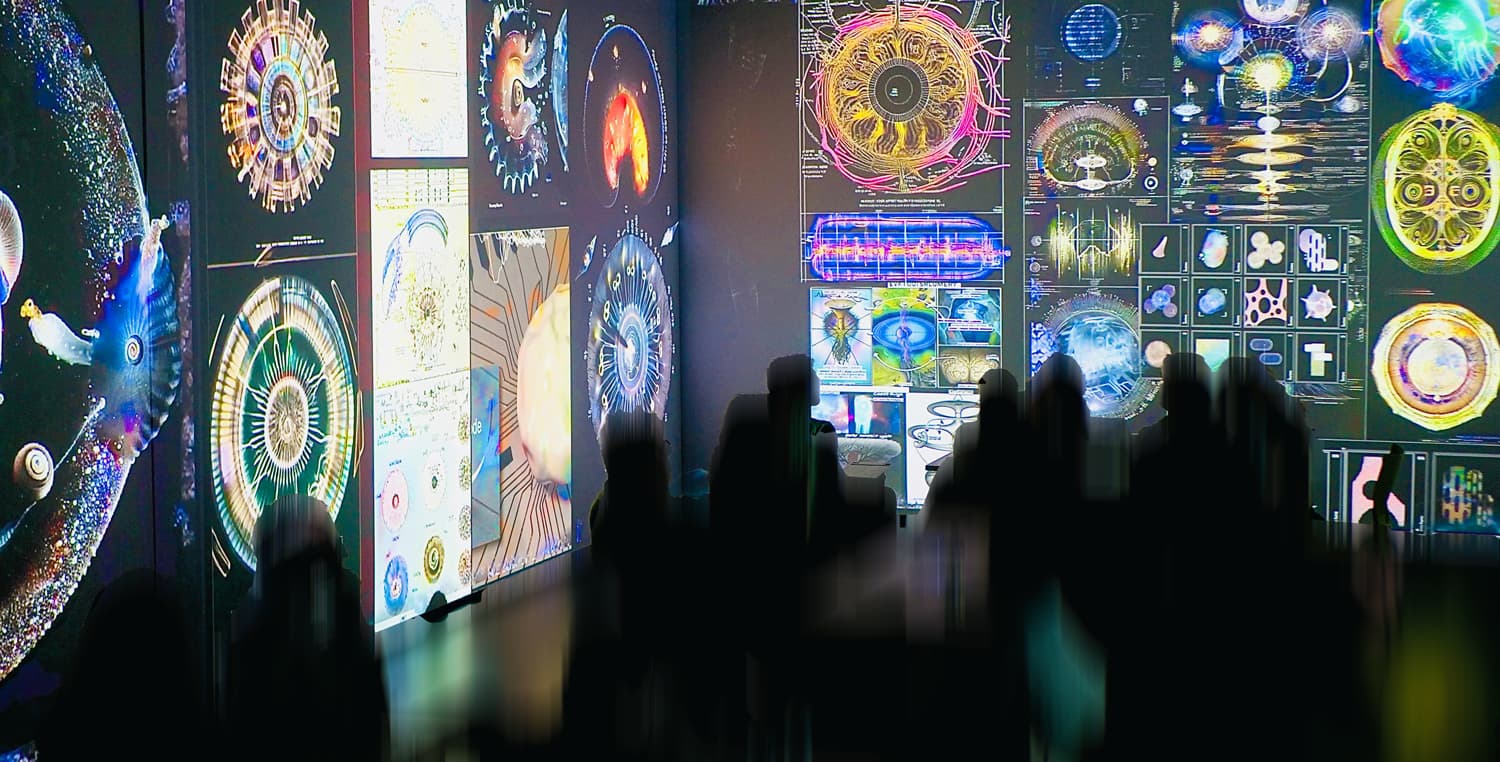
The workshop took place at Goldsmiths, University of London, in the Sonics Immersive Media Lab, and it was the second of these interventions centred on films by artist Joey Holder. Holder’s work brings together AI-generated biology, speculative ecosystems, evolutionary imagination and immersive visual culture. Participants used the films as a shared environment for examining how different forms of expertise interpret ambiguous, unstable and cross-domain threats.
The workshop was the first to be held off Lancaster Campus, and it brought together academics, government practitioners and policy specialists from a range of organisations, including Cardiff University, Kings College London, the Ministry of Defence, the Cabinet Office, the Department for Education, and the Open Innovation Team. Participants contributed expertise across evolutionary biology, crisis response, cyber-physical systems, environmental change, policy practice, security thinking and creative research.
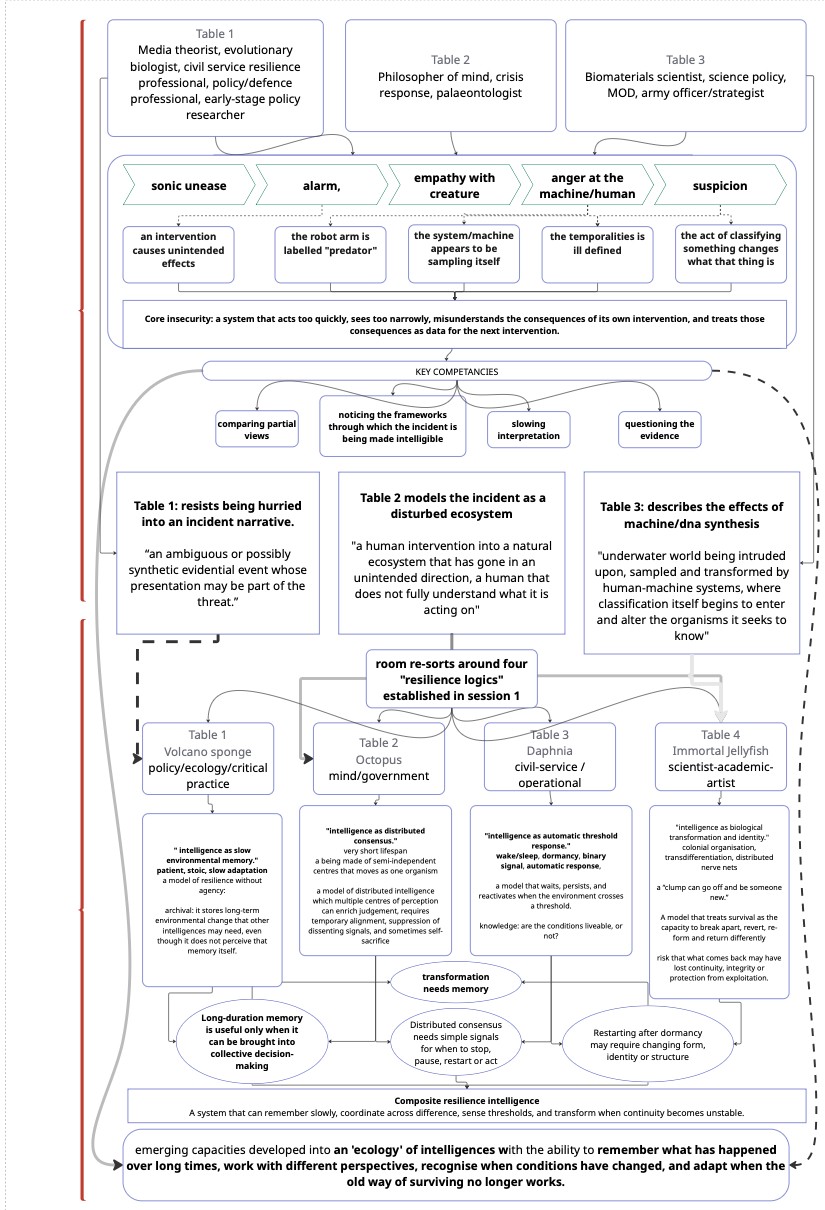
Through structured discussion, the group explored how professional background shapes what people notice first, how groups build accounts of uncertain evidence, and how instinctive reactions can become useful analytical signals. The report shows how participants moved from initial responses of unease, alarm, empathy, anger and suspicion into more developed observations about intervention, misreading, timescale, self-reinforcing evidence and classification failure.
These findings are especially relevant to policy and security teams working with uncertain, AI-mediated or cross-domain evidence, where weak signal loss, premature classification and over-fast consensus can create operational risk.
A central output of the report is the Interaction Map [pictured below], which traces how three different table groups interpreted the same film material and developed a shared diagnosis of the problem. The map offers a practical tool for understanding how expertise behaves under pressure, and how collaborative interpretation can strengthen decision-making in complex security contexts.
The workshop also explored non-human intelligences as models for resilience in volatile environments. This opened up questions about how systems remember, coordinate, adapt and recognise changing conditions under the pressures of the Anthropocene.
For Security Lancaster, the report demonstrates the value of immersive art as a setting for security research. It offers a way to rehearse uncertainty, test interpretive habits, and develop new approaches to complex technological, environmental and AI-mediated hazards.
Future Unsecurities Lab activity led by Nathan Jones will build on this approach through workshops with policy, security, academic and cultural partners, focusing on situations where environmental instability, agential AI, cyber-physical infrastructures and ambiguous evidence overlap.