

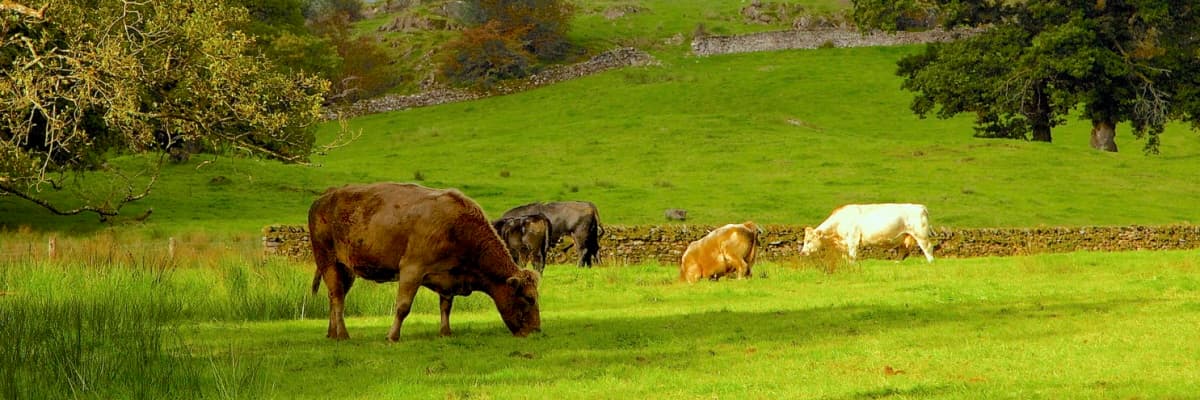
Lancaster University’s collaboration with Lake District Farmers has explored how academic expertise can help upland livestock farming move towards net-zero, while remaining economically viable and environmentally regenerative.
Lancaster University and Lake District Farmers Ltd have completed a significant Knowledge Transfer Partnership (KTP) exploring how meat production on upland farms can move towards net-zero while supporting farmer livelihoods – highlighting that profitable livestock production can be part of creating sustainable and regenerative natural environments.
The 27-month project employed a KTP Associate and brought together researchers from Lancaster Environment Centre and the Pentland Centre for Sustainability in Business with one of the UK’s leading premium meat suppliers. Working directly with farms across Cumbria, the partnership focused on understanding soil carbon storage on farms situated in some of Britain’s most challenging terrain, identifying opportunities to reduce carbon emissions, and embedding environmental data into farm-level decision-making. For Lake District Farmers, this provided a clearer picture of how land management decisions could influence carbon outcomes.
The partnership established robust soil carbon baselines on four upland farms supplying Lake District Farmers, revealing substantial carbon stocks and highlighting the role that land management decisions play in protecting that carbon. This work was combined with information and evaluation relating to carbon tracking and carbon accounting, to help farmers understand not only the financial implications of land management decisions, but also their wider environmental and social impacts, such as soil carbon storage and ecosystem health.
The project was led by KTP Associate Dr Laura Giles, working alongside academic supervisors Professors John Quinton, Jess Davies, and Jan Bebbington.
Dr Giles said of her time working on the project:
“Through the KTP I gained experience of knowledge transfer relationships and how they can benefit all parties. I learned a great deal about upland livestock farming, environmental fieldwork and carbon modelling, as well as how environmental accounting can support better decisions on farms. Working across academia and industry, and with such a wide range of people, has been invaluable.”
For Lake District Farmers Ltd, the project has transformed how the business understands its environmental footprint, particularly emissions generated on farms during livestock production.
Phil Scott, Head of Purpose and Sustainability at Lake District Farmers Ltd, said:
“In helping to develop Lake District Farmers’ sustainability strategy, the KTP has been paramount.Through the detailed research this project has offered…we now look at the farms we with work with through a completely different lens, a lens that focuses on the soil carbon stocks, a vital component on our pathway to net-zero.”
The collaboration also delivered significant research and teaching benefits for Lancaster University. Novel data on carbon stocks in upland soils has contributed to academic understanding, while the project is already being used as a live case study in undergraduate teaching and MSc dissertations.
Professor John Quinton, Professor of Soil Science at Lancaster Environment Centre, said:
“The interactions fostered by the KTP have been incredibly valuable, leading to new insights and practical outcomes that are positive for the environment.”
Professor Jan Bebbington, Director of the Pentland Centre for Sustainability in Business, added:
“This project has deepened my understanding of environmental and carbon accounting through its application in a complex business context. The questions that come from the challenges facing the KTP partner pose important questions for me to feed back into my own field. This has been the perfect situation of knowledge exchange creating a virtuous circle. I would certainly recommend KTPs to colleagues given my experience in this one.”
A new film about the KTP includes interviews with the project team and showcases the outcomes that the project achieved.
Looking ahead, Lancaster University and Lake District Farmers will continue to collaborate to embed the learning from the KTP into business practice and to explore how similar approaches could support other partners across the food and farming sector.
This Knowledge Transfer Partnership (KTP) project was funded by UK Research & Innovation through Innovate UK Business Connect. Innovate UK KTPs bring together forward-thinking businesses and organisations, academics, and graduates to solve complex innovation challenges which help our economy, society, and environment. This approach has proven highly successful in helping UK businesses and organisations innovate for growth since 1975.
