

Summary
The AI:Lab project applied advanced AI methods to explore potential carbon emission reductions through the design and construction process of Eden Project Morecambe, delivered in partnership with Grimshaw Architects and Eden North. IAA funding enabled a summit and public exhibition that engaged over 300 attendees and 22 schools, positioning Lancaster as a national leader in AI driven sustainable design.
The project was led by Professor Des Fagan, Head of Architecture, an expert in optimisation and deep learning (Artificial Intelligence) for decision support systems in design
Challenge
AI:Lab was established in response to an urgent, dual challenge at the intersection of climate action and rapidly evolving architectural practice. The built environment is a major contributor to the climate emergency, responsible for 39% of global energy related carbon emissions, including 28% from operational use and 11% from embodied carbon in materials and construction. Addressing “upfront carbon” has become a critical priority for governments, industry and communities seeking credible pathways toward net zero.
At the same time, architectural practice is undergoing a profound technological shift: a 2024 RIBA survey reported that 41% of UK practices now use some form of AI in their workflows. However, the sector lacks clear guidance, validated methods, or evidence based best practice for responsible, low carbon AI adoption.
AI:Lab aimed to understand how emerging AI technologies could be mobilised to predict, analyse and reduce carbon impacts across the design and construction lifecycle. The challenge was not only technical but cultural and infrastructural: to equip architects, engineers, students and policymakers with new tools, literacy and frameworks for decision-making.
Actions
IAA funding enabled AI:Lab to deliver a structured programme of activities designed to translate emerging AI research into practical, interdisciplinary applications for low carbon building. To communicate and embed this work across stakeholder groups, the IAA funded three major knowledge exchange activities: a sector facing symposium, a multiday public exhibition, and a policy document.
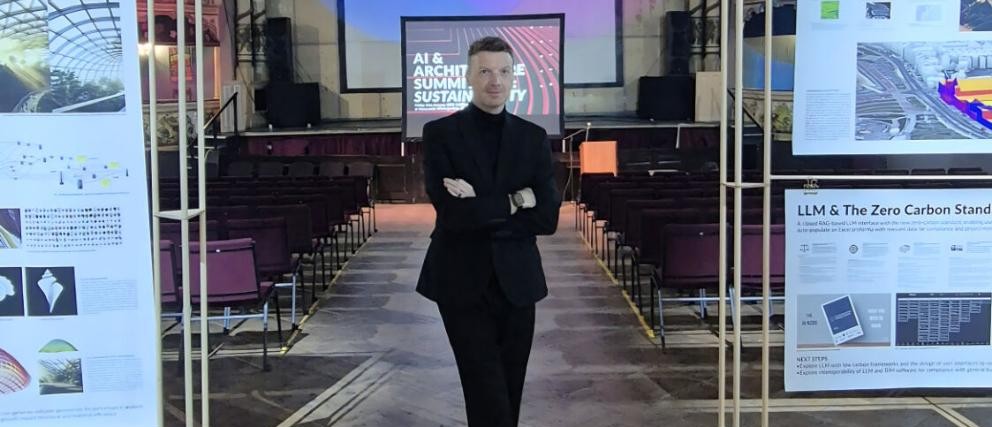
The symposium brought architects, engineers and policy specialists together to interrogate emerging AI workflows in the built environment. The public exhibition at the Grade II listed Morecambe Winter Gardens showcased interactive prototypes and student produced material centred on Eden Project Morecambe, aligning with Grimshaw Architects’ ambitions for net zerol structures and engaging Key Stage 4 students through the Morecambe Bay Curriculum. The policy document, drawing on interviews, workshops and engagement activities, ensured the project’s insights were captured in a structured, transferable format for industry and policy audiences.
AI:Lab also resulted in two policy reports, published in the RIBA Artificial Intelligence Report 2025 and AI and the Future of Architectural Education in the UK, and two conference posters, presented at AI UK 2025 and accepted for the World Design Congress 2025.
Results
Over 300 residents and KS4 pupils from 22 schools engaged with low carbon, AI supported design through the exhibition; LU students across three modules contributed to public facing activities.
Findings from AI:Lab informed Grimshaw Architects’ workflows for Eden Project Morecambe, supporting progress toward net zero ready design. RIBA members gained enhanced literacy in AI enabled sustainable design through the RIBA AI Report, and students and residents developed understanding of carbon emissions and mitigation strategies.
Insights from AI:Lab support Eden Project Morecambe’s development as a carbon negative and economically significant regional asset. The sold-out summit positioned Lancaster’s School of Architecture as a national leader in generative AI for design research.
The project catalysed major follow-on success, including Fagan’s prestigious £58,254 AHRC Design Secondment, enabling continued evaluation of AI tools for low carbon building. AI:Lab’s visibility led to selection for the national AI UK showcase, amplifying sector influence.