

Summary
The restoration of forests in the state of Pará in Brazil presents an incredible opportunity to mitigate climate change and support biodiversity conservation, and to enhance key ecosystem services related to forest cover and water quality. Yet at present, the plans are a target only, with no spatial prioritisation. Professor Jos Barlow, distinguished professor of conservation science, delivered guidance in conjunction with partners including SEMAS (the State Secretariat for the Environment and Sustainability) and Embrapa (a federal research company). To do so, he undertook analysis of extensive datasets and developed a platform for restoration that shows how to maximise benefits and minimise costs, while considering targets such as carbon accumulation and biodiversity.
Challenge
The state of Pará in Brazil is one of the world’s most biodiverse regions, holding over 10% of the world’s birds across four distinct areas of endemism. However, high rates of historical deforestation mean it is also one of the most threatened regions of the Amazon, and holds some of the last populations of Amazonia’s Critically Endangered species. The loss of forest cover that has driven the biodiversity challenges also threatens livelihoods, with agricultural practices and wellbeing affected by increases in local temperature, reductions in dry-season rainfall, and a reduction in the quality of water in streams. Crucially, it has also led to significant greenhouse gas emissions, with Pará being one of the Brazilian states that emits the most.
Actions
The team achieved their goal by processing extensive datasets on Land Use – Land Cover (LULC) history, biodiversity records and socioeconomic surveys (available from existing databases) to build spatially explicit scenarios for restoration plans.
First, the team used data science techniques to estimate the currently converted areas and identified potential candidate areas for restoration, considering the legal requirements (e.g., the minimum area of protection required by the Brazilian law within rural properties). This was one of the first times that potential restoration areas were mapped considering not only converted areas, but land use and human occupation.
Following this, the team used modelling techniques to forecast the potential benefits for climate change (i.e. carbon stock), biodiversity and related ecosystem services in these areas, as well as the potential costs that can be used as a baseline metric.
Next, they developed and delivered an interactive tool that will help with the spatial planning based on the potential cost-benefit balance considering multiple alternative criteria (biodiversity, carbon, costs, connectivity). Finally, they provided training for the partner technicians in the use of the tool and the dissemination of technology among rural landowners.
Results
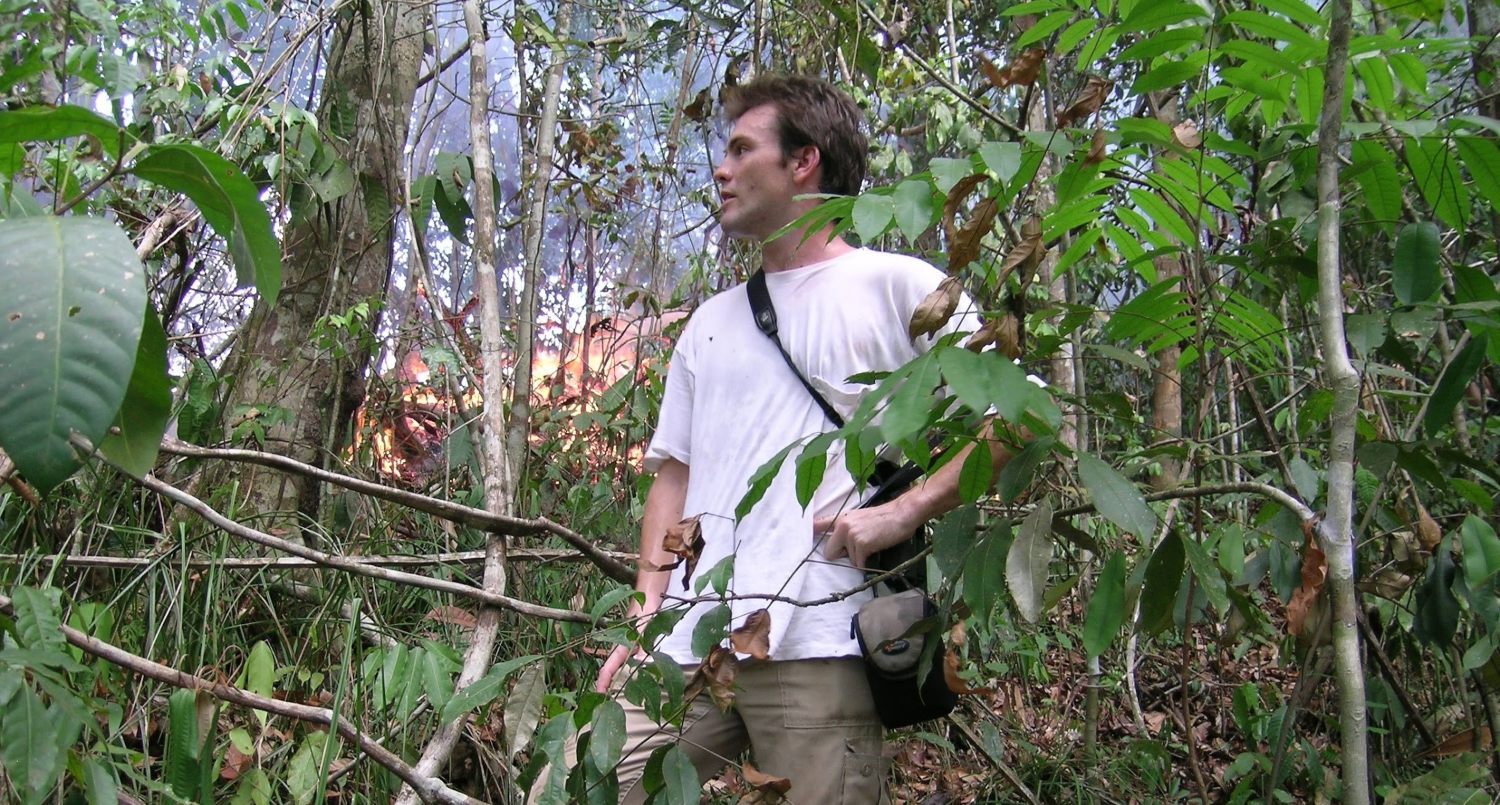
The project resulted in the analysis of extensive datasets, leading to a platform that created spatially explicit scenarios for restoration plans and showed how to maximise benefits and minimise costs, while considering multiple targets such as carbon accumulation and biodiversity. This was achieved by using modern data science methods, including machine learning tools and AI. It also led to the production of the short film Heroes in the Fire, which highlighted the challenges faced by firefighters combating wildfires in the Amazon.
This project has strengthened existing relationships between Lancaster University and SEMAS, positioning us as a centre for reforesting work in the Amazon Rainforest. Barlow has received over £800k of follow-on funding from the Natural Environment Research Council (NERC) and £900k from the Department for Environment, Food, and Rural Affairs (DEFRA) to further his work in the forestation of the Eastern Amazon.
As a result of this work and research, Barlow received the Busk Medal from the Royal Geographical Society (With the Institute of British Geographers). Nigel Clifford, President of the Royal Geographical Society, said: “Jos is one of the leading tropical ecologists of his generation and his record of local collaboration and engagement with policymakers and stakeholders is exemplary. We are delighted to award him the Busk Medal in recognition of his pioneering contributions to the understanding of the risks of climate change and disturbance to tropical forests.”
Barlow’s findings have been presented to policymakers in Brazil to help inform decisions on managing and protecting the Amazon’s tropical forests. The central aim of the project is to help mitigate climate change and support biodiversity conservation – the findings of Barlow’s work could reforest one of the most biodiverse areas on the planet, and have an incredibly wide-reaching and positive environmental impact.