

Summary
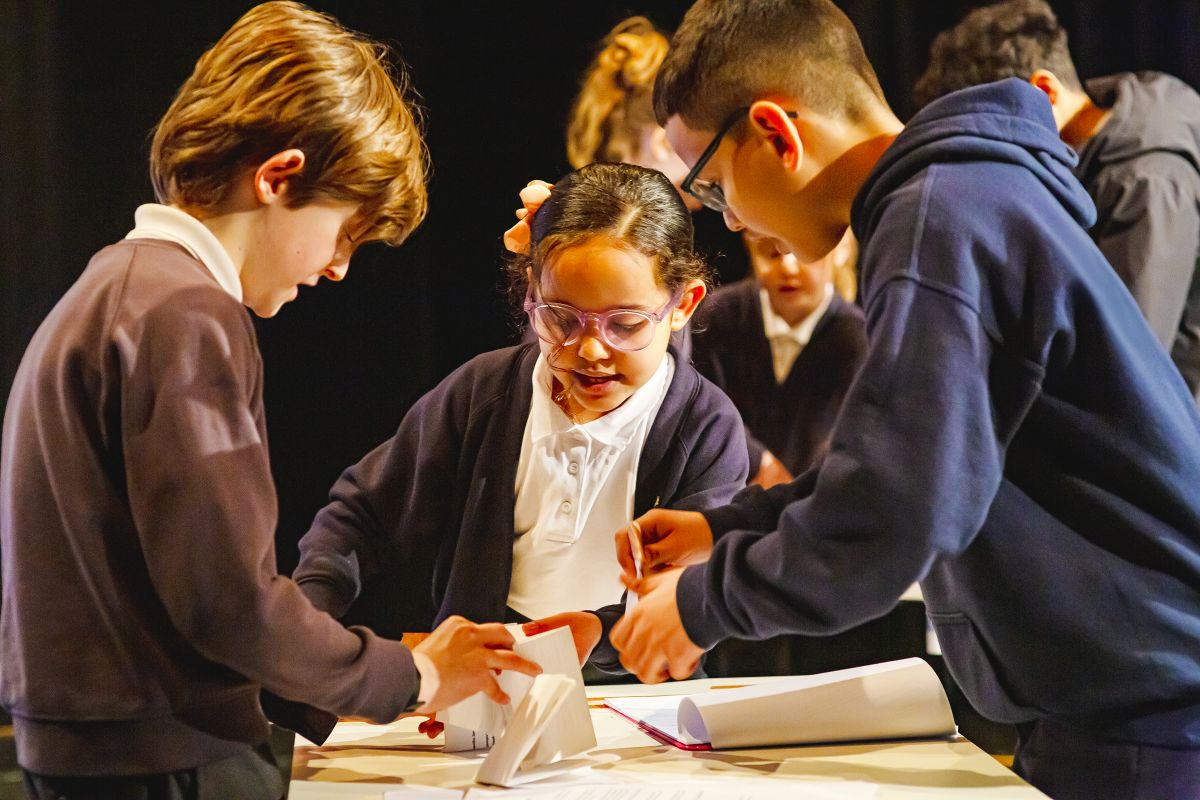
In 2024, 265 key stage 2 pupils across local schools experienced an early iteration of So Unfair!, a play developed through Lancaster’s Impact Acceleration Account (IAA) to encourage children from all backgrounds to explore STEM subjects.
Challenge
The Education Policy Institute (EPI) reported in 2024 that combined science GCSE has the largest disadvantage gap of all subjects. This means that children from deprived backgrounds face significant structural barriers to progressing into STEM post-16 and beyond. So Unfair! addressed this gap, with the tour reaching schools with a Pupil Premium average of 58%, indicating that pupils would typically be less likely to engage with STEM subjects.
Actions
Funded by the Arts and Humanities Research Council (AHRC) IAA, So Unfair! was co-created by playwright and performer Daniel Bye, director Toni Dee Paul, theatre company One Tenth Human, and Lancaster’s own Jenny Roberts, a Lecturer in the School of Engineering.
The play involves interactive elements, introducing children to engineering, fairness, and the application of STEM in real world situations – as well as real-world STEM role models, like Roberts, to demonstrate these solutions.
Following the initial Research and Development phase in summer 2024, the play went on to 18 performances throughout 2025. The venues were in locations including London, Newcastle, St Helens, and Manchester, as well as schools across the North West. In total, over a thousand audience members were reached in this period.
Results
After engaging with the show during the R&D stage, 74% of children agreed or strongly agreed that they knew “quite a lot” about what engineers do, compared with 32% before the play. The production also broadened perceptions of who can be an engineer - around 40% of children’s drawings depicted female engineers.
Teachers reported exceptionally strong responses. 100% recommended the project and highlighted its ability to engage pupils who are typically reluctant, including SEND learners. 90% of parents said the show met or exceeded expectations.
As well as inspiring children to get into STEM subjects, the play served as an opportunity to model new forms of engagement and impact for academics. Involving Roberts and other lecturers through pre-recorded segments and Zoom calls reduced the time commitment for academics. Future use of these methods in other projects would maximise impact while optimising effort and establishing a scalable, equitable and engaging model of outreach.