Environmental Sustainability in Research Quick Guide

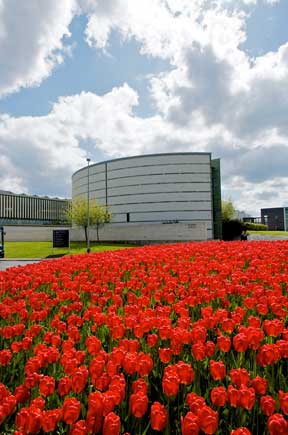
Flowers on campus

Introduction

The purpose of this guide is to better the research culture and environment of Lancaster University. It is designed to help people involved in research improve their work by increasing quality of outputs, increase access to funding, and helping contribute towards a better environment.

How does our research impact the environment?

Research puts demand on our environment through travel, facilities, data infrastructure, procurement and material use. For example, a research facility in France found their own emissions to be 6 times that of the average person, similarly a nature study found that we generate 2% of plastic waste globally.

Irrelevant Flyer

Why Should I Care?

We as scientists have a responsibility to understand and interpret scientific data and are privileged to be trusted by our communities, policy makers, and others. We are both well placed and have a responsibility to clearly communicate the seriousness of the climate crisis. Similarly, our universities and research operate within a sphere of influence, meaning our activities affect a larger area than ourselves. It is important to think broadly about the university’s sphere of influence, and how this affects our sustainability as an organisation.

  • We are the largest employer in the Lancaster district, with approximately 3200 staff, and 15,500 students (> 6250 on campus residents and a further 7400 in Lancaster city)
  • Our 100+ buildings cover an area of 331,228 m2 , and our total estate covers 2.48 km2
  • We have an annual turnover of approximately £350 million
  • And we have five international partnership campuses, as well as 170,000 alumni in 190 countries

Environmentally sustainable research produces better results, makes you more competitive, and is attractive to funders. More funders and institutions are requiring sustainable approaches to research, so the best time to cultivate this skill is now.

How to interact with this guide

If this is your first introduction to sustainable research, please cherry pick. Don’t strive for purity. To do everything in this guide takes time and energy, two scarce resources in research.

Take it slow, going too fast is a recipe for failure. Be a role model with what you do take. Striving to improve your own practices and being open about your efforts will help inspire change in others.

And remember we go farther together; try to join forces and interact with people at Lancaster.

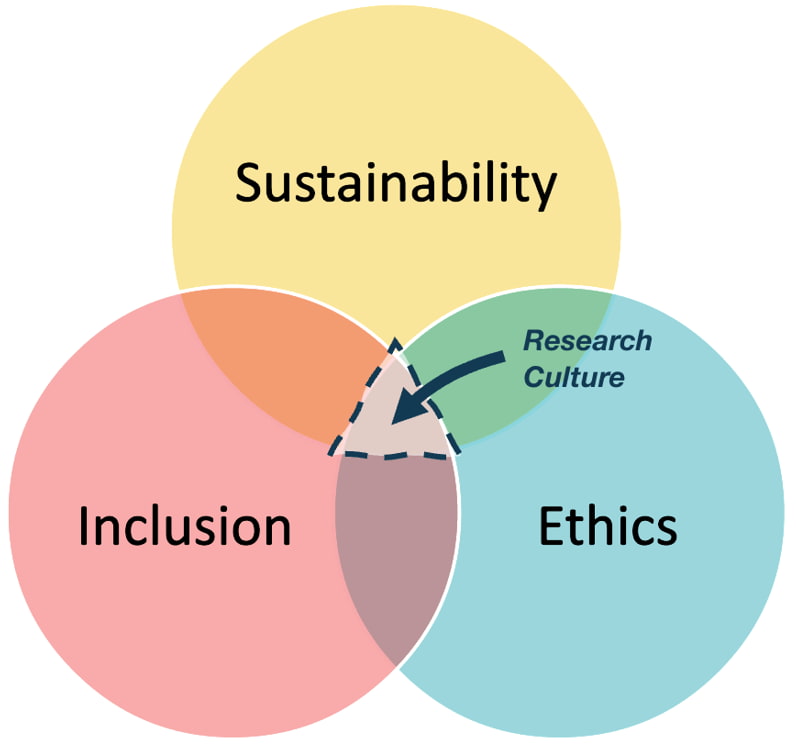
3 Pillars of Research Culture intersecting as part of Research Culture

A Pillar of Research Culture

Environmental sustainability is an essential pillar of research culture and must exist in conjunction with inclusion and ethics to cultivate good research. The practices highlighted in this guide include inclusion of all researchers, and the ethics behind how we operate.

An Office

Office

Sustainable research is just as applicable when we are sitting at a desk to when we are engaged in other activity. Most efforts are similar to how we engage in good practice in our personal lives such as turning lights and equipment off when not in use, cycling or using public transportation, and disposing of items correctly. A good place to start with this is the 5Rs:

  • Refuse: Do you really need it, or can it be shared or spare sourced from elsewhere?
  • Reduce: Can you reduce the need to purchase things?
  • Reuse/Repair: Can it be used again?
  • Repurpose: Can it be used for something else?
  • Recycle: Is there an appropriate waste stream?

When designing research, precision helps reduce waste. Remember the old adage, measure twice, cut once: avoid wasting supplies and resources by being careful and mindful. Go over protocols, make sure units are correct, ask for help if needed Not only is this good for the environment, also helps save money and improves the quality of your work.

Everything we do in the digital world has a carbon footprint, our emails, files, and data are stored in physical servers across the globe, often powered by fossil fuels and cooled by water.

Procurement is a major source of carbon emissions. The things we purchase take energy and resources to make, from mining the materials, to powering the factory, to the fossil fuels used to ship the items. So be mindful and remember the 5R’s when purchasing items.


An aeroplane in flight

Travel

Researchers have an outsized travel footprint as we often take multiple long-haul flights every year. Conference attendance accounts for 35% of a researcher’s carbon footprint. The effects of climate charge are making transatlantic flights less efficient as well, with one model estimating London to New York flights will use an additional 72,000 tons of CO2 per year as global temperature increases.

However, connections and collaborations are essential to modern science, and we feel that international travel and conferences are important for good research and connection. Many trips are avoidable or can be streamlined, and their impact lessened with proper planning.

Steps for smarter travel

  • Alternatives to flying: Take trains, ferries, buses, and carpool for all or part of your journey.
  • Lengthen trips: Instead of multiple short field visits, consider lengthening trips and going less frequently.
  • Consolidate trips: Where possible, plan conferences, holidays, and field work together. For example, if you have a conference in New York and a field site in the Caribbean, group them into one trans-Atlantic trip.

We also recognise emissions from aviation mirror global inequality. Less developed countries containing half of the world population only account from 10% of aviation emissions. This inequality is also reflected in who has the privilege to participate in research. For example, scientists from disadvantaged backgrounds, in caretaker roles, and with medical limitations may not be able to manage current sustainable alternatives. Similarly, early career researchers may feel the need to travel to establish their career.

Lancaster University has a travel decision tree to help with determining what is right for you. Additionally, when in doubt don’t be afraid to ask for accommodation if things seem difficult to book.

Two researchers talking in a lab

Lab

Research sometimes requires specific (possibly extreme) temperature settings for an experiment or to maintain equipment, for example ultra low temperature physics, variable temperature studies in chemistry, or controlled environment plant growth rooms in LEC.

Steps for smarter lab use-

  • Shut the sashes: Sashes use more energy when open, additionally increased airflow from fume hoods means more heat or aircon is needed to maintain room temperature.
  • Turn off equipment: Heated or refrigerated equipment, such as incubators, centrifuges, and PCR machines, are very energy intensive. Turning these machines off when not in use or changing their set-point temperature during use saves energy.
  • Share resources: As its not uncommon for packages to come in larger quantities than needed, avoid wasting products and money by asking if colleagues have extras.
  • Sort waste correctly: Biohazard waste is incinerated, which is energy intensive.

Lancaster University has joined the Laboratory Efficiency Assessment Framework (LEAF) initiative, which sets international standards to enhance sustainability efficiency in labs. It is also increasingly being required by funders to meet funding eligibility.