


Train in cutting-edge methods and explore new ideas with leading experts from Lancaster University’s internationally renowned Digital Humanities Centre. We specialise in Spatial Humanities, Text Analysis, Digital History, and Artificial Intelligence for the Humanities.
What is ‘data’ in the humanities? How are digital sources created? What are the advantages and limitations of material in digital form?
As well as changing the way we live and work, the digital world is also transforming the way we study the humanities. Lancaster’s MA in Digital Humanities will prepare you to work in this new world of data.
Why Lancaster?
- Learn key techniques and concepts from Lancaster’s internationally recognised experts in Digital Humanities
- Study in a faculty that specialises in the development of data science and artificial intelligence methods for humanities research
- Collaborate with your peers in our Digital Scholarship Lab, a state-of-the-art research space with specialist software and equipment
- Develop skills and knowledge that will open doors to professional roles or PhD study
A global leader in the field
Digital methods are changing the ways in which humanities scholars do research across the UK and internationally. They are also rapidly transforming how cultural heritage organisations share and preserve collections. AI is turbo-charging this in ways that are still developing. You will explore these shifts and others to analyse implications, positive and negative, for our disciplines, for libraries and archives, and for society and the state. At Lancaster, the Digital Humanities are an opportunity to link humanities questions about bias and power to these new scholarly ways of working, and to considerations about digital culture in the world.
Our academic team at Lancaster have tackled big research questions such as:
- How can AI be used to better understand oral history testimonies about the Holocaust?
- How can we read a million maps?
- How can Shakespeare's corpus be visualised?
- What can billions of words extracted from nineteenth-century newspapers and legal testimonies tell us about life in Victorian Britain?
- What changes can we identify at a landscape scale during the formation of the Aztec Empire?
Our MA in Digital Humanities is taught by internationally recognised tutors who have a wide range of subject knowledge from across the Faculty of Humanities, Arts and Social Sciences. You can draw on their expertise and develop your degree in a way that suits your interests and career prospects.
Digital skills and contexts
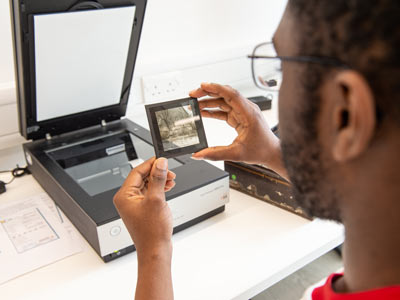
Without assuming anything other than a conventional ability to work with computers, you will develop digital skills tailored to working with digitised humanities sources such as historical newspapers, books, maps, oral histories, photographs, and more. As you acquire the technical competencies required to work with such sources, you will place these methods in the context of key debates around the history, ethics and cultures of today’s digitised world.
Computational skills can be used to study societies and cultures of the past, present and future. On this course, you will develop a critical approach to understanding and interacting with humanities data, testing methods to answer research questions in your own areas of interest. Modules will prepare you to develop your own digital humanities research project, with supervision from Lancaster experts.
Drawing on innovative research at Lancaster and further afield, you will learn classic and state-of-the-art methods including:
- Text Analysis (especially Corpus Linguistics)
These skills can be applied to a range of disciplines from across the humanities including History, Literary Studies, Media Studies, Linguistics and more.
A digital community
The MA in Digital Humanities is embedded in Lancaster’s Centre for Digital Humanities. In this thriving community you will have access to a range of seminars and other events as well as opportunities to co-design new initiatives with students and staff. You will learn about developments in Digital Humanities at Lancaster and beyond and can meet and chat to PhD students and staff working in this exciting field. The Library’s Digital Scholarship Lab hosts many events and is a key space for collaborative activities. Lancaster’s Data Science and AI Institute offers further opportunities for interdisciplinary learning and collaboration.
Take a look at some of our recent and current projects:
Digital Innovation in Water Scarcity in Coimbatore, India
Unlocking the Colonial Archive: Harnessing Artificial Intelligence for Indigenous and Spanish American Collections (AHRC NEH)
Digging into Early Colonial Mexico
Chronotopic Cartographies
Digital Humanities and Heritage in India
Encyclopedia of Shakespeare's Language Project
MapReader
Machines Reading Maps
Data/Culture
GEODE
Living with Machines
Digital Panopticon
Data Mining Convict Tattoos