

Since 2012, Light Up Lancaster has transformed the city into an annual after-dark light art festival, bringing together artists, cultural organisations and audiences to explore Lancaster’s heritage, landscape and contemporary life through large-scale light installations. Delivered in partnership with Lancaster City Council, Lancaster BID and The Dukes, the festival is primarily funded through Arts Council England and Lancaster City Council, with additional support from a range of partners, including Lancaster University.
Over time, the festival has grown into a major cultural event in the region, attracting tens of thousands of visitors each year and contributing significantly to the city’s cultural economy and evening-time footfall. Within this wider ecosystem, Lancaster University’s role has focused on enabling research-led contributions through targeted AHRC and EPSRC Impact Acceleration Account (IAA) support.
A dedicated Light Up Lancaster IAA call has provided a structured route for researchers to collaborate with artists and festival producers, developing large-scale installations that translate research into public experience in the heart of the city.
Research at scale: Lancaster Castle as a public canvas
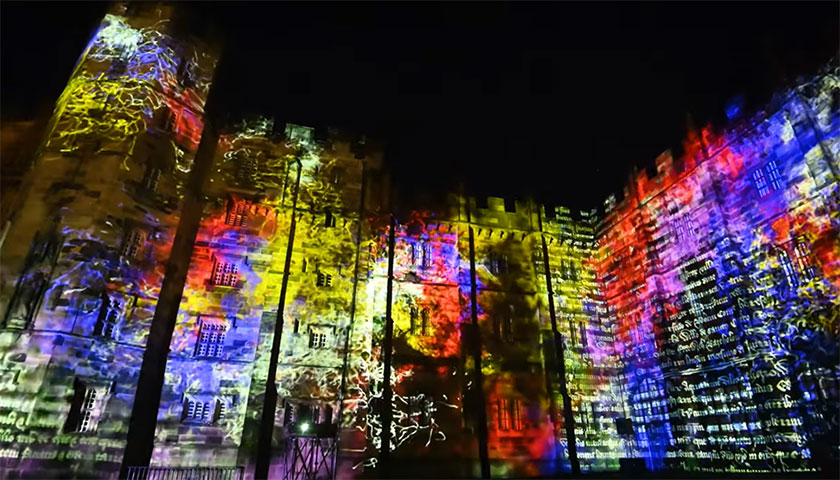
Lancaster Castle has become a focal point for these collaborations, hosting research-led installations that use projection, sound and digital media to reinterpret science, history and environment for large public audiences.
In 2023, the Castle hosted a projection mapping work developed with researchers and creative practitioners that illuminated the Duchy of Lancaster’s Great Cowcher Book, transforming medieval archival material into a large-scale immersive light and sound experience.
In 2024, In Microns shifted attention to the microscopic world of biological research. Developed through Lancaster’s Biomedical and Life Sciences Division, the installation drew on high-resolution bioimaging to reveal cellular and sub-cellular structures, translating scientific imagery into a dynamic public artwork that made the “invisible” visible at architectural scale.
Climate, creativity and deep time
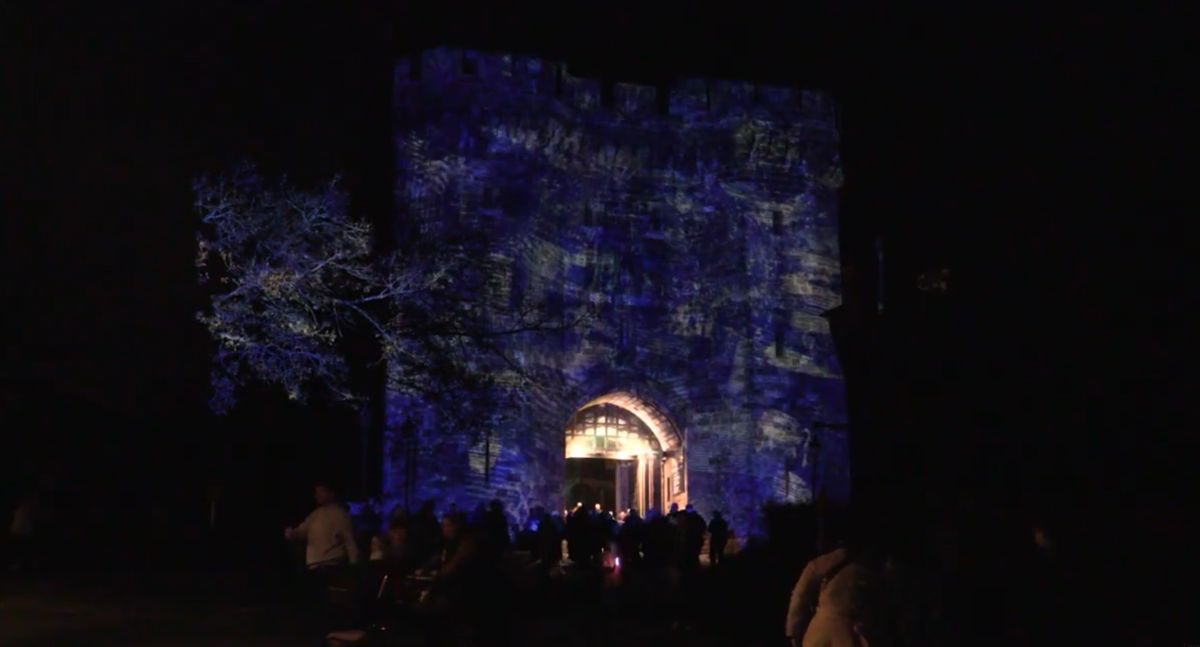
The 2025 IAA-funded commission Still Waters Run Deep, developed by Dr Diego Moral Pombo (Lancaster Environment Centre) with artist James Hooton and collaborators, extended this approach into climate science and environmental change.
The work used large-scale projection mapping across Lancaster Castle’s gateway to visualise the internal movement of glaciers, compressing centuries of geological transformation into a live, immersive visual experience.
By combining environmental research, digital animation and sound, the installation reframed glaciers as dynamic, evolving systems rather than static landscapes, using the Castle itself as a surface for storytelling at scale.
A platform for research-led public engagement

Across these installations, Light Up Lancaster provides a high-profile civic platform, while the AHRC and EPSRC IAAs enable researchers to actively shape what is presented within it.
From medieval archives to cellular biology, and from heritage to climate science, the festival has become a space where research is reimagined through collaboration with artists, designers and technical specialists. The IAA call provides a structured mechanism for developing these collaborations, supporting early-stage ideas to move into fully realised public works.
Together, these initiatives demonstrate how targeted research funding can unlock new forms of public engagement—turning complex research into shared cultural experiences at the heart of the city, while situating the festival within a broader ecosystem led primarily by Arts Council England and Lancaster City Council.