We welcome applications from the United States of America
We've put together information and resources to guide your application journey as a student from the United States of America.
Overview
Top reasons to study with us
Apply creative solutions to real life challenges
Collaborate with local organisations on live briefs
Discover a wide range of humanities, arts and social science approaches and techniques
Studying Liberal Arts at Lancaster offers you the opportunity to expand your mind and become a creative and critical thinker, able to take a holistic view of global issues. Engage with local communities, tackle societal challenges, and explore influential ideas.
By exploring ideas from a range of arts, humanities and social science subjects, you will develop a sophisticated understanding of the key issues facing humanity, hone your problem-solving skills and innovative thinking. Prepare to become a versatile, global citizen ready to make a meaningful impact in an ever-changing world.
Why Lancaster?
Think big and think differently: Develop your creative and critical thinking through dynamic, interdisciplinary approaches in humanities, arts, and social sciences
Unleash your creativity: Choose innovative assessments that develop your interests and skills, from producing a podcast to crafting a case study or creating a performance piece
Make a real-world impact: Collaborate with local communities to design and deliver meaningful, hands-on projects that make a difference
Build a future-ready skill set: Apply your learning in practical, professional settings to master problem-solving, negotiation, communication, and empathy
Turn learning into action: Graduate with experiences and skills that demonstrate your ability to innovate, connect, and lead in a rapidly changing world
Embark on an adventure: Expand your horizons by studying, working, or teaching abroad and gaining a truly international perspective
Apply your ideas to current issues
Many challenges we face today are complex and require input from a range of disciplines and perspectives. You will develop a holistic understanding of real-world issues and learn how to solve problems drawing on a range of methodologies and approaches.
Topics could include the environment and climate change, objectivity and subjectivity in information, relationships between human and non-human, as well as our digital presents and futures. As we explore different topics, we will draw on principles from Fine Art to Politics, from English Literature to Cultural Studies and from History to Philosophy. You will encounter big thinkers, game-changing ideas, and influential theories that shape the way we understand the world, challenge conventional thinking, and inspire innovation across various fields.
You will learn to analyse, critique and question relationships between different perspectives.
You will also learn how to relate cultural artefacts such as paintings, literature, buildings and iconic figures to the contexts of their production and reception and ask how these principles have impact in the real world. For example, what is the link between the literary and industrial heritages of Lancaster and the Lake District? Between the global leisure industry and climate change? How do legacies of colonialism impact local communities?
Learn through real-world encounters
We emphasise the importance of ‘place’ in our teaching, encouraging you to engage with local communities within their own unique locations on their own terms. A key part of the course is connecting your studies to the real world, applying what you have learned to current social issues.
You will develop awareness of and engagement with community partners such as councils, charities, arts and heritage groups, health care partners and businesses; local community settings may also include Lancaster Castle, Preston Archives, the Gregson Community centre or the proposed Eden Project in Morecambe.
As you progress through the course, you will work collaboratively on live briefs aiming to produce creative solutions to social challenges set in various local contexts across the globe. Through these immersive experiences and collaborative projects, you will address pressing societal challenges. You will learn how to apply your knowledge and skills in professional contexts preparing you for your future career and empowering you, as a graduate to make a difference in the world.
New ways of thinking. New ways of assessment.
As you experience alternative ways of thinking and develop your awareness of the relationship between global issues and local realities, your sensitivity to cultural diversity will increase.
You will become a more flexible, lateral and creative thinker. Through human interactions you will develop negotiation skills grounded in empathy and insight. We believe that it’s not about looking for the right answers but finding the right questions to ask.
An innovative approach to study requires alternatives to traditional assessment methods. On some modules you will have creative choice over the kind of work you submit for assessment. For example, you might deliver a podcast, present a theatre performance, create a case-study or make a piece of art!
Tailor your degree to your interests
In the later stages of your degree, you will be able to tailor your journey by choosing your options from a range of modules offered across the Faculty, whilst keeping a core of shared modules with your fellow Liberal Arts students.
Language modules are available to all Liberal Arts students, whether or not you choose the four-year Global Engagement Year course. You can opt to develop an existing language or start a new one from beginner’s level. You can choose from French, German, Spanish, Italian, Chinese or Arabic.
Language learning not only equips you with communication skills but enhances your knowledge and understanding of diverse cultural mind-sets and practices preparing you to take your place in the world as a global citizen.
If you are interested in consolidating the skills you have learned and expanding your horizons via working or studying abroad in one or more countries, you may be interested in our four-year course that includes a Global Engagement Year.
Graduates from a Liberal Arts degree acquire transferable skills that are a real asset to a wide range of professions that require effective communication, problem-solving and leadership skills as well as an ability to work in multicultural environments. Graduate destinations could for example include government and policy-making, education, charity and arts sectors as well as journalism.
Creative and critical thinking skills are in high demand in the workplace as is the ability to communicate ideas at every level. A skilled analyst able to see all sides of an argument, you will be a persuasive negotiator while remaining open to the ideas of others. Your adaptability and flexibility, evidenced throughout your degree, will be an asset in today’s rapidly changing and sometimes challenging work environment.
The practical elements of this course will give you demonstrable experience of real-life situations where you have organised and managed workloads and collaborated as part of a team. You will have developed sensitivity to and tolerance of others along with an ability to make ethical and informed decisions.
With the knowledge, skills and experiences you acquire at Lancaster, you can graduate with ambition and confidence that you will bring real value to whatever you choose to do.
Future careers could include:
Broadcasting: Radio or TV work
Barrister
Public relations manager
Teacher
Social or community worker
Manager or team leader in charitable sector
Museum or gallery curator
Archivist
Politics researcher
Documentary maker
Journalist
Marketing or social media specialist
Manager or team leader in an Arts organisation or the Heritage Industry
Social responsibility manager
As well as a variety of other roles in local and national public sector, and in the business world in the UK and overseas.
This course also prepares for further study at Postgraduate level; for instance, you could go on to the Global Leadership MAs in the School of Global Affairs:
Alternatively, you could study postgraduate courses across a wide range of disciplines in the humanities, arts, social sciences and beyond.
Careers and employability support
Our degrees open up an extremely wide array of career pathways in businesses and organisations, large and small, in the UK and overseas.
We run a paid internship scheme specifically for our arts, humanities and social sciences students, supported by a specialist Employability Team. The team offer individual consultations and tailored application guidance, as well as careers events, development opportunities, and resources.
Whether you have a clear idea of your potential career path or need some help considering the options, our friendly team is on hand.
Lancaster is unique in that every student is eligible to participate in The Lancaster Award which recognises activities such as work experience, community engagement or volunteering and social development. A valuable addition to your CV!
Find out more about Lancaster’s careers events, extensive resources and personal support for Careers and Employability.
Careers
Find out about some of the careers our alumni have entered into after graduation.
Entry requirements
These are the typical grades that you will need to study this course. This section will tell you whether you need qualifications in specific subjects, what our English language requirements are, and if there are any extra requirements such as attending an interview or submitting a portfolio.
Qualifications and typical requirements accordion
AAB
36 Level 3 credits at Distinction plus 9 Level 3 credits at Merit
We accept the Advanced Skills Baccalaureate Wales in place of one A level, or equivalent qualification, as long as any subject requirements are met.
DDD
A level at grade B plus BTEC(s) at DD, or A levels at grade AB plus BTEC at D
35 points overall with 16 points from the best 3 HL subjects
We are happy to admit applicants on the basis of five Highers, but where we require a specific subject at A level, we will typically require an Advanced Higher in that subject. If you do not meet the grade requirement through Highers alone, we will consider a combination of Highers and Advanced Highers in separate subjects. Please contact the Admissions team for more information.
Distinction overall
Help from our Admissions team
If you are thinking of applying to Lancaster and you would like to ask us a question, complete our enquiry form and one of the team will get back to you.
Delivered in partnership with INTO Lancaster University, our one-year tailored foundation pathways are designed to improve your subject knowledge and English language skills to the level required by a range of Lancaster University degrees. Visit the INTO Lancaster University website for more details and a list of eligible degrees you can progress onto.
Contextual admissions
Contextual admissions could help you gain a place at university if you have faced additional challenges during your education which might have impacted your results. Visit our contextual admissions page to find out about how this works and whether you could be eligible.
Course structure
We continually review and enhance our curriculum to ensure we are delivering the best possible learning experience, and to make sure that the subject knowledge and transferable skills you develop will prepare you for your future. The University will make every reasonable effort to offer programmes and modules as advertised. In some cases, changes may be necessary and may result in new modules or some modules and combinations being unavailable, for example as a result of student feedback, timetabling, Professional Statutory and Regulatory Bodies' (PSRB) requirements, staff changes and new research. Not all optional modules are available every year.
Discovery modules
Humanities, arts and social sciences offer important and innovative perspectives on the topics and debates that are shaping our futures. Each year you will take a Discovery module alongside your core subject modules. Discovery modules are designed to empower you to develop your individual voice and skills.
Discover how conceptions of the Liberal Arts in global and local contexts are shaped through past and present narratives. You will engage with a series of cultural artefacts, such as a film, museum object, or an iconic figure, and through these you’ll explore a range of social issues and opportunities that connect the humanities to the real world.
You will approach each cultural artefact of study from a range of disciplinary methods, including subjects such as:
Approaching objectivity
Power structures
Decolonisation
Digital literacy
By focusing on narratives – how they are constructed, what effects they have, who they are aimed at – you will begin to understand and critique how humanity shares knowledge, tackles problems, and creates opportunities.
What does it mean to think in and about the world? This module will draw on disciplines from across the School of Global Affairs to think about the very different ways in which the world can be imagined.
What are the ideas that have framed or limited our understanding of the world and others in it? How can we challenge existing narratives and explore alternative perspectives?
Optional
optional modules accordion
Chinese, French, German, Italian, Spanish
In this year-long module you will progress to B1/B2 on the CEFR scale and HSK 4/5 for Chinese.
By the end of the year, you’ll be able to understand the main ideas of complex texts on both concrete and abstract topics, including technical discussions in fields of specialisation. You will be able to interact with a degree of fluency and spontaneity with native speakers, including facilitating intercultural encounters.
You will be exposed to a wide range of authentic materials in the target language, varying in terms of content, format and register aimed at broadening and deepening your understanding of different aspects of modern society, politics and culture, global issues and institutions.
The study of the cultural, social and historical context is embedded in the language learning within overarching themes. You will begin by focusing on issues relating to people, power and places and move on to exploring centres, peripheries and mobilities.
Please note: Italian is not available for students taking BA Psychology and Languages.
Take your chosen language from beginners' level and, over the academic year, reach a high A2 level on the CEFR scale for the European Languages, and HSK 2/3 for Chinese.
By the end of the year, you’ll be able to engage with everyday life situations such as describing your environment, express preferences and discuss past events or future plans in simple terms.
In seminars you will cover a range of oral, aural, written, and reading skills in an integrated way that embraces techniques of linguistic mediation and the plurilingual contexts of each language. The study of the cultural, social and historical context is embedded in the language learning, under the umbrella themes: Discovering Languages and Cultures and Locating the Global.
You will begin by focusing on linguistic discovery, invention and growth and move on to locating language-specific places, landscapes, and communities. You will also be introduced to key translation techniques.
Please note: Italian is not available for students taking BA Psychology and Languages.
Britain is one of the most successful and influential film industries in world cinema. In this module you will explore the key films, filmmakers and traditions that have shaped British cinema over the past century. Through a study of major genres, styles, filmmakers and themes, you will consider how British cinema has evolved and reflect on historical cinema-going habits.
Alongside this historical overview, you will engage with critical debates. You’ll examine the relationship between national identity and cinema, the role of realism and recurring preoccupations with emotional repression, race, gender and social class. You will also explore how British cinema captures and shapes ideas of ‘’Britishness’’.
Each week, screenings of case-study films by influential British directors will be paired with key readings, providing a foundation for discussion. By the end of the module, you will have developed a critical understanding of British cinema’s distinctive characteristics and its role within film history and culture.
Why do historians disagree about how to interpret the past? What issues divide them and why do they disagree? Continue your training as a first-year historian and study real-life examples of historical debate introduced by our experts.
If the cornerstone of historical research is handling evidence, why do historians place different values on certain evidence or interpret evidence differently—or miss evidence all together—and how do they build their arguments to come to alternative conclusions?
You’ll develop skills in reading historical arguments, uncovering how historians select and present evidence and engage critically with fellow scholars and how they craft their argument. In the process, you’ll learn from examples how to build an argument to engage, inform and persuade, forging the essential skills of the historian.
Explore philosophical traditions not usually studied in standard histories of philosophy, and understand what we gain by including them in our interpretation of the history of philosophy.
By engaging with understudied texts and contexts in this module, you will learn to question familiar narratives about philosophical history and to reconstruct alternative lineages and conceptual resources. And by comparing various traditions, you will develop tools to think across boundaries and to put diverse voices into conversation, comparison, and contrast.
You will study at least two philosophical traditions in depth, in dialogue, and in their historical, cultural, and intellectual contexts. The specific traditions covered in the module will vary each year, but may include:
Chinese philosophy
African philosophy
Feminist thought
Women philosophers from specific time periods and locales, such as the Victorian era
Continental European philosophy
Any other tradition that has been historically marginalised in traditional histories of philosophy
You will look at how these different traditions approach a variety of topics, which may include personhood, knowledge and truth, value, morality, and politics, and you will consider how these traditions resist exclusion and broaden our understanding of philosophy and its possibilities past, present, and future.
By the end of this module you will have knowledge of a broader philosophical landscape, and be able to think critically about practices of inclusion and exclusion within philosophical thinking – both as it has been practised in the past, and how it might be practised in the future.
What is real, how can we know, and how can we check our reasoning? In this module you will study philosophical tools for reasoning and arguing (critical thinking) and discover fundamental philosophical questions about knowledge (epistemology) and the nature of reality (metaphysics).
In studying critical thinking, you will learn methods of constructing and analysing arguments and acquire basic logical terminology.
In exploring epistemology, you’ll discuss questions such as: what exactly is it to ‘know’ something? Can we know anything at all? Are there alternative knowledges?
In metaphysics, you will consider questions such as: what is the fundamental nature of reality? How are we to understand cause and effect, necessity and contingency, time and space, personal identity?
You will gain the means to think about some of the deepest and broadest philosophical questions we can ask. And you will be equipped with critical thinking tools to face the contemporary challenges of a globally connected world.
Chinese, French, German, Italian, Spanish
Progress your language on this year-long module reaching a good B1 level on the CEFR scale or HSK 3/4 for Chinese.
By the end of the year, you’ll understand and produce texts on familiar matters regularly encountered in work, school, leisure, etc. You will be able to deal with situations likely to arise whilst travelling in an area where the language is spoken.
Throughout the module you will be exposed to a wide range of authentic materials in the target language. You will broaden and deepen your understanding of different aspects of modern and contemporary society, politics and culture under the umbrella theme of power and resistance.
You will begin by focusing on people and power (governance, democracy and revolution) and move on to exploring centres, peripheries, and mobilities with a translation focus on cultural translation.
Please note: Italian is not available for students taking BA Psychology and Languages.
What does it take to disrupt the normal course of history, to overhaul how countries are run, to overturn long-held scientific knowledge and show people the world in a different light, or fundamentally disrupt the ways that wars are fought? What counts as a revolution? How do they happen? Here we explore a concept fundamental to History: historical change. We discover what it looks like and how it happens.
Together, we investigate a series of political, economic, social, environmental and cultural events and developments from the medieval period to the modern era that have been identified as revolutionary. You’ll gain the knowledge and skills to interpret and explain change in history and to ask challenging questions, such as who benefitted and who was excluded.
Look beyond the boundaries of traditional courses in English Literature and explore a wide and exciting range of literatures in English and translation from antiquity to the present day. Discover texts that have influenced the development of literary English, from the Bible and classical figures such as Ovid and Homer, through Medieval and Early Modern authors such as Dante and Rabelais to contemporary world authors in translation such as Kafka and Rushdie.
Core
core modules accordion
Discover opportunities for making a real difference in the local community by mapping and remapping the region and its range of communities. You will learn critical and theoretical approaches to spatial humanities. Then, through workshops on location in community settings and a series of guest speakers, you will use this knowledge and experience to map community organisations and networks.
Addressing a range of themes such as mobilities, networks, invisible existence, or cohesion, you’ll create and archive a landscape visualisation of the region which will build each year to enact lasting change and engagement with North-West communities.
Develop your critical and analytical skills in relation to culturally, socially and politically relevant themes. You will learn to read critically within and across a variety of disciplines and genres. Themes may include:
Crisis and paradigm shifts
The State and Institutions
The relationship between ideology (or post-ideology) and political formation
Relationality with place
Resistance to infrastructure projects
Cyberpunk and Big Tech
Alongside each theme you will study contextualizing information such as interviews or manifestos by individuals or collectives, another text that offers analysis or intervention and a representation (for example, a film, novella, essay, exhibition and so on). You will develop an ability to make informed choices about which materials to draw on for what purpose and in what way.
Optional
optional modules accordion
French, German, Italian and Spanish
Progress to B2 level on the CEFR scale by the end of the year. You will develop a range of oral, aural, written and reading skills in an integrated way that embraces techniques of linguistic mediation and the plurilingual contexts of each language. By the end of the year, you’ll be able to understand the main ideas of complex texts on both concrete and abstract topics and interact with native speakers in a range of situations. You will be able to produce clear, detailed texts on a wide range of subjects including explaining viewpoints on topical issues.
The study of cultural, social, and historical context is embedded in the language learning within overarching themes. You will begin by exploring social justice and move on to studying cultural translation.
Please note: Italian is not available for students taking BA Psychology and Languages.
Explore how philosophical thinking can tackle real-world problems, from personal dilemmas to global challenges, by linking abstract ideas to concrete decisions.
In this module you will engage with an applied philosophical challenge, using your philosophical skills to provide compelling reasons in favour of your solution. Through production of a short podcast or in-person presentation, you will also develop your ability to engage in philosophical argumentation beyond the written word. And along the way, you’ll gain the tools to think clearly, act responsibly, and engage thoughtfully with the complex world around you.
Specific topics studied each year draw on Lancaster’s wide range of applied expertise and may include:
Ethics and regulation in traditional and social media, in the era of mass global communication and impact
Bioethical topics such as euthanasia, rationing, ageism, research ethics and public health ethics
Health and illness, the concept of mental health, and the role of lay or patient knowledge versus medical expertise
Ethics in professional and organisational life, including divisions of roles, decent work, unpaid and care work, the rights and duties of corporations and employers and codes of ethics
Study of different scientific methods and their limitations
Throughout this module you will learn about topics in applied philosophy, while developing and practicing some of the many transferable skills that Philosophy graduates bring to a wide range of professional roles, such as critical problem solving, political and ethical reasoning, the clear identification of problems, and the art of communicating potential solutions to diverse audiences.
Chinese, French, German, Italian, Spanish
In this year-long module you will progress to B1/B2 on the CEFR scale and HSK 4/5 for Chinese.
By the end of the year, you’ll be able to understand the main ideas of complex texts on both concrete and abstract topics, including technical discussions in fields of specialisation. You will be able to interact with a degree of fluency and spontaneity with native speakers, including facilitating intercultural encounters.
You will be exposed to a wide range of authentic materials in the target language, varying in terms of content, format and register aimed at broadening and deepening your understanding of different aspects of modern society, politics and culture, global issues and institutions.
The study of the cultural, social and historical context is embedded in the language learning within overarching themes. You will begin with a focus on issues relating to people, power and places, and move on to exploring centres, peripheries and mobilities.
Take your chosen language from beginners' level and, over the academic year, reach a high A2 level on the CEFR scale for the European Languages, and HSK 2/3 for Chinese.
By the end of the year, you’ll be able to engage with everyday life situations such as describing your environment, express preferences and discuss past events or future plans in simple terms.
In seminars you will cover a range of oral, aural, written, and reading skills in an integrated way that embraces techniques of linguistic mediation and the plurilingual contexts of each language. The study of the cultural, social and historical context is embedded in the language learning, under the umbrella themes: Discovering Languages and Cultures and Locating the Global.
You will begin by focusing on linguistic discovery, invention and growth and move on to locating language-specific places, landscapes, and communities. You will also be introduced to key translation techniques.
Reflect on what it means to do criticism in a post-theoretical age. This module asks what happens to literary interpretation after all its many theoretical upheavals – from Marxism and feminism to postcolonialism and queer theory. Is it time to get back to the close reading of literature? Is there still room for pleasure, appreciation and creativity in the practice of criticism? We might question whether literature, in the traditional sense, even exists anymore.
You will pose these questions in relation to a range of traditional and non-traditional texts.
Explore literary criticism as it is now and what it may yet become. You will have the opportunity to consider a whole range of major theoretical and philosophical concepts, such as:
The body
Race
Gender
Violence
Ecology
God
Time
Death
War
Self
The animal
You will study a range of fascinating modern thinkers, ranging from Marx, Freud and Nietzsche, through to more recent figures such as Simone Weil, Walter Benjamin, Jacques Derrida, Judith Butler, Fred Moten, Cornel West and Sara Ahmed.
Join us as we explore how cinema constructs, reinforces and challenges ideas of gender, race and ideology through global examples. You will engage with key theoretical frameworks, including feminist and queer film phenomenology, psychoanalysis, Marxism and postcolonial theory, to critically examine how films reflect and shape social and political structures.
Through screenings and readings, you will analyse the work of women filmmakers, Third Cinema movements and representations of race and identity across different cultural and historical contexts. The module considers how film style, narrative and spectatorship contribute to ideological meaning, encouraging you to question dominant perspectives in mainstream and independent cinema.
By the end of the module, you will have developed critical tools to analyse cinema through multiple theoretical lenses, deepening your understanding of film as a site of ideological negotiation. This module provides essential skills for further study in film theory, global cinema and cultural analysis.
How do people share ideas? Who controls information? What technologies make communication around the world possible? From medieval to modern history, knowledge and ideas have been written, printed, hidden, copied, gossiped about, archived, and destroyed.
You’ll examine cultures of information and misinformation around the world. Circuits of information have been cultivated in state and religious institutions, social networks, mass media, and, more recently, the internet. From espionage to scandals and fake news, you’ll ask who is shaping information, with what tools or media, and with what political, ethical, social, and economic motivations and consequences.
You’ll study how ideas are transmitted, for example in songs, slave networks, books, laws, maps, advertisements, newspapers, and letters. You’ll build critical skills in assessing provenance and context of information, past and present, preserved and lost, digital and analogue, true and false.
Soon, you will find yourself in a professional job in a company, school, charity, medical centre, local government or other place of employment. Although very different, such organisations are all held together by language – the language of meetings, client or investor interactions, team leadership and/or crisis management.
You will explore linguistic concepts such as (im)politeness, narrative, and metaphor and consider their implications for multilingual communication and using English as a lingua franca. You will develop your knowledge of how professional communication is organised and how language is used to both reflect and influence wider discourses. The module distinguishes between professional communication and business/workplace language and includes attention to difficult professional communication such as delivering bad news and responding to bullying.
By the end of the module, you will be able to read and assess studies of professional communication, drawing on a range of linguistic approaches and using frameworks to analyse real-life data.
Chinese, French, German, Italian, Spanish
Progress your language on this year-long module reaching a good B1 level on the CEFR scale or HSK 3/4 for Chinese.
By the end of the year, you’ll understand and produce texts on familiar matters regularly encountered in work, school, leisure, etc. You will be able to deal with situations likely to arise whilst travelling in an area where the language is spoken.
Throughout the module you will be exposed to a wide range of authentic materials in the target language. You will broaden and deepen your understanding of different aspects of modern and contemporary society, politics and culture under the umbrella theme of power and resistance.
You will begin by focusing on people and power (governance, democracy and revolution) and move on to exploring centres, peripheries, and mobilities with a translation focus on cultural translation.
Who makes History? What drives them to investigate the past? You’ll meet the women and men who have helped shape the discipline of History, delving into their life and works. How did their experiences and opportunities shape their careers and what questions spurred their curiosity? How did they find the sources they would need, and what methods did they use to analyse them?
In exploring their stories, you’ll ask how the place, time and society in which they lived opened opportunities or created obstacles to their careers, how they collaborated with other scholars or carved roles in learned societies or public debate. And you’ll ask why some historians have been heralded as ‘great’ – their names famous, their books widely read – and why others are consigned to the footnotes of the historical profession, their endeavours in the archives unrecognised. What makes a pioneering historian?
Core
core modules accordion
In this final project module, you will apply your own Liberal Arts perspective in a practical, external-facing way designed to strengthen a range of employability skills. Inspired by works of relevant historical and contemporary figures, you will collaborate with external stakeholders to create a project in response to a jointly devised brief.
You’ll work on the project element of the module as a group. The output(s) will be presented at the end of the year and may take different forms such as:
Creative performance
Policy work
Multimedia projects
You will also create an individual journal in which you will discuss your contribution to the project, drawing on the experience, knowledge and skills you have acquired through your degree.
As a Liberal Arts student what role can you play in future challenges and opportunities? In this module you will encounter imagined futures across a range of creative and critical methodologies. You will ask a series of central questions relating to key reading materials and you’ll consider a range of possible perspectives and responses to provocations relating to imagined futures.
These questions will address areas such as:
Personhood and community
Non-human experience and the environment
Utopia and dystopia
Radical disruption and alternative timelines
Technology
Digital connectivities of the future
You will develop your own innovative Liberal Arts approach to the module’s creative assessment. This module will empower you as a Liberal Arts graduate for the future.
Optional
optional modules accordion
Chinese, French, German, Italian, Spanish
Progress to B2 level on the CEFR scale and HSK 5 for Chinese in this year-long module. You will develop a range of oral, aural, written and reading skills in an integrated way that embraces techniques of linguistic mediation and the plurilingual contexts of each language. By the end of the year, you’ll be able to understand the main ideas of complex texts on both concrete and abstract topics and interact with native speakers in a range of situations. You will be able to produce clear, detailed texts on a wide range of subjects including explaining viewpoints on topical issues.
The umbrella theme of these modules is ‘self, body and other’. You will begin by exploring linguistic roots and variations and then move on to focus on the body. In terms of translation, you will pay particular attention to texts that embrace feminist, queer and disabled identities.
Chinese, French, German, Italian, Spanish
In this year-long module you will progress to B1/B2 on the CEFR scale and HSK 4/5 for Chinese.
By the end of the year, you’ll be able to understand the main ideas of complex texts on both concrete and abstract topics, including technical discussions in fields of specialisation. You will be able to interact with a degree of fluency and spontaneity with native speakers, including facilitating intercultural encounters.
You will be exposed to a wide range of authentic materials in the target language, varying in terms of content, format and register aimed at broadening and deepening your understanding of different aspects of modern society, politics and culture, global issues and institutions.
The study of the cultural, social and historical context is embedded in the language learning within overarching themes. You will begin with a focus on issues relating to people, power and places, and move on to exploring centres, peripheries and mobilities.
Take your chosen language from beginners' level and, over the academic year, reach a high A2 level on the CEFR scale for the European Languages, and HSK 2/3 for Chinese.
By the end of the year, you’ll be able to engage with everyday life situations such as describing your environment, express preferences and discuss past events or future plans in simple terms.
In seminars you will cover a range of oral, aural, written, and reading skills in an integrated way that embraces techniques of linguistic mediation and the plurilingual contexts of each language. The study of the cultural, social and historical context is embedded in the language learning, under the umbrella themes: Discovering Languages and Cultures and Locating the Global.
You will begin by focusing on linguistic discovery, invention and growth and move on to locating language-specific places, landscapes, and communities. You will also be introduced to key translation techniques.
What is the contemporary? When did the present cultural moment start and how might it end. How do?writers?respond to the challenge, excitement,?pressure?and novelty of the ‘now’??And how is imaginative writing faring in the digital age?
You will consider these questions in relation to the work of such major authors as Ali Smith, Kazuo?Ishiguro?and Colson Whitehead.
Discover cinema as a dynamic socio-cultural institution, exploring how films are circulated, exhibited and received. You will analyse the role of mediators such as programmers, distributors and critics, as well as the spaces where films are consumed and preserved, including cinemas, festivals, archives and digital platforms.
Focusing on both historical and contemporary perspectives, the module considers how film cultures evolve within local and global contexts. Examples may include:
The introduction of movie theatres in colonial settings
The rise of multiplexes
The role of film festivals in shaping regional industries
You will also explore how exhibition and distribution shape audience engagement and film heritage.
By the end of the module, you will have developed advanced research, analytical and communication skills, enabling you to engage critically with film institutions and cultural industries. This will prepare you for further academic study or careers in film curation, distribution and exhibition.
Examining a wide range of texts and authors from early periods to the age of the climate crisis, this module will explore the many and various ways in which the non-human world is celebrated, championed and exploited by the literary imagination.
You will explore questions such as:
What do we mean by the ‘the environment’?
What experiences, meanings and values do we take from, or discover in our surroundings?
How have writers characterised the environment and in what ways might the literary imagination be significant for contemporary environmental concerns?
Chinese, French, German, Italian, Spanish
Progress your language on this year-long module reaching a good B1 level on the CEFR scale or HSK 3/4 for Chinese.
By the end of the year, you’ll understand and produce texts on familiar matters regularly encountered in work, school, leisure, etc. You will be able to deal with situations likely to arise whilst travelling in an area where the language is spoken.
Throughout the module you will be exposed to a wide range of authentic materials in the target language. You will broaden and deepen your understanding of different aspects of modern and contemporary society, politics and culture under the umbrella theme of power and resistance.
You will begin by focusing on people and power (governance, democracy and revolution) and move on to exploring centres, peripheries, and mobilities with a translation focus on cultural translation.
Engage with a significant philosophical text or collection of texts, working with an academic philosopher on the topic of their live philosophical project and expertise. In this module you will:
Read deeply
Develop interpretations
Make reasoned assessments
Find and engage with secondary literature
Contribute to contemporary understanding and critique of your text(s)
In student-led and discussion-based workshops, you will present your own philosophical interpretations and arguments, take part in guided debates, and work on a portfolio of critical readings. In doing so you will be joining the practice, shared by all professional philosophers, of contributing to the understanding and development of the field itself.
The specific text(s) you will work on will vary year by year, but will be drawn from the interests and expertises of Lancaster philosophy staff. They might include, for example:
Work by philosophers whose work had, and continues to have, major impact, such as Immanuel Kant, John Stuart Mill and Harriet Taylor Mill, Hannah Arendt, J. L. Austin, or Iris Marion Young
Work by significant contemporary philosophers such as Miranda Fricker, Peter Railton, Martha Nussbaum, or David Lewis
Work from within a specific philosophical tradition, such as classical or modern Chinese philosophy, or work by nineteenth-century women philosophers.
One or more options will be offered each year.
In studying this module, you will deploy the skills you have developed in your first two years of study, gain in-depth knowledge of an important area of philosophy, and further sharpen your skills in reading, interpretation, and thoughtful response – critical skills for both postgraduate study and a range of post-study careers.
Why does History matter? What does it contribute to our world? Challenge yourself to consider how our discipline is applied.
Beyond working in universities, historians are active in public debate and influence the policies of institutions and governments on matters from the memorialisation of historic figures and institutional links with the Transatlantic Slave Trade to geopolitical threats to UK security. They collaborate with museums, helping visitors engage with material remains of the past, and write books for a wide public readership.
You’ll develop a critical awareness of your discipline and gain confidence in articulating its significance in our world. You’ll also contend with the subjective use of History: how political leaders have co-opted stories of the past to justify war and conquest, and ideologically driven groups claim historical legitimacy. What role should historians play in shaping how our understanding of the past influences the present?
Fees and funding
Our annual tuition fee is set for a 12-month session, starting at the beginning of each academic year.
There may be extra costs related to your course for items such as books, stationery, printing, photocopying, binding and general subsistence on trips and visits. Following graduation, you may need to pay a subscription to a professional body for some chosen careers.
Specific additional costs for studying at Lancaster are listed below.
College fees
Lancaster is proud to be one of only a handful of UK universities to have a collegiate system. Every student belongs to a college, and all students pay a small college membership fee which supports the running of college events and activities. Students on some distance-learning courses are not liable to pay a college fee.
For students starting in 2025, the fee is £40 for undergraduates and research students and £15 for students on one-year courses.
Computer equipment and internet access
To support your studies, you will also require access to a computer, along with reliable internet access. You will be able to access a range of software and services from a Windows, Mac, Chromebook or Linux device. For certain degree programmes, you may need a specific device, or we may provide you with a laptop and appropriate software - details of which will be available on relevant programme pages. A dedicated IT support helpdesk is available in the event of any problems.
The University provides limited financial support to assist students who do not have the required IT equipment or broadband support in place.
Study abroad courses
In addition to travel and accommodation costs, while you are studying abroad, you will need to have a passport and, depending on the country, there may be other costs such as travel documents (e.g. VISA or work permit) and any tests and vaccines that are required at the time of travel. Some countries may require proof of funds.
Placement and industry year courses
In addition to possible commuting costs during your placement, you may need to buy clothing that is suitable for your workplace and you may have accommodation costs. Depending on the employer and your job, you may have other costs such as copies of personal documents required by your employer for example.
The fee that you pay will depend on whether you are considered to be a home or international student. Read more about how we assign your fee status.
Home fees are subject to annual review, and are liable to rise each year in line with UK government policy. International fees (including EU) are reviewed annually and are not fixed for the duration of your studies. Read more about fees in subsequent years.
We will charge tuition fees to Home undergraduate students on full-year study abroad/work placements in line with the maximum amounts permitted by the Department for Education. The current maximum levels are:
Students studying abroad for a year: 15% of the standard tuition fee
Students taking a work placement for a year: 20% of the standard tuition fee
International students on full-year study abroad/work placements will also be charged in line with the maximum amounts permitted by the Department for Education. The current maximum levels are:
Students studying abroad for a year: 15% of the standard international tuition fee during the Study Abroad year
Students taking a work placement for a year: 20% of the standard international tuition fee during the Placement year
Please note that the maximum levels chargeable in future years may be subject to changes in Government policy.
Scholarships and bursaries
You will be automatically considered for our main scholarships and bursaries when you apply, so there's nothing extra that you need to do.
You may be eligible for the following funding opportunities, depending on your fee status:
Unfortunately no scholarships and bursaries match your selection, but there are more listed on scholarships and bursaries page.
Scheme
Based on
Amount
Based on {{item.eligibility_basis}}
Amount {{item.amount}}
We also have other, more specialised scholarships and bursaries - such as those for students from specific countries.
The information on this site relates primarily to the stated entry year and every effort has been taken to ensure the information is correct at the time of publication.
The University will use all reasonable effort to deliver the courses as described, but the University reserves the right to make changes to advertised courses. In exceptional circumstances that are beyond the University’s reasonable control (Force Majeure Events), we may need to amend the programmes and provision advertised. In this event, the University will take reasonable steps to minimise the disruption to your studies. If a course is withdrawn or if there are any fundamental changes to your course, we will give you reasonable notice and you will be entitled to request that you are considered for an alternative course or withdraw your application. You are advised to revisit our website for up-to-date course information before you submit your application.
More information on limits to the University’s liability can be found in our legal information.
Our Students’ Charter
We believe in the importance of a strong and productive partnership between our students and staff. In order to ensure your time at Lancaster is a positive experience we have worked with the Students’ Union to articulate this relationship and the standards to which the University and its students aspire. Find out more about our Charter and student policies.
Open days and campus tours
Visit campus and put yourself in the picture at an open day or campus tour.
Take five minutes and we'll show you what our Top 10 UK university has to offer, from beautiful green campus to colleges, teaching and sports facilities.
Most first-year undergraduate students choose to live on campus, where you’ll find award-winning accommodation to suit different preferences and budgets.
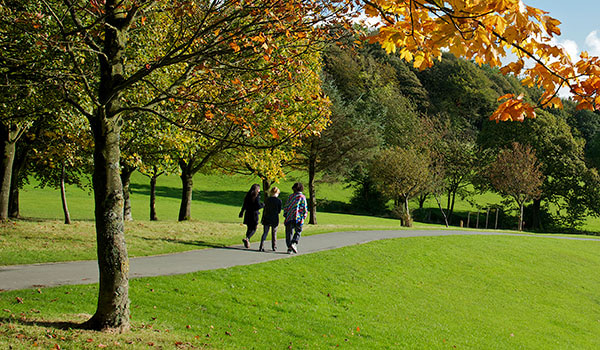
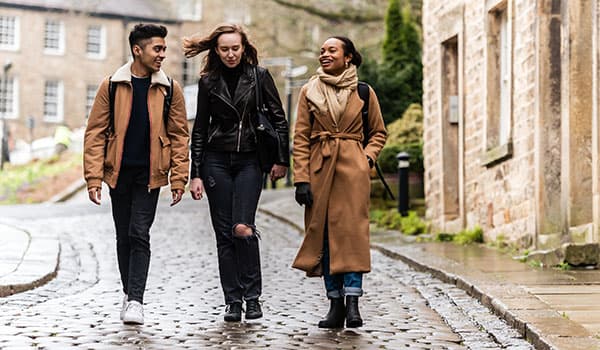
Our historic city is student-friendly and home to a diverse and welcoming community. Beyond the city you'll find a stunning coastline and the world-famous English Lake District.