We welcome applications from the United States of America
We've put together information and resources to guide your application journey as a student from the United States of America.
Overview
Top reasons to study with us
10
10th for Mathematics
The Times and Sunday Times Good University Guide (2026)
13
13th for Mathematics (joint - satisfied with teaching)
The Guardian University Guide (2026)
13
13th for graduate prospects: Accounting and Finance
The Times and Sunday Times Good University Guide (2026)
Financial mathematicians are interested in making good decisions in the face of uncertainty. Through our rigorous programme, you will develop the skills and knowledge to become a major decision maker and influencer in your chosen career.
Financial maths is about learning to interpret and manipulate data to draw valuable conclusions and make predictions. This is particularly important in business and finance, but the skills gained from this programme are widely applicable and highly sought after. Over the three years, you will be able to draw on expertise from three specialist departments: the School of Mathematical Sciences; Accounting and Finance; and Economics.
During your first year, you will build on your previous knowledge and understanding of mathematical methods and concepts. Modules cover a wide range of topics from calculus, probability and statistics to logic, proofs and theorems. As well as developing your technical knowledge and mathematical skills, you will also enhance your data analysis, problem-solving and quantitative reasoning skills. During this year, you will also receive an introduction to accounting and finance, which will provide you with a comprehensive understanding of the concepts and techniques of the discipline, including financial accounting, managerial finance, and financial statement analysis.
In the second year, you will further develop your knowledge in analysis, probability and statistics. During this year, you will also begin to explore advanced finance and will benefit from modules in economics at managerial level. These will provide you with insight into micro and macroeconomics, and their related issues. You will develop real-world knowledge and experience by applying your analytical skills, interpreting events and evaluating policies. This will be instrumental in developing a career related to banking, finance, international payments and exchange rates, and monetary policy.
During your third year, you will delve deeper into the theory of probability and will explore the concept of statistical inference. Alongside this, you will gain valuable industry and employability skills through a dedicated careers-focused module. This final year will also be highly customisable, allowing you to select from a range of modules to suit your own interests and career aspirations.
The Institute of Mathematics and its Applications is a chartered professional body for mathematicians in the UK. Accreditation means that our degrees demonstrate both a high level of competency and professionalism in the area of mathematics.
Financial maths graduates are very versatile, having in-depth specialist knowledge and a wealth of skills. Through this degree, you will graduate with a comprehensive skill set, including data analysis and manipulation, logical thinking, problem-solving and quantitative reasoning, as well as adept knowledge of the discipline. As a result, financial mathematicians are sought after in a range of industries. However, graduates of this programme are ideally placed to forge rewarding careers in the business and finance, and government sectors.
The starting salary for many financial maths graduate roles is highly competitive, and career options include:
Actuary
Data Analyst
Finance Manager
Financial Analyst
Insurance Underwriter
Investment Analyst
Market Researcher
Alternatively, you may wish to undertake postgraduate study at Lancaster and pursue a career in research and teaching.
Our alumni stories
Listen to our Mathematical Sciences alumni as they tell us how studying at Lancaster helped to prepare them for their future careers within mathematics.
Top 100 in the world for Accounting and Finance
Lancaster University is ranked 14th in the UK and 84th in the world for Accounting and Finance according to the QS World University Rankings by Subject 2026, one of 11 subjects at Lancaster to be featured in the top 100 in these prestigious listings.
“The best part of my experience was definitely my year abroad in La Rochelle, France. I worked as an English language assistant in 4 primary schools over 7 months. I also volunteered for ESN (Erasmus Student Network) while in La Rochelle, helping organise and manage events and trips for international students. Overall, my year abroad was such a rewarding experience, providing me with the opportunity to travel, gain work experience, develop professional skills and relationships, immerse myself in French language and culture, create lifelong friendships and grow as a person. It also enabled me to broaden my horizons when considering future career opportunities.
I would definitely recommend this course to future students – my biggest advice would be to take the opportunity to do a year abroad if you can. My time in France was truly a transformative experience that helped me to grow both personally and professionally. It pushed me outside my comfort zone, gave me lifelong memories, and was without a doubt one of the best years of my life.”
Louana Avison – BA French Studies and Mathematics (Study Abroad)
“During my studies, I have built a strong foundation in both Mathematics and Finance, which are highly valued in many career paths. This includes various probability and statistical models, along with data analysis, analytical thinking, bookkeeping and research skills.
The academic staff have been very friendly and engaging, creating a welcoming atmosphere, where students feel comfortable asking questions whenever something is unclear – whether in lectures, during office hours or via email, with responses typically being quick and helpful.
The course has been challenging, but also well-structured and designed in a way that students at every level of prior knowledge can follow it. It builds on existing knowledge while continuously developing it further as the programme progresses.
In three words, I’d sum up Mathematics with Finance as inclusive, inspiring, insightful.”
Natalia Olszewska - BSc Mathematics with Finance
A future for Mohamed
“The programme is undoubtedly challenging. However, over time I adapted by engaging more deeply with the course materials and seeking support when needed. As a result, I began to enjoy the subject much more. I have enjoyed the finance and accounting aspects of the course, as my interest in pursuing a career in finance has given me strong motivation in this area.
The academic staff have been very supportive throughout my first two years. They were especially helpful during workshops. Many lectures are interactive, which makes it easier to stay engaged and keep up with the material. My academic adviser also played an important role, offering guidance on academic decisions, including module selection for later years.
During my first year, I developed a strong foundation in both mathematics and financial accounting, which I have built on further in my second year. I have strengthened my analytical and critical thinking skills through both subjects. I have also gained an understanding of financial markets, how companies manage policies, and how capital structure impacts performance. Additionally, group work and presentations have helped me become more confident in expressing ideas and taking initiative. I believe these are valuable, transferable skills for any career path.”
Mohamed Elmaghraby - BSc Mathematics with Finance
The beauty of maths
The beauty of maths means different things to different people. Some look to the universal language mathematics provides, transcending cultures and disciplines to connect people and ideas from around the world. Others say it’s the versatility of mathematics as a foundational framework, providing logical principles which are applied to solve real-world problems.
By helping us make sense of complex patterns and relationships, mathematics offers a uniquely satisfying way to understand and navigate the beautiful, yet complex, world around us.
Our beauty of maths foundations
See the world through a unique lens
Mathematics helps you look below the surface to identify and understand the patterns, behaviours and structures shaping our lives. By stripping away the noise, we can find underlying structures, making sense of the world through analytical and logical ways of thinking. We can model and extrapolate data, helping us to make rational decisions, predict outcomes and identify order in complexity.
Open doors to career opportunities
Have you ever wondered where a degree in maths can take you? The answer is anywhere! The beauty of maths is that it opens doors to many career opportunities.
Mathematicians are found in industrial roles, research, government and charitable sectors. Studying mathematics provides you with a strong technical foundation for tackling complex challenges, developing analytical problem-solving and logical thinking skills: a unique and transferable skill set sought after by employers across a wide range of sectors.
Beauty of maths in the world around us
Aesthetic beauty can be seen in nature and the world around us. However, the real beauty emerges when you look closer at the underlying logic. Mathematics helps us make sense of the world by uncovering patterns adopted by nature, revealing order where there first appeared to be complexity. By uncovering these hidden connections, mathematics transforms the familiar into something extraordinary.
Proving theories and finding certainty
Mathematics helps us discover absolute truth. The beauty of mathematics is that it can help with decision making in the face of uncertainty, navigating real world problems by applying logic. As there are still mathematical techniques waiting to be discovered, the satisfaction of finding a new path to understanding is undeniably beautiful.
Student research projects
Our students work on a number of exciting, challenging and rewarding projects throughout their time studying. From first assignments to final dissertations, student projects are an excellent way of celebrating success within a professional research-led community.
Innovative biomass pyrolysis solutions
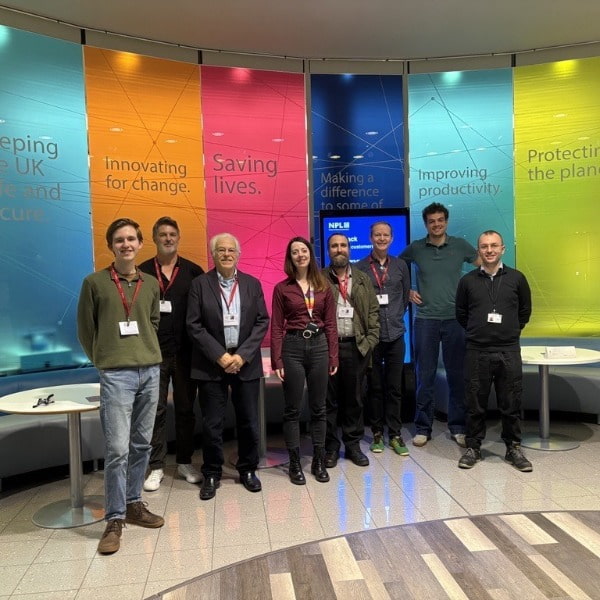
“Immediately following my graduation, I undertook a Research Associate position in the department, working with Dr Eduard Campillo-Funollet alongside the National Physical Laboratory and industry collaborator, the Imagination Factory. The project focused on developing innovative biomass pyrolysis solutions, where my role involved researching and constructing novel ODE and PDE models to simulate the reactors and optimize the process for maximum hydrogen output.
A major setback we faced was the lack of existing mathematical models for high-temperature biomass pyrolysis, as conventional low-temperature models do not account for complex chemical gas reactions. Overcoming this became our greatest milestone; by successfully incorporating mass-action kinetics into our models, we were able to accurately capture these high-temperature reactions and solve the problem.
This project significantly developed my core research, problem-solving and consultancy skills through regular engagement with external industry collaborators. Furthermore, it directly supported my publication aspirations, as we are currently in the process of writing an academic paper detailing our findings.
I have since begun my PhD in Applied Mathematics, which focuses on incorporating Geometric (Clifford) algebra into mathematical and statistical models. Moving forward, I hope to bridge my current research with this past project by modelling the full geometry of the pyrolysis reactors using Clifford algebra and neural networks for PDE modelling.
Biomass pyrolysis is a huge component of green energy, and using mathematical methods to extract high rates of hydrogen could significantly boost the supply of renewable energy from unsuspecting sources like biomass waste. Mathematicians can contribute to solving wider global issues, such as climate change, by modelling and optimizing renewable resource technologies.”
Rob Graham – MARS PhD student, MSci Mathematics graduate
Weyl relations and semigroups
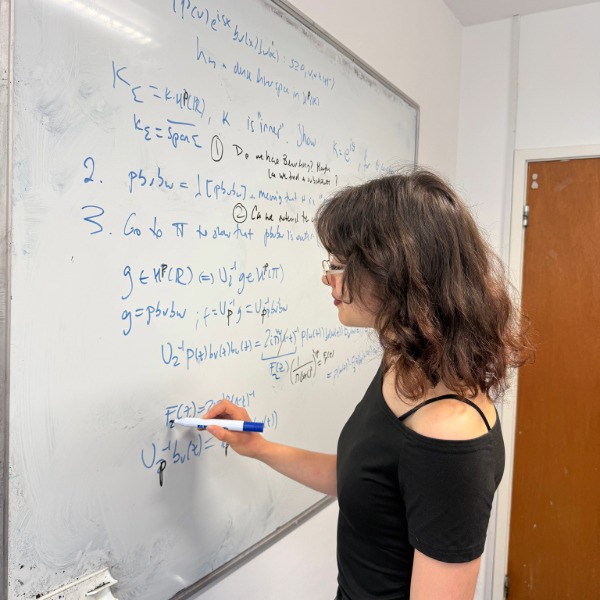
“The project focused on Weyl relations and semigroups, which are closely connected to the celebrated Stone–von Neumann theorem and recent developments in operator algebras. One of our main objectives was to study Weyl semigroups that can be represented using 2×2 upper triangular matrices.
One of the main aims of the project was to gain a deeper understanding of independent study and what working in a research-oriented environment entails – and in that respect the project exceeded my expectations!
The project has strengthened my interest in mathematical research and provided valuable experience in independent study and research-oriented problem solving. It has given me a clearer understanding of what pursuing postgraduate study or a research-related career in mathematics might involve.”
Carlota Gil Ruiz – BSc Natural Sciences student (with pathways in Maths and Physics)
Our societies
Looking to join a community of like-minded mathematicians? Look no further!
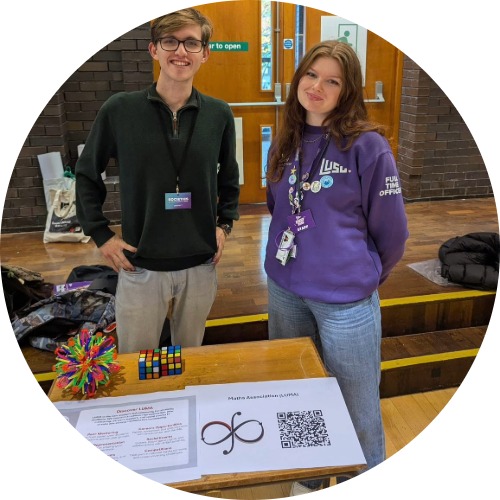
Lancaster University Mathematics Association (LUMA)
“LUMA is a community built by students for students within the School of Mathematical Sciences. We work to ensure that every maths student feels supported, connected and represented throughout their time at Lancaster. Our students organise a wide range of social, academic, and careers-focused activities throughout the year, including Welcome Week events, Maths Cafe, Logic lounge, guest speakers, careers events, competitions and collaborations with other STEM societies.
We also operate a peer mentoring scheme, where experienced students help first years settle into university maths and build confidence in their studies. Alongside this, LUMA incorporates the department's student representative system, enabling students to work closely with staff to shape and continually improve the student experience. From your first day at Lancaster through to graduation, LUMA is here to help you make the most of your time in the department.
These are the typical grades that you will need to study this course. This section will tell you whether you need qualifications in specific subjects, what our English language requirements are, and if there are any extra requirements such as attending an interview or submitting a portfolio.
Qualifications and typical requirements accordion
AAA. This should include Mathematics grade A or Further Mathematics grade A. The overall offer grades will be lowered to AAB for applicants who achieve both Mathematics and Further Mathematics at grades AB, in either order.
Considered on a case-by-case basis. Our typical entry requirement would be 45 Level 3 credits at Distinction, but you would need to have evidence that you had the equivalent of A level Mathematics grade A.
We accept the Advanced Skills Baccalaureate Wales in place of one A level, or equivalent qualification, as long as any subject requirements are met.
DDD considered alongside both A level Mathematics grade A and A level Further Mathematics grade B
A level Mathematics grade A plus A level Further Mathematics grade A plus BTEC at D
36 points overall with 16 points from the best 3 HL subjects including 6 in Mathematics HL (either analysis and approaches or applications and interpretations)
We are happy to admit applicants on the basis of five Highers, but where we require a specific subject at A level, we will typically require an Advanced Higher in that subject. If you do not meet the grade requirement through Highers alone, we will consider a combination of Highers and Advanced Highers in separate subjects. Please contact the Admissions team for more information.
Only considered alongside A level Mathematics grade A
Help from our Admissions team
If you are thinking of applying to Lancaster and you would like to ask us a question, complete our enquiry form and one of the team will get back to you.
Delivered in partnership with Lancaster University International Study Centre, our one-year tailored foundation pathways are designed to improve your subject knowledge and English language skills to the level required by a range of Lancaster University degrees. Visit the Lancaster University International Study Centre for more details and a list of eligible degrees you can progress onto.
Contextual admissions
Contextual admissions could help you gain a place at university if you have faced additional challenges during your education which might have impacted your results. Visit our contextual admissions page to find out about how this works and whether you could be eligible.
Course structure
We continually review and enhance our curriculum to ensure we are delivering the best possible learning experience, and to make sure that the subject knowledge and transferable skills you develop will prepare you for your future. The University will make every reasonable effort to offer programmes and modules as advertised. In some cases, changes may be necessary and may result in new modules or some modules and combinations being unavailable, for example as a result of student feedback, timetabling, Professional Statutory and Regulatory Bodies' (PSRB) requirements, staff changes and new research. Where the course offers optional modules, they may not all be available every year.
This introductory module is your gateway to mastering three essential areas in business: financial accounting, management accounting, and managerial finance
In financial accounting, you will learn to craft and understand how to prepare financial statements for external stakeholders such as investors, creditors and regulators.
In management accounting, you will explore the preparation of financial information for reporting to internal stakeholders such as managers or executives and discover how tailored financial information is used to inform managers’ and executives’ planning, decision-making and control of business activities.
In the area of finance, you will study financial markets and the process of managing money, investments and other financial resources. You will also learn how firms budget, borrow and invest for the future.
By the end of this module, you will have the knowledge and skills needed to navigate these critical areas with confidence.
At university, emphasis is placed on understanding general mathematical theorems. They apply in many different cases, and understanding why a result is true enables us to creatively use the underlying ideas to tackle new problems.
Study the language and structure of mathematical proofs, illustrated by results from number theory. You will see the concept of congruence of integers, which is a simplified form of arithmetic where seemingly impossible problems become solvable. In relation, you’ll encounter the abstract idea of an equivalence relation.
Sets and functions form the basic language of mathematics. You will study functions of a real variable and abstract functions between arbitrary sets, and you will explore how to count sets, both finite combinatorial arrangements and infinite sets.
You will survey the language of networks, studying relations and how to model real-world events. Throughout the module you will practise writing concise and rigorous mathematical arguments.
A mathematical model is a representation of a real-world event, such as a building vibrating during an earthquake or the spread of a disease within a population. In this module, you will investigate mathematical models that lead to ordinary differential equations and will study a variety of core analytical methods for solving them, such as integrating factors and separation of variables.
You will learn to develop models by extracting important information from real-world scenarios, which can then be analysed and refined. Many mathematical models, including those used in artificial intelligence, cannot be solved analytically, and to deal with this you will establish and practice fundamental programming skills and concepts that will be used in future modules. You will also learn to apply one of the most fundamental tools in modern AI research, the deep neural network, on real world datasets.
Interested in how mathematicians build theories from basic concepts to complex ideas, like eigenvalues and integration? Journey from polynomial operations to matrices and calculus through this module.
Starting with polynomials and mathematical induction, you will learn fundamental proof techniques. You will explore matrices, arrays of numbers encoding simultaneous linear equations, and their geometric transformations, which are essential in linear algebra. Eigenvalues and eigenvectors, which characterise these transformations, will be introduced, highlighting their role in applications including population growth and Google's page rankings.
Next, we will reintroduce you to calculus, from its invention by Newton and Leibniz, to its formalisation by Cauchy and Weierstrass. You will explore sequence convergence, techniques for evaluating limits, and key continuity tools like the intermediate value theorem. Differentiation techniques develop a geometric understanding of function graphs, leading to mastering integration methods for solving differential equations and calculating areas under curves. We conclude with a first look at vector calculus.
Modern artificial intelligence relies on multivariate calculus: every time a neural network learns, it does so by computing derivatives in high-dimensional spaces. Many real-world problems seek to understand the function of a vector, where the vector could be a position in space, a direction, or the weights of a neural network. In this module, you will explore the world of multivariate techniques and multivariate calculus, deepening your understanding of vectors, angles, curves, surfaces and volumes, multidimensional space, and alternative co-ordinate systems. You will encounter multidimensional derivatives, integrals and stationary points, and practice multidimensional analogues of techniques such as the chain rule and integration by substitution.
Throughout the module, the methods and techniques that you learn will be applied to create and solve new mathematical models for real-world problems. By the end, you will see how multivariate calculus underpins many of the techniques used in modern machine learning.
An introduction to the mathematical and computational toolsets for modelling the randomness of the world. You will learn about probability, the language used to describe random fluctuations, statistics and the mathematical techniques used to extract meaning from data. You will explore how computing tools can be used to solve challenges in scientific research, artificial intelligence, machine learning and data science.
You will develop the axiomatic theory of probability, discover the theory and uses of random variables and investigate how theory matches intuitions about the real-world. You will then dive into statistical inference, learning to select appropriate probability models to describe discrete and continuous data sets.
Learn how to implement statistical techniques to draw clear, informative conclusions. Throughout, you will learn the basics of R or Python, and their use within probability and statistics. This will equip you with the skills to deploy statistical methods on real scientific and economic data.
Core
core modules accordion
In this module, you will be introduced to essential statistical and econometric techniques for data analysis. You will learn how to model relationships between variables and make predictions using the established linear regression model framework. Additionally, you will explore discrete choice models, which are useful for decision-making scenarios with two outcomes, such as yes/no or success/failure.
You will also explore two important estimation methods: Ordinary Least Squares (OLS) and Maximum Likelihood Estimation (MLE) for estimating linear regression and discrete choice models. We will highlight the importance of statistical and diagnostic testing in the context of econometrics applications.
We will illustrate all these techniques empirically using real-word data examples and popular statistical software languages, such as Python and R. This hands-on approach will help you develop practical skills in data analysis and draw meaningful conclusions.
This module will enhance your knowledge in accounting and finance. You will first focus on financial accounting, exploring essential topics like the valuation of inventory and non-current assets such as machinery, buildings and land. This knowledge is critical for understanding financial statements. You will examine financial accounting in limited liability companies and sharpen your skills in analysing financial statements.
In terms of management accounting, you will learn techniques to take control of business costs and performance. You will master the art of costing through absorption and activity-based costing methods, and perfect your approach to budgetary control for planning and effective oversight.
In finance, you will cover key areas of financial markets, including traditional equity, bond and currency markets as well as modern development such as cryptocurrencies. You will also tackle the fascinating subjects of capital investment decision-making, risk and return, and calculating the cost of capital. These are essential tools to help businesses plan for a profitable future.
Building on your knowledge of vectors and matrices, this module explores the elegant framework of linear algebra, a powerful mathematical toolkit with remarkably diverse applications across statistical analysis, advanced algebra, graph theory, and machine learning.
You'll develop a comprehensive understanding of fundamental concepts, including vector spaces and subspaces, linear maps, linear independence, orthogonality, and the spectral decomposition theorem.
Through individual exploration, small-group collaboration, and computational exercises, you'll gain both theoretical insight and practical skills. The module emphasises how these abstract concepts translate into powerful problem-solving techniques across multiple disciplines, preparing you for advanced studies while developing your analytical reasoning abilities.
Statistics allows us to estimate trends and patterns in data and gives a principled way to quantify uncertainty in these estimates. The findings can lead to new insights and support decision-making in fields as diverse as cyber security, human behaviour, finance and economics, medicine, epidemiology, environmental sustainability and many more.
Dive into the behaviour of multivariate random variables and asymptotic probability theory, both of which are central to statistical inference. You will then be equipped to explore one of the most fundamental statistical models, the linear regression model, and learn how to apply general statistical inference techniques to multi-parameter statistical models. Statistical computing is embedded in the module, allowing you to investigate multivariate probability distributions, simulate random data, and implement statistical methods.
Optional
optional modules accordion
Never has the collection of data been more widespread than it is now. The extraction of information from massive, often complex and messy, datasets brings many challenges to fields such as statistics, mathematics and computing.
Develop the skills and understanding to apply modern statistical and data-science tools to gain insight from contemporary data sets. By addressing challenges from a variety of applications, such as social science, public health, industry and environmental science, you will learn how to perform and present an exploratory data analysis and deploy statistical approaches to analyse data and draw conclusions. You will also develop judgement to critically evaluate the appropriateness of different methods for real-world challenges.
Machine learning is at the heart of modern AI systems, and it is a fundamentally mathematical subject. You will learn this mathematics by discovering how techniques are deployed in several AI systems, including the neural networks that have revolutionised the field.
You’ll start by building connections with previously encountered approaches through the unifying concept of a loss function of a parameter vector. For example, with a neural network model the vector input is the set of weights, and the loss function might be the prediction error on a dataset.
The goal is to find a vector input that produces a small loss; in the above example, this is known as training the neural net. You will learn and deploy some of the key mathematical ideas and numerical techniques, such as back propagation and stochastic gradient descent, that enable the automated iterative learning of a good vector input.
Many of the most important real-world challenges, from predicting climate change, to modelling the spread of disease, are described by equations that cannot be solved analytically. To start, you will be introduced to techniques for tackling such problems, beginning with fundamental numerical methods, such as the trapezium rule and Euler’s method, before progressing to more advanced techniques and quantifying the accuracy, stability and limitations of these methods. Alongside numerical approaches, you will also develop heuristic methods to characterise a system's limiting behaviour.?
Other familiar phenomena, such as pulses of light down a fibre optic cable to the shudder of turbulence on a plane, involve multiple variables, such as time and position. Their mathematical description requires differentiation with respect to each of these independent variables, leading to partial differential equations (PDEs). You will learn how to formulate PDEs for complex, real-world problems and practice core techniques for solving them. By the end of the module, you will have the tools to build and analyse mathematical models that underpin emerging challenges across engineering, physics, biology and the environment.?
Core
core modules accordion
This advanced module in accounting and finance will give you the tools to navigate the complexities of modern business environments.
In financial accounting, you will explore the critical areas of disclosure and earnings management, unravelling how these practices shape perceptions of a company’s performance. You will also investigate the pivotal role of auditors and the importance of maintaining auditor independence in safeguarding financial integrity.
In management accounting we will focus on strategic management accounting, where you will learn how to align accounting strategies with broader business goals. You will also examine the recent developments in value creation, discovering how organisations generate and sustain competitive advantages.
Finally, in finance, we will delve deeper into various aspects of financial markets, as well as on capital structure and payout policy, key factors that influence how businesses fund their operations and distribute profits to shareholders.
Stochastic processes are fundamental to probability theory and statistics and appear in many places in both theory and practice. For example, they are used in finance to model stock prices and interest rates, in biology to model population dynamics and the spread of disease, and in physics to describe the motion of particles.
During this module, you will focus on the most basic stochastic processes and how they can be analysed, starting with the simple random walk. Based on a model of how a gambler's fortune changes over time, it questions whether there are betting strategies that gamblers can use to guarantee a win. We will focus on Markov processes, which are natural generalisations of the simple random walk, and the most important class of stochastic processes. You will discover how to analyse Markov processes and how they are used to model queues and populations.
Optional
optional modules accordion
This module provides a solid foundation in banking and behavioural finance. You will explore the fundamentals of banking, including the role of financial institutions in the economy and the complexities of their business activities, such as lending and risk management.
The module highlights the role of regulation and supervision in the banking industry, highlighting how these aspects differentiate banking from other industries, and how crises reshape regulation in banking. You will be introduced to the fascinating world of behavioural finance, where you will discover how psychological factors and cognitive biases such as overconfidence, loss aversion and herding behaviour influence decision-making in financial markets.
By combining traditional banking concepts with the latest insights from behavioural finance, this module offers a unique perspective on the interplay between human behaviour and financial systems. With real-world examples, you will gain practical insights into how these concepts apply to both individual and institutional decision-making.
Understanding how data evolves over time is crucial across numerous sectors, from finance and engineering to climate science. Develop the tools to analyse temporal data, detect structural changes and build predictive models.
Using changepoint detection algorithms, you will learn how to identify abrupt changes in the mean or variance of a process, or parameters in a regression model. These methods will be introduced from a foundational perspective, developing both computational and mathematical understanding. You will then learn to handle temporal dependence by studying a popular range of time-series models, using these to generate insights about the data and produce forecasts. Throughout the module, you will learn to critically evaluate and compare models, whilst applying these techniques to real-world challenges.
Models of dynamical systems are fundamental to our understanding of the physical and natural world.
Explore a new class of model, the Markov jump process, for the time evolution of dynamical systems such as the evolution of species populations in the wild and the spread of infectious diseases. You will learn how to simulate from these processes and will study methods for understanding their properties and behaviours. Unlike deterministic differential equation models, Markov jump processes are random, allowing for different behaviour every time they are simulated. You will discover how it is often possible to associate a jump process with a related differential equation approximation and that this can provide important insights into the behaviour of the jump process and the original real-world system.
Statistical techniques are often applied to environmental data, such as air temperatures, rainfall or wildfire locations. You will learn about some of the common features of such datasets and how these features are used to design statistical models. You will first be introduced to the Gaussian process model for continuous spatial processes. You will learn about the properties of the Gaussian process and implement this model for spatial data analysis, before investigating methods for point-reference data, such as earthquake or wildfire locations.
You will also dip into natural hazard risk management, which seeks to mitigate the effects of events, such as flooding or storms, in a manner that is proportionate to the risk. You will learn basic concepts from extreme value theory, including the appropriate distributions for extremes, and how to use these as statistical models for estimating the probability of events more extreme than those in the dataset.
This module provides a solid foundation in Environmental, Social, and Governance (ESG), climate and energy finance by exploring the financial aspects of transitioning to a sustainable future. You will explore how businesses integrate ESG factors into strategy and operations, addressing investor expectations, regulatory demands, and societal pressures.
The module covers:
ESG data collection
measurement
reporting frameworks, including TCFD, GRI, and national regulations
It also examines the challenges of incorporating ESG into risk management, supply chains, and corporate performance assessments. Additionally, you will study how financial markets, investment strategies, and policy decisions align with global climate change efforts, including green bonds, climate risk assessments, and sustainable finance. The module also explores the financial aspects of both traditional and renewable energy markets.
Combining theory with practical insights, this module prepares you to navigate the growing field of sustainable finance and contribute to the transition to a low-carbon economy.
The study of graphs (mathematical objects used to model networks and pairwise relations between objects) is a cornerstone of discrete mathematics. Graphs can represent important real-world situations, and the study of algorithms for graph-theoretical problems has strong practical significance.
You will learn about structural and topological properties of graphs, including graph minors, planarity and colouring. We will introduce several theoretical tools, including matrices relating to graphs and the Tutte polynomial. We will also study fundamental algorithms for network exploration, routing and flows, with applications to the theory of connectivity and trees, considering implementation, proofs of correctness and efficiency of algorithms.
You will gain experience in following and constructing mathematical proofs, correctly and coherently using mathematical notation, and choosing and carrying out appropriate algorithms to solve problems. The module will enable you to develop an appreciation for a range of discrete mathematical techniques.
Linear systems of differential and integral equations provide a mathematical model for a wide range of real-world devices, including communication systems, 5G networks, electrical circuits, heating systems and economic processes. Mathematical analysis of these models gives insight into the behaviour of these devices, with applications in automatic control, signal processing, wireless communications and numerous other areas.
Linear systems are considered in continuous time that reduce to a standard (A,B,C,D) state space representation. Via the Laplace transform, these are reduced further to rational transfer functions. Linear algebra enables us to classify and solve (A,B,C,D) models, while we describe their properties via diagrams in standard computer software. You will consider feedback control for linear systems, describing the rational controllers that stabilise an (A,B,C,D) system. Alongside the development of analytic methods to study linear systems, you will also gain experience in modelling real-world devices by such systems.
Mathematical models are central to financial decision making. You will discover the mathematical foundations necessary to model certain transactions in the world of finance. You will then study stochastic models for financial markets and investigate the pricing of European and American options and other financial products.
You will explore two discrete models, the binomial model and the finite market model, and one continuous model. Following an introduction to some probabilistic terminology, such as sigma algebras and martingales, and some financial terminology such as arbitrage opportunities and self-financing trading strategies, you will deduce the Black Scholes formula. You will also gain a brief overview of Brownian motion.
From denoising diffusion to flow matching, modern generative models are governed by elegant mathematics: stochastic differential equations, PDEs for probability evolution and transport on spaces of measures. This module develops that mathematical toolkit and shows how it underpins today’s state-of-the-art image, audio and scientific generative models.?
We start from how probability distributions evolve over time (continuity and Fokker–Planck equations) and show how this leads to a reverse-time stochastic differential equation and an equivalent probability-flow ODE. We then look at discrete-time diffusion models and explain why their training objective is a practical stand-in for maximum likelihood estimation.
You will be introduced to score matching and denoising score matching, continuous-time formulations and the main numerical solvers (e.g. Euler–Maruyama, predictor–corrector), together with sensible choices of noise/step-size schedules. In parallel, we cover flow-based models: continuous normalising flows and flow matching, which fit a velocity field along a path between distributions, with links to optimal transport and Schrödinger bridges. We finish with fast samplers (e.g., distilled/consistency models) and with how to judge models in practice - negative log-likelihood, bits per dimension and coverage - while balancing against compute cost, stability and common failure modes.?
By the end, you will be able to read and reproduce the derivations that make these models work, implement small-scale prototypes, and reason from first principles about design choices such as noise schedules, guidance and solver accuracy.??
Optimisation is the hidden engine behind the remarkable success of modern AI. Training an AI model, whether a simple regression or a state-of-the-art Transformer architecture, ultimately boils down to minimising a loss function that encodes both the training data and the neural architecture. The optimisation algorithms that make this possible are not only efficient in practice, but also mathematically elegant and broadly applicable across science, engineering and economics.
You will develop the mathematical foundations of optimisation and see how they translate into practice. We will begin with convexity and smoothness of functions before introducing core optimisation schemes and key theoretical notions. Building on this foundation, you will study gradient descent and its many refinements, including momentum, acceleration and adaptive methods that drive modern AI training. Along the way, you will also explore duality and mirror descent, which provides rich algorithmic perspectives, and second-order methods that exploit curvature for faster convergence.
You will gain a solid mathematical understanding of optimisation algorithms and the ability to design algorithms that address real-world constraints such as limited memory, compute and scalability. These skills will prepare you to both analyse algorithms rigorously and adapt them to the practical challenges encountered in AI, data science and beyond.
Building on the statistical techniques explored so far, you deepen your understanding of both the theoretical underpinnings and practical application of frequentist statistical inference. You will then be introduced to an alternative paradigm: Bayesian statistics.
The frequentist perspective views all probabilities in terms of the proportions of outcomes over repeated experimentation and has been the foundation of hypothesis testing and experimental design over years of data-driven science and research. Meanwhile, the increasingly popular Bayesian approach arises directly from Bayes theorem, avoiding hypothetical repeated sampling. As a result, Bayesian statistics is often more intuitive and easier to communicate and naturally takes all forms of uncertainty into account.
With this in mind, you will compare and contrast these two perspectives and their associated tools. You will learn to select and justify an appropriate methodology for inference and model selection, and to reason about the uncertainty in your findings within each paradigm.
Statistics and machine learning share the goal of extracting patterns or trends from very large and complex datasets. These patterns are used to forecast or predict future behaviour or interpolate missing information. Learn about the similarities and differences between statistical inference and machine learning algorithms for supervised learning and how the two approaches can be used for classification and prediction.
You will explore the class of generalised linear models, which is one of the most frequently used classes of supervised learning model. You will learn how to implement these models, how to interpret their output and how to check whether the model is an accurate representation of your dataset. Lastly, you will have the opportunity to see how regularisation and dimension-reduction techniques can be used to apply these models to the case of the ‘large p, small n’ question. This phrase refers to datasets with many more variables than samples.
Fees and funding
Our annual tuition fee is set for a 12-month session, starting at the beginning of each academic year.
There may be extra costs related to your course for items such as books, stationery, printing, photocopying, binding and general subsistence on trips and visits. Following graduation, you may need to pay a subscription to a professional body for some chosen careers.
Specific additional costs for studying at Lancaster are listed below.
College fees
Lancaster is proud to be one of only a handful of UK universities to have a collegiate system. Every student belongs to a college, and all students pay a small college membership fee which supports the running of college events and activities. Students on some distance-learning courses are not liable to pay a college fee.
For students starting in 2026 or 2027, the fee is £40 for undergraduates and research students and £15 for students on one-year courses. Students on some distance-learning courses are not liable to pay a college fee.
Computer equipment and internet access
To support your studies, you will also require access to a computer, along with reliable internet access. You will be able to access a range of software and services from a Windows, Mac, Chromebook or Linux device. For certain degree programmes, you may need a specific device, or we may provide you with a laptop and appropriate software - details of which will be available on relevant programme pages. A dedicated IT support helpdesk is available in the event of any problems.
The University provides limited financial support to assist students who do not have the required IT equipment or broadband support in place.
Study abroad courses
In addition to travel and accommodation costs, while you are studying abroad, you will need to have a passport and, depending on the country, there may be other costs such as travel documents (e.g. visa or work permit) and any tests and vaccines that are required at the time of travel. Some countries may require proof of funds.
Placement and industry year courses
In addition to possible commuting costs during your placement, you may need to buy clothing that is suitable for your workplace and you may have accommodation costs. Depending on the employer and your job, you may have other costs such as copies of personal documents required by your employer for example.
The fee that you pay will depend on whether you are considered to be a home or international student. Read more about how we assign your fee status.
Home fees are subject to annual review, and are liable to rise each year in line with UK government policy. International fees (including EU) are reviewed annually and are not fixed for the duration of your studies. Read more about fees in subsequent years.
We will charge tuition fees to Home undergraduate students on full-year study abroad/work placements in line with the maximum amounts permitted by the Department for Education. The current maximum levels are:
Students studying abroad for a year: 15% of the standard tuition fee
Students taking a work placement for a year: 20% of the standard tuition fee
International students on full-year study abroad/work placements will also be charged in line with the maximum amounts permitted by the Department for Education. The current maximum levels are:
Students studying abroad for a year: 15% of the standard international tuition fee during the Study Abroad year
Students taking a work placement for a year: 20% of the standard international tuition fee during the Placement year
Please note that the maximum levels chargeable in future years may be subject to changes in Government policy.
Scholarships and bursaries
You will be automatically considered for our main scholarships and bursaries when you apply, so there's nothing extra that you need to do.
You may be eligible for the following funding opportunities, depending on your fee status:
Unfortunately no scholarships and bursaries match your selection, but there are more listed on scholarships and bursaries page.
Scheme
Based on
Amount
Based on {{item.eligibility_basis}}
Amount {{item.amount}}
We also have other, more specialised scholarships and bursaries - such as those for students from specific countries.
The information on this site relates primarily to the stated entry year and every effort has been taken to ensure the information is correct at the time of publication.
The University will use all reasonable effort to deliver the courses as described, but the University reserves the right to make changes to advertised courses. In exceptional circumstances that are beyond the University’s reasonable control (Force Majeure Events), we may need to amend the programmes and provision advertised. In this event, the University will take reasonable steps to minimise the disruption to your studies. If a course is withdrawn or if there are any fundamental changes to your course, we will give you reasonable notice and you will be entitled to request that you are considered for an alternative course or withdraw your application. You are advised to revisit our website for up-to-date course information before you submit your application.
More information on limits to the University’s liability can be found in our legal information.
Our Students’ Charter
We believe in the importance of a strong and productive partnership between our students and staff. In order to ensure your time at Lancaster is a positive experience we have worked with the Students’ Union to articulate this relationship and the standards to which the University and its students aspire. Find out more about our Charter and student policies.
Open days and campus tours
Visit campus and put yourself in the picture at an open day or campus tour.
Take five minutes and we'll show you what our Top 10 UK university has to offer, from beautiful green campus to colleges, teaching and sports facilities.
Most first-year undergraduate students choose to live on campus, where you’ll find award-winning accommodation to suit different preferences and budgets.
Our historic city is student-friendly and home to a diverse and welcoming community. Beyond the city you'll find a stunning coastline and the world-famous English Lake District.



.jpeg)