The technologies of tomorrow will be rooted in our understanding of the physical laws of the universe. Breakthroughs made by theoretical physicists have led to nano materials, solar cells, wireless technologies, and diagnostic imaging. This combined degree gives you an understanding of the mathematical foundations of physics, for example, you will learn how quantum mechanics is underpinned by the powerful mathematical concept of a Hilbert space. As a graduate you will be uniquely equipped with an understanding of physics that sets you up for an exciting, multi-disciplinary future. You could be working on cutting-edge technologies, modelling climate change, or even bringing your advanced mathematical skills to complex issues at the heart of the economy.
Build a degree around two passions
With our five-year MSci Hons Theoretical Physics with Mathematics (Placement Year) degree you get the benefit of not one, but two departments where excellence in teaching and research is at the core of what you learn. Taught alongside the School of Mathematical Sciences, your maths foundations are laid down early in the degree, while in the latter parts, the focus shifts to applications of theoretical physics.
What to expect
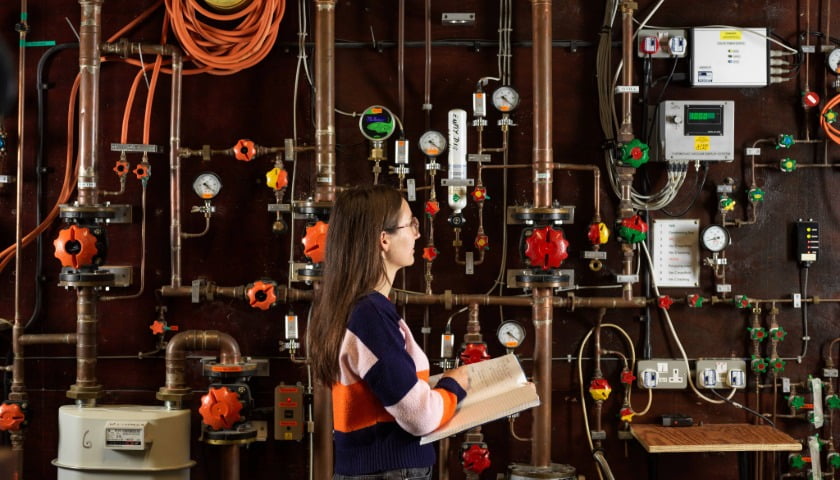
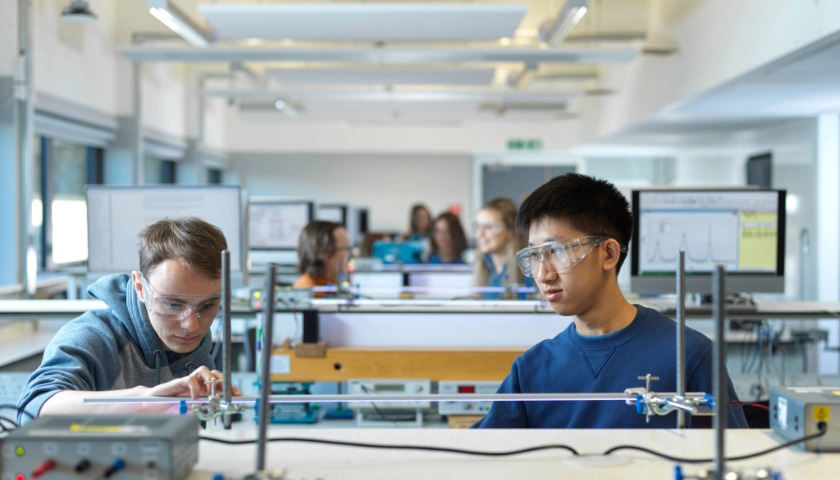
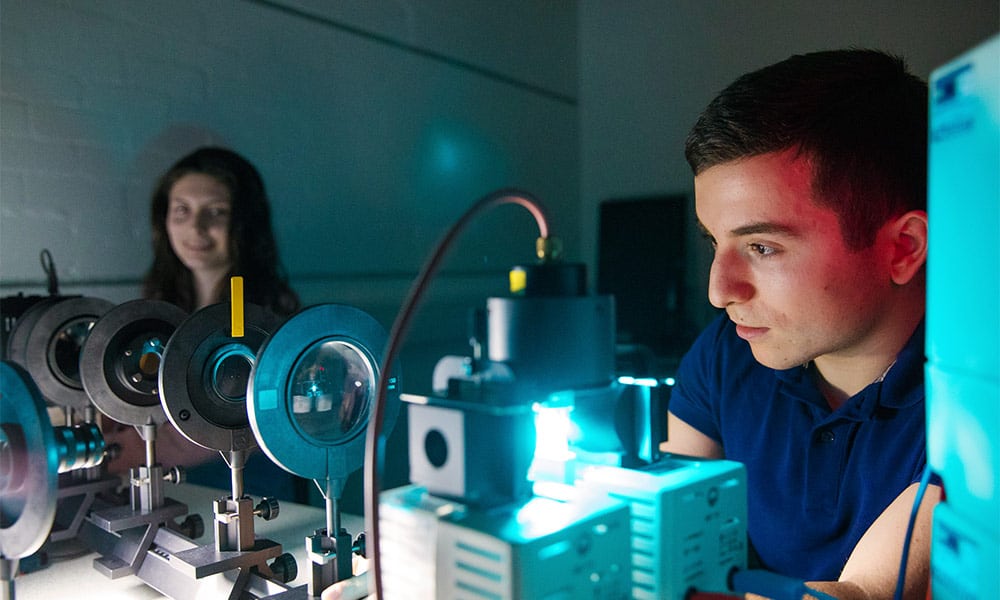
In the first year, core content will be shared between physics and mathematics covering topics such as quantum mechanics, electromagnetism, group theory and vector calculus. The physics content increases in each subsequent year where you will study topics like solid state physics, ladder operators and variational techniques, complemented by topics from mathematics such as real analysis and linear and abstract algebra. It’s so much more than lectures and workshops; you’ll also spend time gaining hands on experience with experimental physics in our state-of-the-art labs.
Your placement
In Year 4, you will undertake a placement that will enable you to apply the knowledge and skills learnt so far and gain invaluable experience that will then inform your studies in Year 5 and your career beyond.
Although it’s up to you to find your placement, we will support you all the way. Our Careers Service will provide guidance on CVs, applications, interview techniques and creating a digital profile.
Research and group projects
An important and exciting part of your degree is the opportunity to take part in a group project where you can choose a theoretical physics project working alongside one of our expert researchers.
Here are some examples of recent projects:
Theoretical Physics Group Project
- Simulations of quantum computers including quantum game theory
- Cellular automata simulations of disease or fire spreading
- Machine learning applied to real world data
Master’s-level training
You can advance your degree in Year 5 by studying Master’s modules and conducting a significant, individually supervised research project. This is a great opportunity to build your CV and is a gateway to future research opportunities too.
Examples of recent final year projects include:
- The inverse scattering transform and non-linear evolution equations
- Divisibility and dilations of quantum channels
- Many-body quantum chaos, symmetries, and space-time duality
- Neural network wave functions for quantum Monte Carlo calculations
Personal development
You will develop valuable transferable skills that make you highly desirable to future employers. Through working in collaboration, delivering presentations, communicating your research results, using modern computer programs and taking part in experiments, you will grow skills in analytical thinking, logic, reasoning, communication and digital proficiency. With a year’s experience added to your CV, you will be a standout graduate.
Before graduation, you will have the fantastic opportunity to showcase your transferable skills toolkit at the Physics at Lancaster Annual Conference and Exhibition (PLACE).
3 things our theoretical physics with mathematics students would like you to know:
- It’s a fun and challenging combination of subjects. We get to apply our mathematical brains to theoretical physics questions that need disentangling before heading to the lab to test our models and predictions
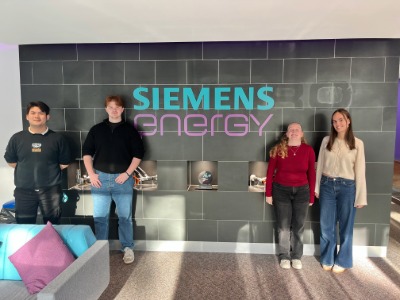
- We have great physics-based study and social spaces which are perfect for group work or downtime between lectures. You’ll find us hanging out in the atrium where we work on physics related problems or playing games!
- There are plenty of doors to knock on whenever you need support. You’ll also have a dedicated academic advisor to support your studies