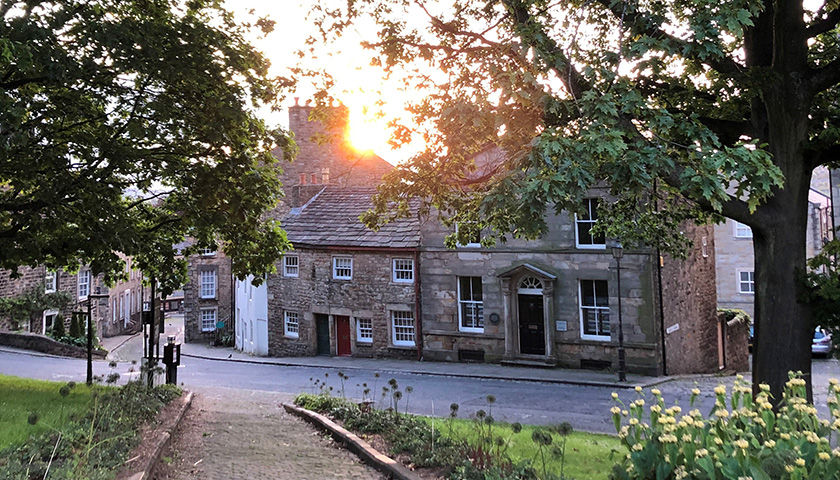
We welcome applications from the United States of America
We've put together information and resources to guide your application journey as a student from the United States of America.
Overview
Top reasons to study with us
Apply Philosophy to the challenges of today's world
Top 15 for Teaching Quality (Philosophy)
The Guardian University Guide (2027)
Expand your experience with an internship
Our Linguistics and Philosophy degree at Lancaster offers a compelling opportunity to delve into the intricate relationship between language and philosophical principles from around the globe. You will be taught by world-leading experts and will explore how language and philosophy impact human experience in real-world contexts.
In Linguistics you’ll address the most important topics in linguistic research using the very latest tools and techniques. You’ll investigate the link between language and thought, how language is used to spread disinformation online, and how language intersects with psychology and forensic investigations.
In Philosophy you will engage with fundamental questions about human existence. By applying philosophy in real-world scenarios, you will understand its role in addressing global, social and political challenges.
Why study Linguistics and Philosophy at Lancaster?
Study with the best. Linguistics at Lancaster is ranked 2nd in the world by QS 2026
Engage in philosophy as an active practice, learning from philosophers who are involved in developing the research, ideas, and theory you will study
Explore core areas of linguistic theory such as phonetics, phonology, grammar and pragmatics
Study a curriculum that draws upon multiple philosophical traditions including, western, Chinese, continental and feminist thought
What aspects of Linguistics does the course cover?
Language is central to human behaviour, societies and cultures. In Linguistics you’ll address fundamental questions concerning the nature of language. You’ll gain a comprehensive grounding in areas such as phonetics, grammar, semantics and pragmatics before applying this knowledge to understand language use across a range of real-world contexts. Guided by our supportive and welcoming staff, you might explore a range of topics ranging from politics, law, media, medicine and technology. You’ll explore questions such as:
Where does language come from and what is it made of?
How is language represented in the mind/brain and how is it related to culture and society?
How do the world’s languages vary and how does the language you speak shape your experiences?
How is language learned and how can it be impaired?
How can technology be harnessed to study patterns in the way language is used and changes?
Through such explorations, you’ll learn to ask critical questions about the language around you and gain skills required by a range of employers.
What will I study in Philosophy?
In your Philosophy studies at Lancaster, you will gain strong foundational knowledge, building confidence in key areas of the discipline, before going on to examine specialist topics of particular relevance to your interests, and to your joint honours programme.
From core study in epistemology, metaphysics and history of philosophy to optional study in ethics, political philosophy, philosophy of science and more, you will leave your degree with a deeper understanding of multiple philosophical traditions, themes and topics, and their relevance to important historical and contemporary challenges. You will have developed the critical thinking, reasoning and communication skills essential to engaging in, understanding and influencing the contemporary world.
As a Linguistics and Philosophy student, you will study philosophy in your second year that will directly enrich and draw on your study of Linguistics. Examining debates in language, communication and knowledge, you will consider the social aspects of our collective discourse and gain a deeper appreciation of the connections between the two subjects of your degree.
Alongside this, you’ll benefit from our specialist, cutting-edge research in applied and theoretical philosophy through your choice of topics in each year of study, ranging from philosophy and popular culture, to the philosophy of global crises. Through multiple traditions and perspectives you will develop your critical reasoning skills and discover philosophy’s relevance to social and political life in a globally connected world.
As a final year student, you will have the opportunity to carry out independent research to produce a portfolio of work in an area of philosophy that interests you; to write a dissertation, or to work with philosophers at Lancaster on research-led close study of philosophical texts and the questions that comprise their own live philosophical projects.
Through this, and through participation in a broad range of assessments, including podcasts, policy briefings, public philosophy and more traditional essay-based coursework and exams, you will develop and showcase your reasoning and critical thinking skills, your communicative abilities and your experience of deploying these skills and abilities - valuable attributes that will open up a wide range of career prospects.
Download the course booklet to find out more about Lancaster University, how we teach Linguistics and English Language, and what you'll study as a Linguistics and English Language student.
Linguistics and English Language at Lancaster University
“The sorts of things that you learn about can change your whole world view”. Hear from students and teaching staff on what it’s like to study Linguistics and English Language at Lancaster University.
Forthcoming webinars for prospective students
Sorry, we looked but there are no events currently scheduled in this area.
Get to know some members of our staff. In the videos they give brief insights into their research interests and teaching.
Sam Kirkham
Dr Sam Kirkham discusses articulatory phonetics, demonstrating how ultrasound technology allows us to observe the dance of the tongue during speech production.
Elena Semino
Professor Elena Semino discusses stylistics, highlighting how linguistic analysis helps us to understand the way poems or novels work in arousing feelings or transporting us to another world.
Claire Nance
Professor Claire Nance discusses sounds of the world’s languages using ‘r’ as an example, which articulatorily complex and varies in its articulation across different languages.
Chris Hart
Professor Christopher Hart discusses linguistic relativity and the language of Tzeltal, which describes object locations as uphill, downhill or across the hill rather than using words for left and right.
George Brown
Dr George Brown discusses computational linguistics and its contributions to speech technology including text-to-speech conversion and AI.
Silke Brandt
Dr Silke Brandt discusses child language acquisition and the question of how much innate knowledge children bring to the task and how much they learn from the linguistic environment.
Claire Hardaker
Dr Claire Hardaker discusses forensic linguistics and the different tasks that forensics linguists perform for the police, including authorship analysis and profiling.
Your year abroad
Study abroad
The study abroad option is an exciting opportunity for anyone who is thinking of working abroad during their career or who simply wants the experience of living and studying overseas as part of their degree.
Often study abroad students describe the year abroad as a “transformative experience”, as it can shape your future career path as well as having a positive impact on your personal development.
On a study abroad course, you'll spend two years at Lancaster before going overseas in your third year to study at one of our international partner universities. This will help you to
develop your global outlook
expand your professional network
increase your cultural awareness
develop your personal skills.
You’ll return to Lancaster for your final year of study in year four.
Host universities
During your year abroad, you will choose specialist modules relating to your degree and potentially other modules offered by the host university that are specialisms of that university and country.
The places available at our overseas partners vary every year. In previous years destinations for students in the Faculty have included Australia, United States, Canada, Europe and Asia.
Alternative option
We will make reasonable endeavours to place students at an approved overseas partner university that offers appropriate modules. Occasionally places overseas may not be available for all students who want to study abroad or the place at the partner university may be withdrawn if core modules are unavailable.
If you are not offered a place to study overseas, you will be able to transfer to the equivalent standard 3-year degree scheme and would complete your studies at Lancaster. Lancaster University cannot accept responsibility for any financial aspects of the year abroad.
Careers
What careers can I pursue with a degree in Linguistics and Philosophy?
Your course gives you access to career paths across a range of industries.
Employers seek individuals with the mental agility and critical thinking skills to tackle and solve complex and novel challenges. They look for independence of mind, and the ability to communicate clearly at all levels. Philosophy at Lancaster develops all of these skills, preparing you for success in a senior position in a wide variety of employment sectors.
On the course you may further enhance your skills through a live research project or volunteering opportunities. You are also invited to apply for one of our paid research internships, where you will work alongside an academic member of staff on an active research project.
As a linguist in an increasingly digital world there are work opportunities in developing chatbots, improving the quality of AI-generated voices and understanding how humans interact with technology. With a grounding in the fundamentals of language, you could be a part of these exciting innovations.
Our graduates go on to a variety of careers such as:
Speech and language therapists
Marketing professionals
Researchers
Journalists
Project managers
Policy analysts
Public relations specialists
Teachers of higher education
Publishing specialists
This course also provides a strong foundation for further study, with some students going on to take a master's degree.
What careers and employability support does Lancaster offer?
Our degrees open up an extremely wide array of career pathways in businesses and organisations, large and small, in the UK and overseas.
We run a paid internship scheme specifically for our arts, humanities and social sciences students, supported by a specialist Employability Team. The team offer individual consultations and tailored application guidance, as well as careers events, development opportunities, and resources.
Whether you have a clear idea of your potential career path or need some help considering the options, our friendly team is on hand.
Lancaster is unique in that every student is eligible to participate in The Lancaster Award which recognises activities such as work experience, community engagement or volunteering and social development. A valuable addition to your CV!
Find out more about Lancaster’s careers events, extensive resources and personal support for Careers and Employability.
Entry requirements
These are the typical grades that you will need to study this course. This section will tell you whether you need qualifications in specific subjects, what our English language requirements are, and if there are any extra requirements such as attending an interview or submitting a portfolio.
Qualifications and typical requirements accordion
AAB
36 Level 3 credits at Distinction plus 9 Level 3 credits at Merit
We accept the Advanced Skills Baccalaureate Wales in place of one A level, or equivalent qualification, as long as any subject requirements are met.
DDD
A level at grade B plus BTEC(s) at DD, or A levels at grade AB plus BTEC at D
35 points overall with 16 points from the best 3 HL subjects
We are happy to admit applicants on the basis of five Highers, but where we require a specific subject at A level, we will typically require an Advanced Higher in that subject. If you do not meet the grade requirement through Highers alone, we will consider a combination of Highers and Advanced Highers in separate subjects. Please contact the Admissions team for more information.
Distinction overall
Help from our Admissions team
If you are thinking of applying to Lancaster and you would like to ask us a question, complete our enquiry form and one of the team will get back to you.
Delivered in partnership with Lancaster University International Study Centre, our one-year tailored foundation pathways are designed to improve your subject knowledge and English language skills to the level required by a range of Lancaster University degrees. Visit the Lancaster University International Study Centre for more details and a list of eligible degrees you can progress onto.
Contextual admissions
Contextual admissions could help you gain a place at university if you have faced additional challenges during your education which might have impacted your results. Visit our contextual admissions page to find out about how this works and whether you could be eligible.
Course structure
We continually review and enhance our curriculum to ensure we are delivering the best possible learning experience, and to make sure that the subject knowledge and transferable skills you develop will prepare you for your future. The University will make every reasonable effort to offer programmes and modules as advertised. In some cases, changes may be necessary and may result in new modules or some modules and combinations being unavailable, for example as a result of student feedback, timetabling, Professional Statutory and Regulatory Bodies' (PSRB) requirements, staff changes and new research. Where the course offers optional modules, they may not all be available every year.
In order to ask questions about the way language works in society, how it connects with the mind/brain or how it is acquired by computers, you first need to know something about the foundational elements of language. This module will introduce you to the building blocks of human language.
You will learn about sounds in language, how they are pronounced and how they can be combined to form words. We will teach you about the way words themselves are structured. You’ll also explore how language puts words together to build sentences of different types and how sentences express meaning, in isolation and in context.
By the end of the module, you will be familiar with the essentials of phonetics, phonology, morphology, syntax, semantics and pragmatics. This knowledge will enable you to study those areas in more detail, as well as other areas of linguistics or English language studies which build on them.
Language is intimately connected with both mind and society. Learn about the relationship between language and the mind as you explore questions central to linguistics such as: how does a child acquire their first language? To what extent does the language we speak influence the way we think? And what effect can brain damage have on language?
You will also examine the different ways in which language intersects with society, with an introduction to the foundations of sociolinguistics and discourse analysis. You’ll also explore how communication works across different cultures and how language planning and policies can shape the world.
As the module progresses, you will investigate the way mind and society are bridged by language. Discover the link between them by studying how language has evolved in the human species and how multiple languages can coexist in both individual minds and among communities.
Introducing you to the fundamentals of collecting and analysing linguistic data as well as important areas where those methods are put into practice, this module will prepare you for further, more specialised studies in linguistics.
You will explore the diverse nature of linguistic data and how the different types of data we gather, e.g. from experiments or interviews, cannot be analysed the same way. You will also learn about the different places linguistic data is gathered from, including historical sources or records of language used in a legal or healthcare context, to name just a few.
Throughout the module, you'll learn about both qualitative and quantitative tools used in linguistic research. For example, you’ll discover how corpus linguistics helps uncover patterns in large datasets. You’ll also learn how to reconstruct the undocumented ancestors of modern languages. And in addition, you'll discover how linguistics is applied in areas such as computer science, forensic science, and in the creation of artificial languages.
From questions about truth, justice, and knowledge to debates over freedom, power, and human purpose - how has philosophical inquiry shaped cultural, political, and scientific life across centuries?
In this module you will explore the major ideas and traditions that have guided the development of Western thought. Specific thinkers examined will vary from year to year, but they will include philosophers whose ideas have helped shape philosophical viewpoints, categories and boundaries in the western philosophical tradition. You will be encouraged to think about the problems and limitations of different thinkers’ approaches, and their impact on the way we practice and understand the boundaries and scope of philosophy today, asking questions of them such as:
How did these thinkers conceive of philosophy and its task?
How did they conceive of being and reality?
How did they understand truth and how did they think it could be discovered?
How did they set the agenda for philosophical debates in the West from the past to the present?
By the end of this module, you will have learnt to think with, rather than about some of these influential thinkers, while reflecting on how the concepts that forged the past continue to frame the challenges of our present and the possibilities of our future.
What is real, how can we know, and how can we check our reasoning? In this module you will study philosophical tools for reasoning and arguing (critical thinking) and discover fundamental philosophical questions about knowledge (epistemology) and the nature of reality (metaphysics).
In studying critical thinking, you will learn methods of constructing and analysing arguments and acquire basic logical terminology.
In exploring epistemology, you’ll discuss questions such as: what exactly is it to ‘know’ something? Can we know anything at all? Are there alternative knowledges?
In metaphysics, you will consider questions such as: what is the fundamental nature of reality? How are we to understand cause and effect, necessity and contingency, time and space, personal identity?
You will gain the means to think about some of the deepest and broadest philosophical questions we can ask. And you will be equipped with critical thinking tools to face the contemporary challenges of a globally connected world.
Optional
optional modules accordion
How should you live? Who should you be? What should you value? What is value? And on what basis can anyone make such claims?
This module introduces you to philosophical ethics, the systematic theoretical study of these questions. You will develop both your philosophical skills, and a map of the landscape of philosophical ethics by practicing critical reading and discussion and writing about questions relating to a range of topics.
Topics may include:
Major ethical theories such as utilitarianism, deontology, contractarianism, or virtue ethics
Global moral dilemmas relating to areas such as the environment, medicine, poverty, or technology
Goodness and rightness
Personhood and selfhood
Practical reasoning and moral psychology
The best kind of life to live
The objectivity or subjectivity of morality
By studying philosophical ethics, you will gain an invaluable set of philosophical skills and ideas while reflecting on how ethical choices – both small and large – affect our relationships, our societies, and our shared futures.
Explore philosophical traditions not usually studied in standard histories of philosophy, and understand what we gain by including them in our interpretation of the history of philosophy.
By engaging with understudied texts and contexts in this module, you will learn to question familiar narratives about philosophical history and to reconstruct alternative lineages and conceptual resources. And by comparing various traditions, you will develop tools to think across boundaries and to put diverse voices into conversation, comparison, and contrast.
You will study at least two philosophical traditions in depth, in dialogue, and in their historical, cultural, and intellectual contexts. The specific traditions covered in the module will vary each year, but may include:
Chinese philosophy
African philosophy
Feminist thought
Women philosophers from specific time periods and locales, such as the Victorian era
Continental European philosophy
Any other tradition that has been historically marginalised in traditional histories of philosophy
You will look at how these different traditions approach a variety of topics, which may include personhood, knowledge and truth, value, morality, and politics, and you will consider how these traditions resist exclusion and broaden our understanding of philosophy and its possibilities past, present, and future.
By the end of this module you will have knowledge of a broader philosophical landscape, and be able to think critically about practices of inclusion and exclusion within philosophical thinking – both as it has been practised in the past, and how it might be practised in the future.
Political philosophy explores how best to arrange our collective life - through our political institutions, social practices and shared values, and through the economic, private and public structures that support them.
In this module you will consider critical debates that both historical and contemporary communities have faced about the boundaries, rights and duties of the state, community and individual citizens, through consideration of core concepts and values in political philosophy, such as justice, freedom, and equality.
You will examine central questions about the justification of power and the rights and duties of people within political communities. And you will apply these foundational positions to critical contemporary debates, looking at topics such as:
Global and local inequality and poverty
Migration and control of state borders
Political protest and resistance
Gender and racial justice
You will leave this module with a deeper understanding of some of the normative questions raised by our collective life, and with tools and ideas to help you reason and act as a global and local citizen, in shaping the outcomes and outlook of our social world.
Core
core modules accordion
Critically engage with questions and debates about our socially connected lives and the ways in which we interact and act on the world through language and communication, individually and as a society, to shape knowledge and reality. In this module you will gain the skills and insight to ask questions which change each year but may include:
How does communication work in our individual and collective lives?
How might certain kinds of communication bring about ethical and political change (for example, by making something permissible or changing the boundaries of acceptable political discourse)?
Are lying and other kinds of deception permissible, and if so, when and for whom?
What does freedom of speech really mean, and how might duties and rights differ in this space for citizens, for the press, for politicians, for academics, and on social media?
How can collective knowledge practices exclude or harm, do we have duties to address these problems, and what might work to do so?
What is the nature and appropriate regulation of propaganda and hate speech?
What are the ways in which patterns of attention and exclusion or inclusion in who we listen to and develop knowledge with may have ethical and political implications?
What communicative protest and speech acts are legitimate in a democratic state?
You will leave this module with a better understanding of how practices of knowledge creation and participation, and of language and communication, may actively shape and determine the boundaries of our world, and with the skills to critically examine these forces in action across the media, social media, politics and society.
Understand the human ability to produce and organise the smallest building blocks of language as you study the fundamental principles of spoken communication. From the movements used to express speech and the properties of sound travelling through the air to how sounds are processed in the brain, this module investigates how language is spoken.
You will learn to describe and produce sounds of speech from around the world and to use and critique models such as the International Phonetic Alphabet. You will explore the whole range of human vocal skills – such as clicks in isiXhosa – and discover how humans have adapted language to communicate across long distances – as in whistled languages. You will also study phonology and units of communication in sign languages, which challenge foundational principles of linguistics.
By the end of this module, you will have the knowledge and skills that are essential for work as a speech therapist, teacher or audiologist. You will also acquire transferable skills relevant for careers in speech technology and analytics.
What do the world’s languages have in common and what sets them apart from each other? In this module, you’ll explore this fundamental question in linguistics and grammar and be introduced to the field of linguistic typology, which aims to describe and explain the (dis)similarities between languages around the world.
Through hands-on exercises, you will develop the skills needed to analyse unknown languages and come to see familiar concepts such as 'subject’ and ‘passive’ in a new light. You will also learn about new phenomena, such as ‘antipassives’ and ‘tripartite alignment’.
Focussing on much more than just grammatical analysis, this module will help you understand why languages work the way they do. You will find that the answers lie in the nature of communication, in the way humans think about reality and more. By the end of the module, even your own language(s) will no longer feel as ‘normal’ as before.
Optional
optional modules accordion
Explore how philosophical thinking can tackle real-world problems, from personal dilemmas to global challenges, by linking abstract ideas to concrete decisions.
In this module you will engage with an applied philosophical challenge, using your philosophical skills to provide compelling reasons in favour of your solution. Through production of a short podcast or in-person presentation, you will also develop your ability to engage in philosophical argumentation beyond the written word. And along the way, you’ll gain the tools to think clearly, act responsibly, and engage thoughtfully with the complex world around you.
Specific topics studied each year draw on Lancaster’s wide range of applied expertise and may include:
Ethics and regulation in traditional and social media, in the era of mass global communication and impact
Bioethical topics such as euthanasia, rationing, ageism, research ethics and public health ethics
Health and illness, the concept of mental health, and the role of lay or patient knowledge versus medical expertise
Ethics in professional and organisational life, including divisions of roles, decent work, unpaid and care work, the rights and duties of corporations and employers and codes of ethics
Study of different scientific methods and their limitations
Throughout this module you will learn about topics in applied philosophy, while developing and practicing some of the many transferable skills that Philosophy graduates bring to a wide range of professional roles, such as critical problem solving, political and ethical reasoning, the clear identification of problems, and the art of communicating potential solutions to diverse audiences.
Discover language in relation to Artificial Intelligence and other technology. In this module, you will learn about the ideas that power language-related technologies such as:
Translation technologies
Speech recognition systems
Generative AI and much more
You'll think creatively about how these technologies could be used in new ways. You’ll also tune in to important discussions around ethics and responsible tech development.
Without the need for prior programming experience, this module will set you up with technical skills including coding and script writing. These skills will help you test how different language technologies work with both written and spoken language, whilst setting you up for a future career in computational linguistics.
In the nineteenth and twentieth centuries, a new approach to philosophy began to emerge that questioned and interrogated the inherited western philosophical tradition from Plato to Kant. This new approach was later described as ‘continental’ philosophy.
In this module, you will discover some of the key thinkers from this continental tradition of philosophy. The particular philosophers will vary from year to year, but will include pioneering thinkers who have been particularly influential on later continental philosophers (for example, Hegel, Kierkegaard, Nietzsche and Wittgenstein) as well as more recent continental thinkers themselves (for example, Lyotard, Derrida, Levinas, Badiou, Žižek, Foucault, Arendt and Beauvoir). While engaging with their thoughts, we will consider difficult and enduring questions such as:
What is the relationship between history and truth?
How does subjective experience relate to universal truth?
What is the significance of gender and embodiment in philosophical reflection?
What is the role of language and discourse in philosophical claims?
How might we conceive of the relationship between power and freedom?
On completion of this module, you will be able to understand and interpret the central arguments made by these thinkers and to assess their distinctive claims, methods and approaches and their continuing significance for philosophy and for how we ought to structure our societies and lives.
In an era shaped by data and revolutionary technologies, understanding how language reflects and creates societal trends is extremely important. This module introduces corpus linguistics as a powerful way of analysing vast amounts of language data to uncover meaningful patterns.
You will experience a hands-on introduction to language analysis using specialised computer software, suitable for students with no prior experience. You’ll learn the fundamentals of corpus linguistics, including essential tools and statistical techniques for robust social science research. You will also explore how large-scale language data can uncover insights into communication patterns and cultural trends. Applying these skills to real-world challenges, you will address topics such as social inequality and healthcare and explore areas such as language learning and politeness strategies.
Emphasising practical learning through real-world case studies and hands-on tasks working with authentic language data, this module will help you develop analytical skills that are highly sought after in the private and public sector.
Explore how language is used to interact with others, form social groups and shape society. In this module, you will examine how communication functions socially, from the persuasive language used by politicians and advertisers to the way social organisation is reflected in and reinforced through casual conversations among friends.
You’ll draw on different models in linguistics to explore the way language is used and organised to achieve social goals. This includes:
Using principles of systemic functional grammar to identify who is represented in texts and how,
Conversation analysis to uncover the structure and management of conversation
Methods of visual analysis to consider non-linguistic meanings
By the end of this module, you will become more confident in analysing texts and understanding their functions. You will see everyday texts, such as a phone call with a family member or a letter from your GP, in different light because you will understand the features and structures of language that help to organise society.
As children learn language, they produce creative utterances. They say things like ‘we goed to the zoo’. They understand sentences they have never heard before, such as ‘the bunny is meeking the mouse’. Remarkably, they will eventually learn to say ‘we went to the zoo’ without any explicit language lessons. They will also acquire additional languages in their home and communities with ease. In this module, you will explore these incredible abilities from different theoretical perspectives.
You’ll explore two main theories about how we learn language: the nativist theory, suggesting we’re born with a special ability just for language, and the usage-based theory, suggesting we learn it through everyday thinking and experience.
You will consider different conditions under which children learn multiple languages at home and outside it. You will discover what social and cognitive factors contribute to the development of their language skills.
Throughout the module, you will explore other important topics including:
Language development in deaf and bilingual children
Second language acquisition
Developmental disorders affecting language
How many advertisements have you already seen today? From moving billboards to advertisements between games on your phone - advertising is everywhere.
How many advertisements have you already seen today? From moving billboards to advertisements between games on your phone, advertising is everywhere.
In this module, you will learn how advertisers use language, visuals, sound and music to influence behaviour. You will discover how to differentiate advertising from marketing by examining hard and soft selling, influencer advertising and the role of “prosumers” on social media. You will explore consumer research to ask what makes a good advertisement. Rich examples show how advertising has borrowed from prose, poems and plays.
You will explore aspects of language including:
Phonetics (sounds in a language)
Stylistics (linguistic analysis of literary texts)
Pragmatics (meaning in context)
By the end of this module, you will be able to analyse the creative use of language in advertisements, understanding the role that advertising plays in wider marketing efforts and reflecting on its uses in your future professional and personal lives.
Learning requires language. That makes pedagogic practice language work, and the design of talk and text a crucial dimension of a professional educator's practice.
You will explore talk between teachers and students to better understand what makes for effective classrooms. You will analyse genres that students read and write, and how teachers unpack densely organised information to provide students access and control. You will consider how digital technologies, multilingualism and the growing influence of visual communication can inform teaching. You will work with authentic classroom data while examining what current research says about language and teaching.
By the end of this module, you will have newfound insights into the complex ways in which talk, text and image shape processes of meaning-making in educational settings. Although our primary focus is on the classroom, the insights we provide are equally valuable in any setting where people gather to learn and collaborate.
What does it take to have a mind? How does science work? Does human reason equip us to understand the external world? In this module we explore the nature of consciousness and reality, and the methods by which we understand them, focussing on key debates in the philosophy of mind and philosophy of science.
In the first part of the module, you will explore what it takes to have a mind, examining and critiquing some of the wide range of answers philosophers have offered to this intractable problem. Questions you will investigate include:
What is the relationship between the mind and the brain?
How do animal minds or artificial intelligence fit into our understanding of thought and consciousness?
Can science ever provide us with a full understanding of how consciousness is possible?
The second part of the module turns to the nature of science itself. Modern science is often regarded as our most reliable guide to reality, but what justifies this status? In investigating the nature of science, you will learn about some of the most influential twentieth-century accounts of scientific method and theory-testing. Questions you will address include:
How does science differ from non-science?
Is there a scientific method?
Should we believe in unobservable entities posited by scientific theories, such as quarks or superstrings?
What are limits of scientific and rational inquiry?
Through wrestling with debates about the nature of consciousness, science, and the extent to which we can understand reality you will leave this module equipped with a greater understanding of some of the most difficult and enduring challenges in philosophy: what it is to be human, to have sentience, and how should we understand the vast body of scientific knowledge that shapes our collective world?
Global and local political and economic affairs raise complicated philosophical issues. While political theory and philosophy often focus on normative questions – such as the nature of justice, freedom, or legitimacy – this module centres on the epistemological and methodological challenges that underpin our understanding of political and economic life. These challenges are no less important for how we think about contemporary societies and the difficulties they face and are, as you will discover, closely connected to more normative questions.
Concepts such as democracy or autocracy, money, taxation and national debt, power and economic growth – all are complex and contested:
They raise metaphysical questions: what sorts of ‘things’ are they?
They pose epistemological challenges: how can we know or measure them? Is it possible to study them without making assumptions about values?
They provoke broader considerations: how do large-scale political and economic phenomena relate to individual people and their activities?
Through considering these questions on this module, you will gain an understanding of the special challenges involved in knowledge of our social, political and economic systems, and how philosophical thinking complements the tasks of political science and economics.
Create a portfolio of investigative and critical writing which explores a particular philosophical topic in depth.
In this module you will be guided with expert support from Lancaster philosophers to develop your philosophical and independent study skills. Through deep engagement with a specific topic you will develop your ability to assess philosophical arguments and make independent judgements, informed by reasoning and evidence. You will engage with a text, problem, figure or body of work chosen by an academic within the philosophy team at Lancaster who is a specialist on the topic and work with their expert support, in groups and independently.
Project topics offered each year will be drawn from one or more of Lancaster’s many areas of expertise, such as:
Global philosophy
Comparative philosophy
Ethics
Metaphysics
Political philosophy
Applied philosophy
Social ontology and epistemology
Philosophy of science
Philosophy of mind
The history of philosophy
Feminist philosophy
Continental philosophy
Aesthetics
Completion of this module will equip you with the skills and knowledge you need for further independent writing in your final year of study.
Soon, you will find yourself in a professional job in a company, school, charity, medical centre, local government or other place of employment. Although very different, such organisations are all held together by language – the language of meetings, client or investor interactions, team leadership and/or crisis management.
You will explore linguistic concepts such as (im)politeness, narrative, and metaphor and consider their implications for multilingual communication and using English as a lingua franca. You will develop your knowledge of how professional communication is organised and how language is used to both reflect and influence wider discourses. The module distinguishes between professional communication and business/workplace language and includes attention to difficult professional communication such as delivering bad news and responding to bullying.
By the end of the module, you will be able to read and assess studies of professional communication, drawing on a range of linguistic approaches and using frameworks to analyse real-life data.
Core
core modules accordion
In your third year you will study at one of our international partner universities. This will help you to expand your global outlook and professional network, as well as developing your cultural and personal skills. It is also an opportunity to gain a different perspective on your subject through studying it in another country.
You will choose specialist modules relating to your degree and potentially modules from other subjects offered by the host university that are specific to that university and country.
The availability of places at overseas partners varies each year. In previous years destinations for students in the Faculty of Humanities, Arts and Social Sciences have included Australia, United States, Canada, Europe and Asia.
Core
core modules accordion
Now one of the most important paradigms in contemporary linguistics, this module introduces you to principles of Cognitive Linguistics and the alternative view of language it presents compared to other approaches.
You will explore the cognitive structures and processes that underpin language, including radial categories, frames, image schemas and mappings. You will learn how these things relate to aspects of language like word meaning, grammatical structure and metaphor. You will also explore the idea that much more of language than just idioms is stored in the mind in whole chunks.
Cognitive Linguistics is largely theoretical. However, you will learn how it has recently integrated methods from psycholinguistics and gesture studies as well as how it is applied to social contexts like politics, health and more.
Explore competing approaches to phonology as you discover how the most prominent phonological theories have developed.
You will explore the linguistic debates that have caused great controversy in the study of phonology over the past century, whilst also examining the important question of whether phonology is best understood as formal logic – akin to philosophy – or as a cognitive system grounded in psychological reality.
Throughout the module, you will engage with essential topics in linguistics, such as sound change, phonological variation in accents, and models of bilingualism and second language acquisition. Via these topics, you will explore exciting questions such as ‘what is the connection between sound systems and the mind?’, ‘is language learning innate?’ and ‘what happens when we develop more than one sound system?’
Optional
optional modules accordion
Politics is one of the most widespread and diverse phenomena of human experience. Yet it is often studied by relying on concepts, theoretical resources, and methodological approaches derived from a single intellectual tradition. This module seeks to reverse this trend by introducing you to global philosophical perspectives emanating from different intellectual traditions on a particular topic.
The philosophical traditions with which we engage will vary from year to year, but may include Chinese, Continental, Analytic, African, Feminist, Postcolonial, and/or Decolonial perspectives. The topics that we look at will also change but may include one or more of the following:
Democracy
Modernity
Secularism
Pluralism
Rights
Political legitimacy
We will consider how the theme(s) we focus on has or have been construed in different settings, and we will inquire into how these different construals can help us achieve a better understanding of today’s sociopolitical landscape, while also providing new perspectives on how to tackle some of the most pressing political problems of our times.
In addition to learning about different philosophical traditions, you will also reflect on the challenges of studying philosophy comparatively and engaging with philosophical traditions that derive from different cultural settings, developing a broader critical understanding of political community and life.
Can we determine whether someone is lying from their voice or words? Can we identify the sender of anonymous threatening messages? Can we tell whether a call to a bank is a real customer or an AI-generated fraud? This module offers the opportunity to answer these questions and understand how linguistic expertise is applied in intelligence, evidential and judicial contexts.
You will review the fields’ history and development and have your studies brought to life through court cases and practical case studies. Through this, you will be able to see the use and status of linguistic evidence in intelligence gathering, police investigations and in the courtroom.
Throughout the module, you will engage in questions such as ‘who created this linguistic sample and is it authentic?’, which will help you develop the practical skills necessary to critically evaluate different methods and approaches.
Our media environment is constantly changing and has never been more diverse. The way different media approach events or issues - i.e. the language they use to describe and discuss them - varies enormously. Consequently, there are important theoretical and methodological challenges involved in making sense of this environment.
In this module, you’ll examine social and broadcast media in their changing forms to consider how each contributes to our current media ecology. You will apply frameworks including discursive news values, corpus linguistics, framing analysis and multimodal discourse analysis which are useful in future media careers and as a citizen.
Throughout, you will explore media talk, ideology in news selection and presentation, fake news and mis/disinformation.
How is language connected to who we are, how we see ourselves, and how others see us? This module explores the idea of identity and how it relates to language.
You’ll investigate how accents and other language varieties are perceived in society and how they can reflect or reinforce social identities and inequalities. You’ll also explore areas such as language and gender and learn how identity shows up in the way we speak and write.
You will also look at how people choose to use language in different contexts, in multilingual England and beyond, and the reasons behind this, as well as why people choose to learn new languages. Throughout the module, you’ll think about how these issues are shaped by and help shape power and inequality.
By the end of the module, you’ll have gained useful skills in critical thinking as well as a deeper understanding of how language works in the real world.
Explore present-day English to discover how it varies and how it has evolved, within and beyond its heartland. This module will deepen your insight into the English language by examining the (socio)linguistic dimensions along which it varies and the (extra)linguistic processes that have changed it over time.
From Old English to the present and from British dialects to emerging World Englishes, you will explore how variation in English is driven by factors such as gender and class and how it has been shaped by contact with other languages. You will discover how cultural shifts have changed the way English is used and consider whether we can make predictions about its future.
You will be introduced to key research in variationist and historical linguistics. The module will also encourage you to apply these insights to new data and to undertake data collection yourself.
Have you ever wondered what the world looks like in other languages? Or what connects language, cognition, culture and ecology? These are the fundamental questions addressed in this module, which explores the latest developments in language-related cognitive science.
You’ll explore what all human languages have in common, as well as how they can differ, and how language, thought, culture, and the environment are linked. You’ll also look at how we communicate using sign and gesture and think about how language forms connect to meaning.
As you continue through the module, you will consider how things like space, time, colour and numbers are talked and thought about in different cultures. With a strong focus on anthropology, you’ll explore the language and culture of several Indigenous communities, such as those living in Papua New Guinea. To help unlock the evolution of language, you’ll also explore culture and communication in non-human populations including chimpanzees and ancestral homo species.
The module emphasises experimental methods. You will work in groups to design, implement and present the results of a language experiment. Together, you will gain an enriched understanding of the linguistic and cognitive diversity of humankind.
Would you like to learn more about a specific topic in Linguistics or English language? Would you like to research and work independently on a study that matters to you? The final-year dissertation module provides this opportunity.
With support from a supervisor, you’ll build on what you’ve learned in previous modules and carry out your own research project. You’ll gain valuable skills in designing a study, asking research questions, and collecting and analysing data.
This module is especially useful if you’re thinking about postgraduate study or a career in research. It’s also a great opportunity to focus on topics relevant to future careers, such as language teaching or speech and language therapy. You'll also develop your ability to work independently and grow as a writer and learner.
From music, film, and television to sports, fashion, and digital media, explore how cultural texts raise philosophical questions about identity, morality, power, and meaning, and examine how popular culture both reflects and shapes the way we understand ourselves and the world around us. In this module you will look at how philosophers have understood the production, circulation and reception of popular culture, and how it bears on our own autonomy, agency, power, and identity.
You will study themes which may include:
Philosophical approaches to mass culture, cultural value, art, and aesthetic judgement
Authorship, mass production, genre, kitsch, remix, and the ontology of reproducible artworks
Identities, stereotypes, cultural appropriation, objectification, and other political issues in regard to popular culture and mainstream media
The Frankfurt School on the culture industry and the critique of popular music
Pragmatist, analytic and continental arguments for the aesthetic and social value of popular music, film, television and other forms
Philosophical analysis of selected cultural artefacts as case studies – songs, films, novels, and visual art
In studying this module, you will gain an understanding of how philosophy provides tools for interpreting the stories we collectively tell and consume – and how those stories, in turn, influence our sense of self and the very fabric of the societies and world we inhabit.
Interconnected global crises and states of ‘polycrises’ or ‘wicked problems’ impact upon the daily lives of millions of people across the globe. Environmental, financial, security, diplomatic, political and military concerns all pose acute problems of knowledge and understanding, require individual and collective action, and raise questions around duties and rights for addressing multi-faceted complex problems.
Philosophical reasoning can play a key role in helping individuals, politicians, states and societies navigate these challenges, and in shaping and critiquing the principles for taking action. In this module you will actively work on developing your own philosophical contributions to addressing global crises, studying topics which may include:
Themes from social epistemology, including the difficulty of creating shared knowledge in the face of societal challenges; institutions for scrutinising as well as disseminating knowledge claims; the need for diverse perspectives on so-called wicked problems, and also the challenges of combining and reconciling these.
Themes from the philosophy of collective action and metaphysics, including the ways in which human beings can cooperate outside of formal institutions and create new institutions to address societal and international problems, as well as problems of diffuse responsibility amid complex or changing social structures.
Themes from political philosophy, such as the difficulties and strengths of democratic institutions and the compromises they require; the challenges of reconciliation and institution-building after war and conflict; the challenges democracies face in light of populism, authoritarianism, corruption in the democratic process, and problems of disinformation.
Over the course of this module you will learn how different philosophical approaches can help us to think our way through our own responsibilities in these times, offering different perspectives on the various roles we can play in surviving, and even flourishing, in times of global crisis.
In this module you will develop either a single extended piece or a portfolio of independent philosophical work. This may take the form of either (1) a philosophical dissertation or (2) a communication and engagement portfolio of outward-facing philosophical work targeting a diverse range of audiences.
1) Dissertation
Independent research and sustained long-form writing making up the core of professional academic philosophical study. With the Dissertation option, you have the opportunity to demonstrate your research and writing ability via completion of an independent dissertation project.
You will identify a specific philosophical topic from the wide range of research specialisms within Philosophy at Lancaster and, together with your allocated dissertation supervisor, develop a clear research question. you'll then engage with relevant primary and secondary texts to construct a compelling philosophical argument over a sustained piece of writing.
2) Communication and Engagement Portfolio
From public philosophy articles and podcasts to social media posts, science communications and policy advisory notes, academic philosophers regularly engage with, inform and persuade audiences beyond academia. This requires clear, compelling arguments and an understanding of the target audience.
With the Portfolio option, you will apply the philosophical skills and knowledge gained during your degree to communicate ideas to wider audiences. Working with your supervisor, and choosing from among the wide range of philosophical specialisms at Lancaster, you will develop a philosophical claim or perspective on a topic, engage in structured workshops to practice writing and presenting for diverse platforms, discuss your work with peers, and complete a portfolio of public-facing philosophy pieces across multiple media.
____
Whichever option you choose, this module is an opportunity for you to complete your undergraduate student journey by demonstrating that you can expand on the knowledge base you have developed through your degree, and use the philosophical skills your programme has helped you develop, to produce your own independent work in philosophy. In doing so, this module will help you demonstrate, and further develop, your advanced research and communication skills, preparing you for both further academic study in philosophy and for professional roles that require skills in research, critical thinking and independent thought.
Language is much more than linguistic structure. Language is the means through which we pursue social goals and the primary means through which we infer the goals of others. This module will explore how our language use impacts our social and institutional identities, our interpersonal relationships and our impact on the perceptions of others.
You will examine how conventions and norms across contexts and cultures drive the way we interact with others and how deviations from expected behaviour can be perceived negatively. Pragmatics is at the core of Cognitive Science and one of the most exciting disciplines driving the technological and social cognition advances of the 21st century.
As you go through the module, you will develop the theoretical and methodological tools to analyse verbal behaviour in politics, intercultural communication, law, AI and more. You will investigate how communicative behaviour changes alongside neuro-cognitive factors; for example, in first language acquisition, across the autistic spectrum or in dementia.
You will learn how our linguistic behaviours mirror evolutionary patterns in our closest relatives, chimpanzees and bonobos. Human interaction is a fundamental tool for ‘social’ survival and how language use can improve our social gains.
On this module, you will study the psychology of language. You’ll explore how the brain helps us learn languages and how language experience can shape the brain itself.
You will examine what happens when specific brain regions are damaged and how this affects things like semantic vs. syntactic knowledge, memory and inhibition. Throughout the module, you will investigate links between language processing and cognitive and social-cognitive skills while discussing specific topics such as autism, aphasia, Williams Syndrome and bilingualism.
You will learn about neurolinguistic and psycholinguistic methods, including eye-tracking, EEG, and neuroimaging, and discuss appropriate measurement of cognitive and linguistic skills. You will also investigate how empirical data can inform practice in speech and language therapy or diagnosing and supporting children with developmental disorders.
Engage with cutting-edge philosophical research, working with an academic philosopher on the topic of their live philosophical project and expertise. In this module you may be:
Reviewing and critically commenting on the chapters of a manuscript
Reading an academic’s recent publications and coming up with further questions and challenges to build on their ideas
Discussing your module supervisor's new research and it's relevancy to contemporary philosophical debates
In student-led and discussion-based workshops you will present your own summaries and arguments, take part in guided debates, and work on the challenge of your final written piece: a paper which is not only informed by, but may itself eventually inform, current debates within the discipline. In doing so you will be joining the practice, shared by all professional philosophers, of contributing to the understanding and development of the field itself.
The specific question/s you will work on will vary year by year, but will be drawn from the interests and expertise of Lancaster's philosophy staff. They might include, for example:
What is the best life for a human being
What do psychiatric diagnoses mean
What is personhood and what entities can be persons
How can we respect human autonomy while making public policy
What can combatant experience teach us about the ethics of war
One or more options will be offered each year.
In studying this module, you will deploy the skills you have developed in the first two years of your degree, gain in-depth knowledge of an important area of contemporary philosophical inquiry, and further sharpen skills in argument and critique – critical skills for both postgraduate study and a range of post-study careers.
Engage with a significant philosophical text or collection of texts, working with an academic philosopher on the topic of their live philosophical project and expertise. In this module you will:
Read deeply
Develop interpretations
Make reasoned assessments
Find and engage with secondary literature
Contribute to contemporary understanding and critique of your text(s)
In student-led and discussion-based workshops, you will present your own philosophical interpretations and arguments, take part in guided debates, and work on a portfolio of critical readings. In doing so you will be joining the practice, shared by all professional philosophers, of contributing to the understanding and development of the field itself.
The specific text(s) you will work on will vary year by year, but will be drawn from the interests and expertises of Lancaster philosophy staff. They might include, for example:
Work by philosophers whose work had, and continues to have, major impact, such as Immanuel Kant, John Stuart Mill and Harriet Taylor Mill, Hannah Arendt, J. L. Austin, or Iris Marion Young
Work by significant contemporary philosophers such as Miranda Fricker, Peter Railton, Martha Nussbaum, or David Lewis
Work from within a specific philosophical tradition, such as classical or modern Chinese philosophy, or work by nineteenth-century women philosophers.
One or more options will be offered each year.
In studying this module, you will deploy the skills you have developed in your first two years of study, gain in-depth knowledge of an important area of philosophy, and further sharpen your skills in reading, interpretation, and thoughtful response – critical skills for both postgraduate study and a range of post-study careers.
Fees and funding
Our annual tuition fee is set for a 12-month session, starting at the beginning of each academic year.
There may be extra costs related to your course for items such as books, stationery, printing, photocopying, binding and general subsistence on trips and visits. Following graduation, you may need to pay a subscription to a professional body for some chosen careers.
Specific additional costs for studying at Lancaster are listed below.
College fees
Lancaster is proud to be one of only a handful of UK universities to have a collegiate system. Every student belongs to a college, and all students pay a small college membership fee which supports the running of college events and activities. Students on some distance-learning courses are not liable to pay a college fee.
For students starting in 2026 or 2027, the fee is £40 for undergraduates and research students and £15 for students on one-year courses. Students on some distance-learning courses are not liable to pay a college fee.
Computer equipment and internet access
To support your studies, you will also require access to a computer, along with reliable internet access. You will be able to access a range of software and services from a Windows, Mac, Chromebook or Linux device. For certain degree programmes, you may need a specific device, or we may provide you with a laptop and appropriate software - details of which will be available on relevant programme pages. A dedicated IT support helpdesk is available in the event of any problems.
The University provides limited financial support to assist students who do not have the required IT equipment or broadband support in place.
Study abroad courses
In addition to travel and accommodation costs, while you are studying abroad, you will need to have a passport and, depending on the country, there may be other costs such as travel documents (e.g. visa or work permit) and any tests and vaccines that are required at the time of travel. Some countries may require proof of funds.
Placement and industry year courses
In addition to possible commuting costs during your placement, you may need to buy clothing that is suitable for your workplace and you may have accommodation costs. Depending on the employer and your job, you may have other costs such as copies of personal documents required by your employer for example.
The fee that you pay will depend on whether you are considered to be a home or international student. Read more about how we assign your fee status.
Home fees are subject to annual review, and are liable to rise each year in line with UK government policy. International fees (including EU) are reviewed annually and are not fixed for the duration of your studies. Read more about fees in subsequent years.
We will charge tuition fees to Home undergraduate students on full-year study abroad/work placements in line with the maximum amounts permitted by the Department for Education. The current maximum levels are:
Students studying abroad for a year: 15% of the standard tuition fee
Students taking a work placement for a year: 20% of the standard tuition fee
International students on full-year study abroad/work placements will also be charged in line with the maximum amounts permitted by the Department for Education. The current maximum levels are:
Students studying abroad for a year: 15% of the standard international tuition fee during the Study Abroad year
Students taking a work placement for a year: 20% of the standard international tuition fee during the Placement year
Please note that the maximum levels chargeable in future years may be subject to changes in Government policy.
Scholarships and bursaries
You will be automatically considered for our main scholarships and bursaries when you apply, so there's nothing extra that you need to do.
You may be eligible for the following funding opportunities, depending on your fee status:
Unfortunately no scholarships and bursaries match your selection, but there are more listed on scholarships and bursaries page.
Scheme
Based on
Amount
Based on {{item.eligibility_basis}}
Amount {{item.amount}}
We also have other, more specialised scholarships and bursaries - such as those for students from specific countries.
The information on this site relates primarily to the stated entry year and every effort has been taken to ensure the information is correct at the time of publication.
The University will use all reasonable effort to deliver the courses as described, but the University reserves the right to make changes to advertised courses. In exceptional circumstances that are beyond the University’s reasonable control (Force Majeure Events), we may need to amend the programmes and provision advertised. In this event, the University will take reasonable steps to minimise the disruption to your studies. If a course is withdrawn or if there are any fundamental changes to your course, we will give you reasonable notice and you will be entitled to request that you are considered for an alternative course or withdraw your application. You are advised to revisit our website for up-to-date course information before you submit your application.
More information on limits to the University’s liability can be found in our legal information.
Our Students’ Charter
We believe in the importance of a strong and productive partnership between our students and staff. In order to ensure your time at Lancaster is a positive experience we have worked with the Students’ Union to articulate this relationship and the standards to which the University and its students aspire. Find out more about our Charter and student policies.
Open days and campus tours
Visit campus and put yourself in the picture at an open day or campus tour.
Take five minutes and we'll show you what our Top 10 UK university has to offer, from beautiful green campus to colleges, teaching and sports facilities.
Most first-year undergraduate students choose to live on campus, where you’ll find award-winning accommodation to suit different preferences and budgets.
Our historic city is student-friendly and home to a diverse and welcoming community. Beyond the city you'll find a stunning coastline and the world-famous English Lake District.