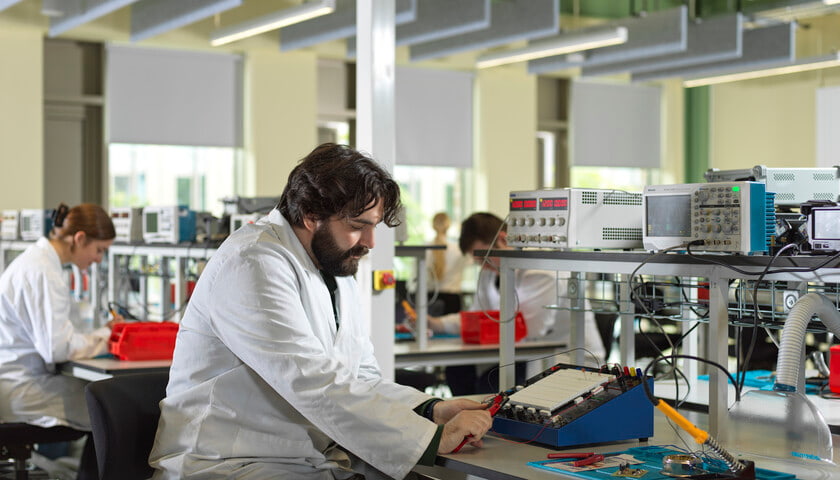
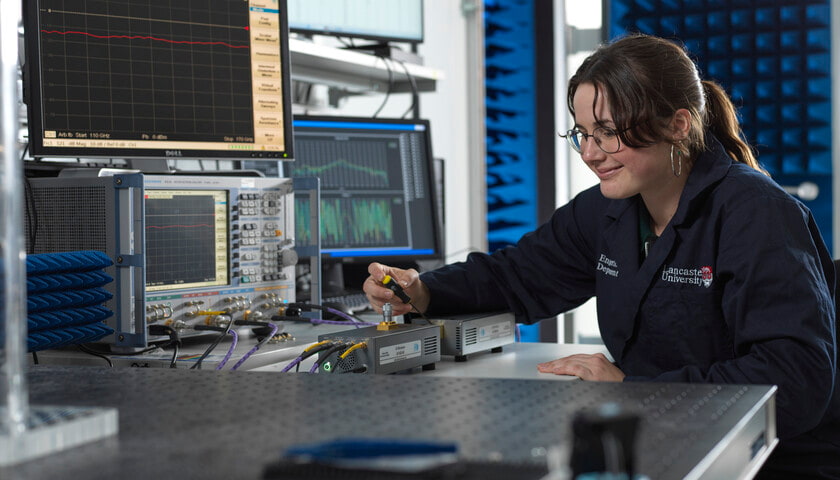
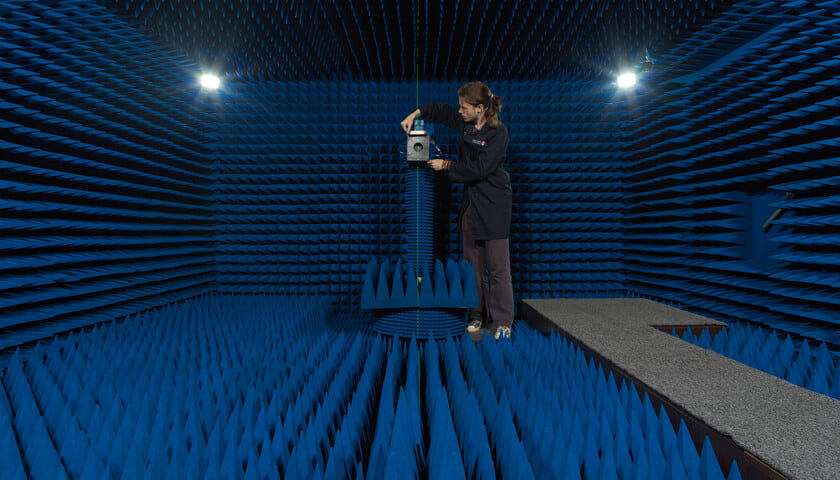
Practical hands-on courses, including lab-based sessions and project work
Gain valuable industry experience through placements
Learn in facilities designed to support hands-on, practical learning
Electrical and electronic engineers are driving innovations that address some of the world’s most critical challenges, from progressing renewable energy solutions to shaping the future of smart cities and automation. Designed in consultation with our Industry Advisory Board, this MSc in Electronic and Electrical Engineering advances your technical expertise and theoretical knowledge in areas directly aligned with national and international priorities, such as the transition to smart grids, 6G networks and sustainable energy systems.
Our general engineering ethos and broad range of modules mean that your learning is inter-disciplinary. Although you are specialising in electronic and electrical engineering, you will benefit from working with other engineers, which is often a requirement of working in industry and greatly enhances your attractiveness to future employers.
Graduates of this MSc will be on a clear pathway toward achieving Chartered Engineer status. This is a new Master’s programme and we are pursuing accreditation with the IET.
Who is this programme for?
Those with a first degree in electronic, electrical or both engineering disciplines, who wish to advance their specialist knowledge and contribute to cutting-edge developments, pursue leadership roles or work in research and development.
Looking ahead to employability
You’ll graduate with a wide range of transferable skills, including creative problem-solving, project management and the confidence to apply both practical and technical knowledge in a rapidly-evolving industry. These skills are gained through:
A dedicated industry consultancy module working on projects and collaborating with other engineers. These group projects go beyond technical design, helping you develop project management and communication skills that today’s employers demand from engineering professionals
A focus on practical work in our state-of-the-art labs. You could be designing and building RF filters; advancing electric vehicle propulsion; developing electrical power systems fit for renewable and low-carbon energy production and storage; using the ARM chip to implement control systems; or using MATLAB to implement machine learning algorithms on real systems
Honing your experience of using professional software like Microwave Office; programming industry standard microprocessors; or taking impedance measurements using network analysers
Understanding industry-relevant design choices, including cost, manufacturability, legal, environmental and end-use aspects
What to expect
This MSc in Electronic and Electrical Engineering allows you to tailor your studies to specialise and stay at the forefront of innovation in fields such as electronics, telecommunications, energy and automation. We offer core modules covering cutting-edge technologies like electrical power system modelling and simulation; design and application of intelligent control systems; the principles of advanced embedded systems; high frequency electronics focusing on RF and mm-wave circuit design.
Your dissertation project will take place within one of our world-leading research groups, working in collaboration with industry, providing exposure to real-world challenges and innovative solutions.
At the end of your Master’s degree you will possess the tools and techniques needed for a successful career in electronic and electrical engineering, alongside an advanced understanding of real-world applications in sectors like aerospace, telecommunications and energy.
3 things we would like you to know
Access to fantastic kit: We have mm-wave and THz fabrication and measurement labs, a range of robots, nuclear test shielded areas with high power RF sources, scanning electron microscope and a wave power test lab with wave tank, which can be used for your dissertation, if appropriate
International recognition for research in electronics and electrical engineering: in RF engineering up to the sub-THz range, mixed-signal electronics, embedded systems, power distribution networks and biophotonics
Industry Advisory Board: We have long established links with major national and international companies as well as local small and medium enterprises. Alongside our world-leading research, they help shape our curriculum so that you are learning modern and innovative engineering techniques. They work directly with you on real projects and challenges, developing your professional collaborative skills and application of solutions
Flexible study options
Study alongside work and other commitments by taking this course on a part-time basis. Running over two years, you take a selection of the modules each year.
We will liaise with you over your choice of optional modules and your schedule, so that you can successfully balance your work and other commitments alongside the Master’s programme.
Interested in master's-level study with us? Fill in our form and we will keep you up to date with course information, events and open days.
Tell me more about postgraduate study at Lancaster accordion
Careers
Skilled engineers with advanced knowledge of innovative electronic and electrical fields – such as electronics, telecommunications, energy and automation – are in high demand. Graduates with an MSc in Electronic and Electrical Engineering are well positioned to take advantage of these opportunities.
From the transition to clean energy and intelligent transport systems to the growth of automation, robotics and communications infrastructure, the sector offers a wealth of rewarding career paths and long-term stability.
Some of the possible employment opportunities open to you include:
Electronic engineer
Electrical engineer
Telecommunication engineer
Control engineer
Robotics engineer
Network engineer
Energy consultant
Sustainable transport engineer
Low carbon consultant
Research engineer
Scholarships for 2026 entry
We are delighted to offer a selection of scholarships for taught master’s programmes in the Faculty of Science and Technology for 2026 entry. These scholarships are awarded to students studying the programme on a full-time basis.
accordion
Students from Bangladesh, Egypt, Ghana, India, Indonesia, Kenya, Malaysia, Nepal, Nigeria, Pakistan, Sri Lanka, Taiwan, Thailand, Turkey or Vietnam
Your qualifications
Programme cost without scholarship
International Regional Scholarship or India Scholarship
Our computer labs are fully equipped with all the software you'll need in order to create virtual prototypes of your projects or systems.
Breakout space
Within the School of Engineering, we have a dedicated Breakout Space for you to get together with other students and collaborate on work, or otherwise socialise in your downtime between lectures, workshops and labs.
Electronics Lab
Our Electronics Lab is equipped with equipment such as oscilloscopes, signal generators, and power supplies to allow you to undertake prototyping and practical work in electronics.
Network Vector Analyser
Our Network Vector Analyser allows you to evaluate the performance of electronic communication systems by analysing how the high frequency signals interact with components and circuits.
Anechoic Chamber
A specialist RF and microwave measurement facility providing a controlled, reflection-free electromagnetic environment for antenna characterisation, near-field and far-field measurements, radar sensing, wireless communication experiments, and electromagnetic compatibility (EMC) testing across microwave and millimetre-wave frequencies.
Entry requirements
Academic Requirements
2:2 Hons degree (UK or equivalent) in a related engineering discipline with a significant amount of both digital and analogue electronics content, which may include some communications, electrical engineering, computer systems and physics courses.
We may also consider non-standard applicants when accompanied by significant experience in a relevant technical field. For UK applicants, a HND together with appropriate practical experience may also be acceptable. Please contact us for further information.
Additional Requirements
Relevant work experience in any practicing Engineering position requiring the application of technical skills is desirable, but not essential.
English Language Requirements
We require an IELTS (Academic) Test with an overall score of at least 6.5, and a minimum of 6.0 in each element of the test.
If you are thinking of applying to Lancaster and you would like to ask us a question, complete our enquiry form and one of the team will get back to you.
Delivered in partnership with Lancaster International Study Centre, our one-year tailored pre-master's pathways are designed to improve your subject knowledge and English language skills to the level required by a range of Lancaster University master's degrees. Visit Lancaster University International Study Centre for more details and a list of eligible degrees you can progress onto.
Course structure
We continually review and enhance our curriculum to ensure we are delivering the best possible learning experience, and to make sure that the subject knowledge and transferable skills you develop will prepare you for your future. The University will make every reasonable effort to offer programmes and modules as advertised. In some cases, changes may be necessary and may result in new modules or some modules and combinations being unavailable, for example as a result of student feedback, timetabling, Professional Statutory and Regulatory Bodies' (PSRB) requirements, staff changes and new research. Not all optional modules are available every year.
Core
core modules accordion
Your dissertation is the culmination of your Master’s degree - an opportunity to demonstrate your ability to research, design and deliver a substantial piece of independent engineering work. Working under the guidance of an academic supervisor, you will contribute to defining your own project, conduct a detailed review of the relevant literature, and apply advanced analytical and technical skills to solve a complex engineering problem.
Projects may focus on experimental investigation, computational analysis, or systems design, and can draw on Lancaster’s research expertise or, where appropriate, industry collaboration. You will develop valuable skills in project management, technical communication and critical evaluation, culminating in a professional dissertation that showcases your ability to plan, execute and present advanced engineering research.
By completing this module, you will gain the confidence and experience to contribute original thinking to your chosen field and demonstrate the professional and academic qualities expected of a Master’s-level engineer.
Apply your knowledge and skills in a real-world context to an exciting industry-linked team project. You will explore the role of engineering consultancy in various industries, focusing on the skills, methodologies and practices involved in providing consultancy services to solve engineering-related problems. This will develop your understanding of industry needs, business requirements, stakeholder management and effective communication with clients.
The module introduces the use of generative AI and prompt engineering as tools to support project management, problem-solving, and communication. You will consider the ethical implications of using AI in professional contexts, including issues related to data use, biases, transparency, accountability and the role of human oversight.
Optional
optional modules accordion
In this module, you’ll explore the structure and operation of electric vehicles, with a focus on their electrical systems, including the energy source, energy conversion system, motor controllers, energy management system, and integration with the mechanical system. You'll delve into drive control, system design, and optimisation to enhance acceleration, braking, and stability that are key factors in ensuring the functionality and safety of electric vehicles. Additionally, you'll study the charging process and how electric vehicles interact with the electricity grid. Through a combination of assignments and group projects, you'll strengthen both your theoretical understanding and practical skills. You'll develop your design capabilities by working with real-world specifications, applying mathematical analyses, and transforming your designs into functional products. The learning experience will incorporate computer simulations of electrical and mechanical systems, microcontroller programming and hands-on electronic and electrical design.
In this module you will cover advanced RF components and techniques, focussing on impedance matching, RF filters and RF amplifiers at high frequencies. You will also focus on the use of transmission lines to replace discrete circuit components. Later, the module will cover RF measurements, and spectrum and network analysis theory and practice. You will build knowledge via microwave simulations, linking practicals to the course material and ultimately building and measuring a microstrip filter. On completion of the module you will have developed experience in the design of RF components.
Explore key concepts in machine learning, intelligent control and modern control theory, with applications in robotics, industrial automation, smart manufacturing, predictive maintenance and digital twin. You will study control theory’s role in ensuring stability and robustness in safety-critical systems, beginning with classical proportional-integral control and progressing to digital control, state-space models and linear quadratic optimal control.
Machine learning (ML) techniques, such supervised and unsupervised learning, reinforcement learning and deep neural networks, will be introduced to address complex, high-dimensional systems where traditional models fall short. The module also examines practical and ethical constraints, while equipping you with computational tools such as MATLAB and Python for real-world implementation.
Throughout, you will gain hands-on experience in designing and applying these methods to engineering challenges, preparing you for the growing role of statistical modelling, intelligent control and ML in diverse fields like healthcare, economics and the natural sciences.
In this module, you’ll explore the structure and operation of electric vehicles, with a focus on their electrical systems, including the energy source, energy conversion system, motor controllers, energy management system, and integration with the mechanical system. You'll delve into drive control, system design and optimisation to enhance acceleration, braking, and stability that are key factors in ensuring the functionality and safety of electric vehicles. Additionally, you'll study the charging process and how electric vehicles interact with the electricity grid. Through a combination of assignments and group projects, you'll strengthen both your theoretical understanding and practical skills. You'll develop your design capabilities by working with real-world specifications, applying mathematical analyses, and transforming your designs into functional products. The learning experience will incorporate computer simulations of electrical and mechanical systems, microcontroller programming and hands-on electronic and electrical design.
This module equips students with advanced skills in energy systems design and power network optimization for a sustainable future. You'll explore large-scale power grids and local microgrids, mastering key concepts essential to the evolving energy sector. Covering climate change mitigation, energy technology assessment, and economic analysis, the module blends power engineering principles with sustainable energy strategies. Hands-on experience with industry software will enhance your expertise in microgrid design, energy cost analysis, and power system simulation. You’ll develop critical skills in EROEI and LCOE calculations, power system stability, fault analysis, and network optimization while navigating the complexities of energy transition. By integrating engineering with economics, this module prepares you for careers in power system design, renewable energy integration, and energy management. Graduates will gain the technical knowledge and practical experience needed to tackle modern challenges in sustainable energy and power engineering.
Explore the core principles of mechatronics and control engineering, where you’ll learn dynamic modelling, actuator design and sensor technologies to tackle real-world challenges in automation, robotics and smart manufacturing. You’ll analyse and optimise systems using time and frequency domain methods, design robust actuators like electric, pneumatic and hydraulic systems, and integrate advanced sensors that measure pressure, temperature and electromagnetic fields.
Gain hands-on experience with signal conditioning, combining hardware and software components, and developing closed-loop control systems for precision in industrial settings. Using tools like MATLAB/Simulink, you’ll simulate projects from robotic assembly lines to IoT-driven automation.
Dive into emerging trends such as AI-enhanced control and master electromagnetic compatibility and noise mitigation - key skills for Industry 4.0 careers. Ideal for aspiring automation specialists and robotics developers, this module focuses on scalable, intelligent system design through industry-aligned labs and hybrid solutions. Shape the future of engineering - one system at a time.
Fees and funding
We set our fees on an annual basis and the 2027/28
entry fees have not yet been set.
Additional fees and funding information accordion
There may be extra costs related to your course for items such as books, stationery, printing, photocopying, binding and general subsistence on trips and visits. Following graduation, you may need to pay a subscription to a professional body for some chosen careers.
Specific additional costs for studying at Lancaster are listed below.
College fees
Lancaster is proud to be one of only a handful of UK universities to have a collegiate system. Every student belongs to a college, and all students pay a small College Membership Fee which supports the running of college events and activities. Students on some distance-learning courses are not liable to pay a college fee.
For students starting in 2026 or 2027, the one-time fee for postgraduate research students is £40. For postgraduate taught students, the one-time fee is £15. Students on some distance-learning courses are not liable to pay a college fee.
Computer equipment and internet access
To support your studies, you will also require access to a computer, along with reliable internet access. You will be able to access a range of software and services from a Windows, Mac, Chromebook or Linux device. For certain degree programmes, you may need a specific device, or we may provide you with a laptop and appropriate software - details of which will be available on relevant programme pages. A dedicated IT support helpdesk is available in the event of any problems.
The University provides limited financial support to assist students who do not have the required IT equipment or broadband support in place.
There is no application fee if you are applying for postgraduate study starting in 2026 or 2027.
Paying a deposit
For some of our courses you will need to pay a deposit to accept your offer and secure your place. We will let you know in your offer letter if a deposit is required and you will be given a deadline date when this is due to be paid.
The fee that you pay will depend on whether you are considered to be a home or international student. Read more about how we assign your fee status.
If you are studying on a programme of more than one year’s duration, tuition fees are reviewed annually and are not fixed for the duration of your studies. Read more about fees in subsequent years.
The information on this site relates primarily to the stated entry year and every effort has been taken to ensure the information is correct at the time of publication.
The University will use all reasonable effort to deliver the courses as described, but the University reserves the right to make changes to advertised courses. In exceptional circumstances that are beyond the University’s reasonable control (Force Majeure Events), we may need to amend the programmes and provision advertised. In this event, the University will take reasonable steps to minimise the disruption to your studies. If a course is withdrawn or if there are any fundamental changes to your course, we will give you reasonable notice and you will be entitled to request that you are considered for an alternative course or withdraw your application. You are advised to revisit our website for up-to-date course information before you submit your application.
More information on limits to the University’s liability can be found in our legal information.
Our Students’ Charter
We believe in the importance of a strong and productive partnership between our students and staff. In order to ensure your time at Lancaster is a positive experience we have worked with the Students’ Union to articulate this relationship and the standards to which the University and its students aspire. Find out more about our Charter and student policies.