

Digital Humanities

MA

  • Entry year 2027
  • Duration Full time 1 year, Part time 2 years

Overview

Top reasons to study with us

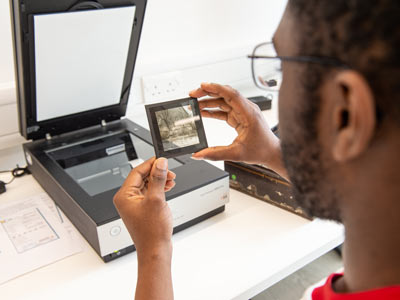
  • Access to digital media studio and specialist equipment

  • Discover the latest specialist knowledge from our experts

  • Opportunity to participate in international projects

On this degree you’ll learn how to apply cutting-edge technology to traditional humanities and cultural heritage research, providing you with expertise that can be applied in further academic research and a wide range of careers.

You will build a portfolio of the skills that the humanities graduates of tomorrow will use – from AI models that read centuries-old handwriting to digital maps that reveal the landscapes of the past.

Why Lancaster?

  • Open doors to exciting professional roles or PhD study through our MA in Digital Humanities
  • Learn from experts with an international reputation in Digital Humanities research and teaching
  • Study in a faculty that specialises in the development and use of data science and artificial intelligence techniques in humanities research
  • Collaborate with your peers in our Digital Scholarship Lab, a state-of-the-art research space

A global leader in the field

You’ll learn from globally recognised experts in the field and engage with cutting-edge research in digital humanities. We particularly emphasise the analysis of historical texts in a digital environment and the use of geospatial technologies to map the geographies of the past.

You may learn about: the use and creation of digital assets and databases; interdisciplinary theories and methods as to how these can be applied; and applications of artificial intelligence (AI) such as natural language processing, machine learning, and computer vision.

Digital skills and contexts

Computational skills can be used to study societies and cultures of the past, present and future. You will gain digital skills tailored to working with digitised humanities sources such as historical newspapers, books, maps, oral histories and more. As you acquire the technical competencies required to work with these sources, you will place these methods in the context of key debates around the history, ethics and cultures of today’s digitised world.

Assuming no prior knowledge other than a conventional ability to work with computers, our modules will give you the skills to develop your own digital humanities research project. This, in turn, provides the knowledge for a rewarding career in a job market where demand for technical abilities is ever increasing.

You will learn state-of-the-art methods including:

  • Textual Analysis: Approaches from corpus linguistics, natural language processing and AI that give you the skills to analyse large collections of digitised texts.
  • Spatial Humanities: Shows how geographical information system (GIS) and other technologies enhance your understanding of the geographies of the past.
  • Digital History: Explores the ways in which digital methods are changing how we understand the past.
  • AI for the Humanities: Cutting edge methods such as Handwritten Text Recognition, large language model (LLM) applications for historical text and computer vision for maps and manuscripts.

You can apply these skills to a range of disciplines from across the humanities including History, Literary Studies, Media Studies, Linguistics and more.

A digital community

The MA in Digital Humanities is embedded in Lancaster’s Centre for Digital Humanities. In this thriving community you will have access to a range of seminars and other events and will have opportunities to co-design new initiatives with students and staff. You will learn about developments in Digital Humanities at Lancaster and beyond and can meet and chat to PhD students and staff working in this exciting field. The Library’s Digital Scholarship Lab hosts many events and is a key space for collaborative activities. Lancaster’s Data Science and AI Institute offers further opportunities for interdisciplinary learning and collaboration.

Take a look at some of our recent and current projects:

  • Encyclopedia of Shakespeare's Language Project: Drawing on Lancaster’s expertise in using Corpus Linguistics to study the past, this project reveals what Shakespeare’s language meant to the Elizabethans through the analysis of millions of words written by his contemporaries.
  • Mapping the Lakes and Lancaster: Streets of Mourning: Focusing on Lake District writing and Lancaster’s experience of the First World War, these projects give two contrasting examples of how geospatial technologies can be used to visualise and better understand the geographies of the past.
  • Unlocking the Colonial Archive: Works with cultural institutions to make collections on colonial Latin America more accessible and explores how digital scholarship can enhance our knowledge of this period. The project draws on a range of AI-based approaches including Handwritten Text Recognition (HTR), natural language processing (NLP), and automated analysis of images.
  • Lancaster Digital Collections and Cinema Memory and the Digital Archive: Two examples of projects that demonstrate the potential of using digital tools to make cultural heritage collections more accessible and understandable.

This and other research at Lancaster allow us to give you access to some of the best digital humanities collections available anywhere. These include:

  • Early English Books Online: Contains much of the content published in English before 1800.
  • Newspaper Corpora such as The Times from the 1790s to the 2000s and the British Library’s Nineteenth Century Newspaper collection, around 50 billion words take from around 50 continuous series of British and Irish newspapers
  • Literary works such as a variety of collections of Shakespeare’s works
  • The Corpus of Lake District Writing: Landscape writing including Wordsworth and many others

and much more.

Request information

Interested in master's-level study with us? Fill in our form and we will keep you up to date with course information, events and open days.

Tell me more about postgraduate study at Lancaster accordion

Careers

This MA equips you with a valuable set of transferable skills. You’ll be able to continue into academia on research projects or apply your newly acquired skills in the private and public sectors.

We prepare our graduates for success in many fascinating careers including:

  • Cultural heritage management
  • Galleries, museums and archives
  • Infrastructure research councils
  • Civil service for digital developments
  • Geographic information systems analysis
  • Digital librarianship

Previous graduates have successfully achieved positions as a Digital Curator with the BBC, a GIS consultant in private industry, and a Digital Humanities Librarian in Higher Education.

This Master's degree also puts graduates in a strong position to further their studies at doctorate level. A PhD is a brilliant opportunity to continue your research and deepen your digital humanities skills in a specific area. Previous graduates secured PhD scholarships both in the UK and overseas.

Careers and employability support

Our degrees open up an extremely wide array of career pathways in businesses and organisations, large and small, in the UK and overseas. Our specialist Employability team is ready to support you, whether you are starting out your career after leaving higher education or returning to university to open up new career options.

We provide individual employability advice, application support, career events, development opportunities and resources to help you plan and achieve your career goals. We also run a paid internship scheme specifically for arts, humanities and social sciences students.

The Lancaster Award is available to all postgraduate taught students and recognises work experience, volunteering and personal development alongside your studies. Developed with employers, it helps you reflect on key skills, boost your CV and articulate your strengths with confidence.

Whether you have a clear idea of your potential career path or need some help considering the options, our friendly team is on hand.

Find out more about Lancaster’s career events, extensive resources and personal support for Careers and Employability.

Entry requirements

Academic requirements

2:2 Hons degree (UK or equivalent) in any humanities discipline or related subjects, such as Library Science, or Journalism, for example.

English language requirements

We require an IELTS (Academic) Test with an overall score of at least 6.5, and a minimum of 6.0 in each element of the test.

We also consider other English language qualifications. If your score is below our requirements, you may be eligible for one of our pre-sessional English language programmes.

Help from our Admissions team

If you are thinking of applying to Lancaster and you would like to ask us a question, complete our enquiry form and one of the team will get back to you.

We also have more details on our website about:

Pre-master's programmes

Delivered in partnership with Lancaster International Study Centre, our one-year tailored pre-master's pathways are designed to improve your subject knowledge and English language skills to the level required by a range of Lancaster University master's degrees. Visit Lancaster University International Study Centre for more details and a list of eligible degrees you can progress onto.

Course structure

Detailed module information for this postgraduate programme will follow shortly. However, if you have any questions please contact the department.

Fees and funding

We set our fees on an annual basis and the 2027/28 entry fees have not yet been set.

Additional fees and funding information accordion

Scholarships and bursaries

Details of our scholarships and bursaries for students starting in 2027 are not yet available.

You can use our scholarships for 2026-entry as a guide.

Important information

The information on this site relates primarily to the stated entry year and every effort has been taken to ensure the information is correct at the time of publication.

The University will use all reasonable effort to deliver the courses as described, but the University reserves the right to make changes to advertised courses. In exceptional circumstances that are beyond the University’s reasonable control (Force Majeure Events), we may need to amend the programmes and provision advertised. In this event, the University will take reasonable steps to minimise the disruption to your studies. If a course is withdrawn or if there are any fundamental changes to your course, we will give you reasonable notice and you will be entitled to request that you are considered for an alternative course or withdraw your application. You are advised to revisit our website for up-to-date course information before you submit your application.

More information on limits to the University’s liability can be found in our legal information.

Our Students’ Charter

We believe in the importance of a strong and productive partnership between our students and staff. In order to ensure your time at Lancaster is a positive experience we have worked with the Students’ Union to articulate this relationship and the standards to which the University and its students aspire. Find out more about our  Charter and student policies.