Access volcanic rock on our doorstep in the English Lake District
The only taught master’s in the UK dedicated to volcanology
Benefit from a community of volcanologists conducting fascinating research
Volcanoes are fascinating phenomena – simultaneously spectacular and dangerous. They can both create and destroy our habitats and human-made infrastructure, in addition to causing economic disruption. As over a billion people worldwide live close to an active volcano, effective hazard management underpins the lives and livelihoods of many.
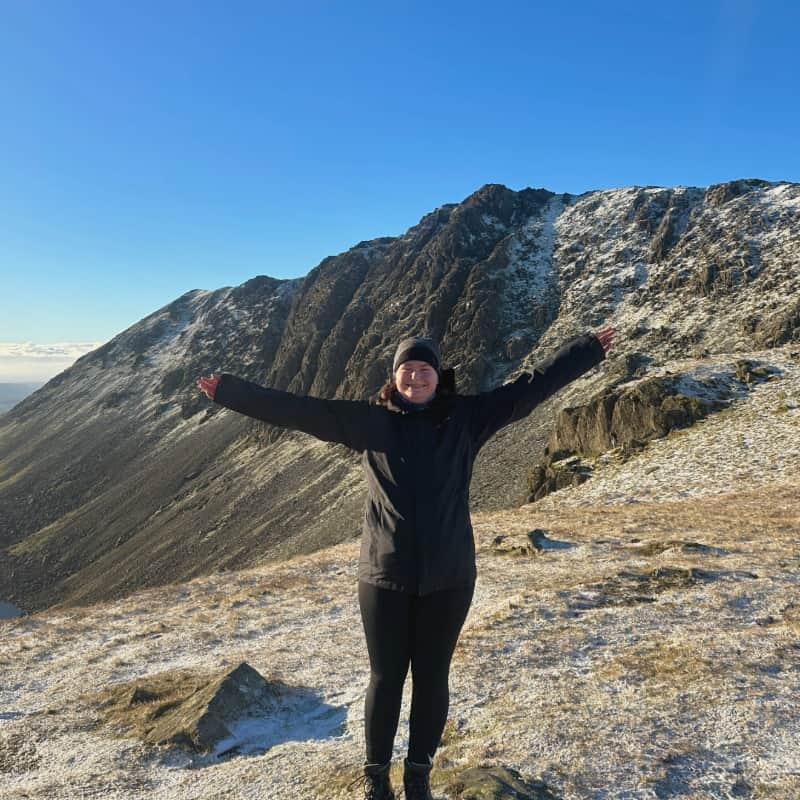
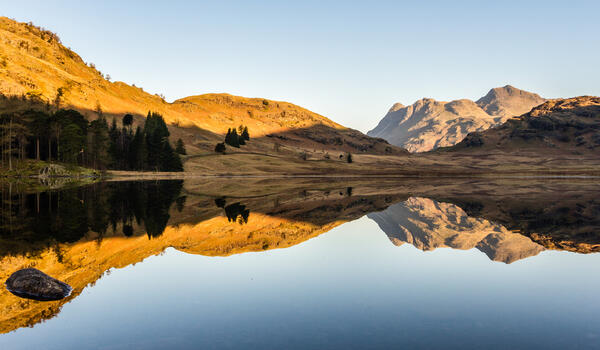
Our MSc Volcanology will develop your expertise in, and understanding of, volcanic activity and its interaction with the wider environment. Taught by our world-leading environmental scientists, we very much believe that getting out into the field is essential to your studies. Lancaster is perfectly placed to do this, with the striking volcanic rocks of the Lake District on our doorstep.
Volcanoes can be analysed and studied in many ways, not just out in the field. You will also develop laboratory and computer-based skills to better analyse and evaluate environmental and volcanological phenomena.
Who is this programme for?
Those looking to gain a deeper understanding of volcanology in order to progress their career in the environment/geoscience sector, or as a step towards research with a PhD.
Looking ahead to employability
Through our volcanology group, we share a passion for the research we do by inviting students to take part in seminars, workshops and wider discussions to learn from their peers and research leaders. This extra-curricular activity broadens your perspective, enhances your research skills and can further your interest in specific areas.
We also develop your transferrable skills so that when you graduate you are well positioned for opportunities in industry or research. You will:
Gain crucial field-working skills, including relating fundamental principles to complex real-world observations, such as the use of volcanic rock textures to reconstruct volcanic behaviour, or characterisation of slope stability from field observations and physical models
Develop your ability to think critically, assess problems and design solutions
Learn how to build a rationale for management or intervention
Communicate your ideas effectively
What to expect
Volcanoes are the most recognisable sign of Earth's dynamic interior. Multifaceted interactions between magma, water and air generate a myriad of volcanic phenomena that can be unravelled through field, laboratory and numerical study. Volcanic deposits provide evidence of physical processes that pose hazards locally and globally.
Taught by world-leading experts in the field, you will start with a core module in physical volcanology. Here, you will learn widely applicable physical and chemical principles that underpin volcanic activity, including the rheology of magma, the behaviour of eruption-triggering volcanic gases and the transport of lava and ash to the surface and atmosphere. You have an additional core module that covers broader geological hazards, including volcanic, seismic and landslide hazards, while providing training in fieldwork and technical report writing. Your third core module provides an interdisciplinary overview of broader environmental challenges by using a set of local case studies in and around the nearby English Lake District. This highlights context and is an important context communication experience. Then you will select three additional optional modules to suit your interests. One of these is the highly popular field course to Mount Etna on Sicily, to see an active volcano close up. Whatever your selection, each module is carefully designed to develop your broader learning and practical skills in that area.
Your Master’s culminates in a dissertation project under the supervision of one of our internationally recognised researchers, taking advantage of our well-equipped experimental and geochemical laboratories.
3 things we would like you to know
Lancaster is ideally situated for environmental study, with volcanic rocks on its doorstep in the Lake District
Over 100 graduates of this Master's are in successful careers in industry, academia and research
Our volcanology research group offers peer support, access to research and networking opportunities
Flexible study options
Study alongside work and other commitments by taking this course on a part-time basis. Running over two years, you can choose from a selection of our modules each year.
We'll liaise with you over your schedule and choice of optional modules, ensuring you successfully balance your commitments alongside our Master’s programme.

Interested in master's-level study with us? Fill in our form and we will keep you up to date with course information, events and open days.
Tell me more about postgraduate study at Lancaster accordion
Postgraduate study is carried out in the Graduate School for the Environment. This is a collaboration between Lancaster University's Environment Centre, the Centre for Ecology & Hydrology, and Rothamsted Research.
Whether choosing to take up a role in industry or pursue a PhD, the MSc in Volcanology provides you with the knowledge base, skill set and additional professional competencies that together will distinguish you from other candidates. Our alumni hold positions as:
Catastrophe modeller
Geo-environmental consultant
Volcanologist
Academic, from lecturer to professor
GIS consultant
Data scientist
Emergency planning officer
Sustainability advisory
Scholarships for 2026 entry
We are delighted to offer a selection of scholarships for taught master’s programmes in the Faculty of Science and Technology for 2026 entry. These scholarships are awarded to students studying the programme on a full-time basis.
accordion
Students from Bangladesh, Egypt, Ghana, India, Indonesia, Kenya, Malaysia, Nepal, Nigeria, Pakistan, Sri Lanka, Taiwan, Thailand, Turkey or Vietnam
Your qualifications
Programme cost without scholarship
International Regional Scholarship or India Scholarship
“Lancaster is the only university that offers a taught MSc in Volcanology. On top of this, the idea of a campus university appealed to me after completing my undergraduate degree at a city-based university that was always very busy. Lancaster University is also very close to many beautiful areas, and the idea of being so close to the Lake District was very enticing – I do love a good hike!
I have loved learning about volcanology in depth, and to be able to learn more thoroughly about the physical processes behind volcanoes. The Volcanology MSc is a mix of geology, geophysics, geochemistry and mathematical modelling.
I came into the course nervous that I would not be able to keep up with the workload and the change in study area. My undergrad was 100% exam based, so moving to a coursework-based MSc had me questioning my writing and time management skills.
This being said, the course has taught me to trust myself and my capabilities, it has allowed me to teach myself how to write scientifically and clearly. The taught nature of the master's has allowed an equal balance of self-motivated work and coursework applied deadlines to help improve my time management. It has made me more confident in my ability to learn and apply myself to new areas of study.
This course is suited to students with many different academic backgrounds, who may not even consider it an option. I have been given the opportunity to academically grow and learn so many more skills.”
Alice Goodman – MSc Volcanology
A future for Jacqueline
“The opportunity to study volcanology gave me the experience to study volcanic systems in-depth, and to understand the wider implications for the Earth’s climate system. Being a student at Lancaster was rewarding and stimulating. The teaching was of a high standard, and the programme included a strongly research-led dissertation. Lancaster Environment Centre is recognised for its expertise in Earth Sciences and has a supportive research environment.
Winning the Best Poster award stands out most. Receiving that award gave me confidence that I could present my work to a wider audience and communicate the key ideas clearly. The Etna field trip gave me firsthand experience of the volcanic processes we had been studying in the lectures. Visiting lava flows and volcanic deposits helped connect theoretical knowledge to real volcanic activity.
The course provided the skills and research experience that helped me progress to a PhD – I would recommend it to anyone considering a future in research.”
Jacqueline Fanner - MSc Volcanology
Facilities
Laboratories
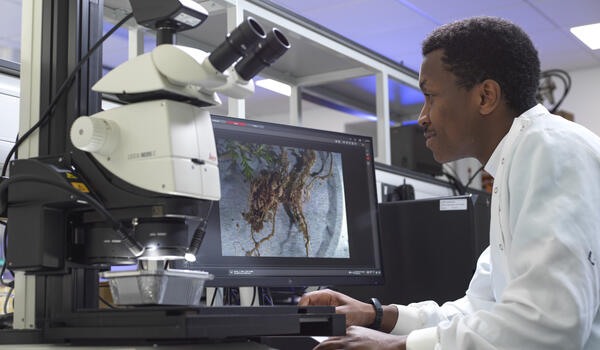
Lancaster Environment Centre features state-of-the-art teaching laboratories and specialist facilities, including dedicated spaces for Environmental Chemistry, Noble Gas analysis, plus Water and Soil Science.
Research Facilities
We offer a diverse range of research facilities to support your work, from glasshouses and controlled-environment plant growth rooms to solar domes and a weather station at our Hazelrigg field site and telemetered research catchments. Our facilities are complemented by advanced equipment such as our Mass Spectrometry facility, X-ray CT-Scanner and Magnetometer.
Local Environment
Our exceptional local surroundings – ranging from coasts and lakes to forests, farms and urban environments – provide a living laboratory for hands-on learning, helping you develop practical skills with global relevance.
Study Spaces
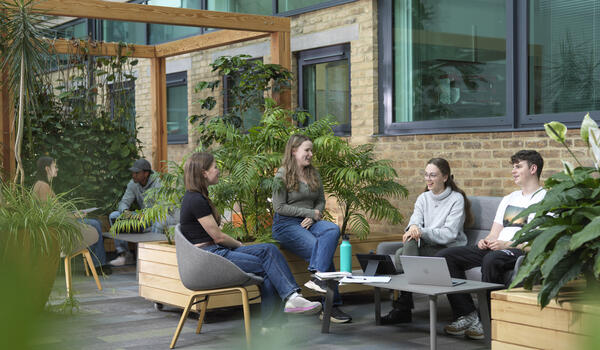
Alongside a range of study areas across campus, our atrium offers a bright, modern environment designed for collaboration and independent work. Filled with natural light and greenery, it’s a welcoming space for students and staff to meet, study and relax.
Data Resources
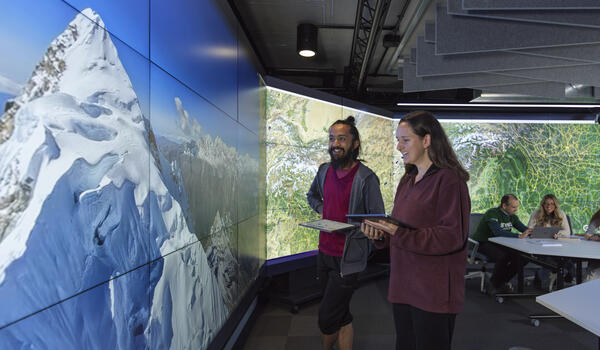
Dedicated support staff with expertise in GIS, statistics, modelling and programming are on hand to help you build advanced data and digital skills. We also have a cutting-edge data immersion suite that’s used in our teaching.
Entry requirements
Academic requirements
2:2 Hons degree (UK or equivalent) in Geology, Geography, Earth Science, Natural Science, Environmental Science or similar.
We may also consider non-standard applicants at a 2:2 degree level in a related subject, alongside relevant experience or training in volcanology, specific volcanology research, field work or broader contributions to environmental science.
Applicants with a 2:2 degree in Engineering, Maths/Statistics, English or Physics are encouraged to contact us for further information.
English language requirements
We require an IELTS (Academic) Test with an overall score of at least 6.5, and a minimum of 6.0 in each element of the test.
If you are thinking of applying to Lancaster and you would like to ask us a question, complete our enquiry form and one of the team will get back to you.
Delivered in partnership with Lancaster International Study Centre, our one-year tailored pre-master's pathways are designed to improve your subject knowledge and English language skills to the level required by a range of Lancaster University master's degrees. Visit Lancaster University International Study Centre for more details and a list of eligible degrees you can progress onto.
Course structure
We continually review and enhance our curriculum to ensure we are delivering the best possible learning experience, and to make sure that the subject knowledge and transferable skills you develop will prepare you for your future. The University will make every reasonable effort to offer programmes and modules as advertised. In some cases, changes may be necessary and may result in new modules or some modules and combinations being unavailable, for example as a result of student feedback, timetabling, Professional Statutory and Regulatory Bodies' (PSRB) requirements, staff changes and new research. Not all optional modules are available every year.
Core
core modules accordion
Geological hazards, especially earthquakes, landslides and volcanic eruptions, endanger lives and livelihoods – disproportionately in vulnerable areas – and cause economic losses and infrastructure damage. Effective hazard management requires detailed understanding of the underlying physical processes, use of appropriate monitoring techniques to assess hazards and rigorous policymaking. In this module you’ll learn, via numerous case studies, how the boundaries of our knowledge of geological hazards are advanced by ongoing research. You’ll gain understanding of why landslides occur and the geomechanical models underpinning slope failure analysis and why faults slip. You will look at the probabilistic models used in seismic hazard assessment and how volcanic unrest and eruption relates to physical processes in magmatic systems. You will gain employability-relevant experience of geological hazards, which integrates field, remote sensing and modelling approaches and includes a site survey of a local landslide. You will thus develop systematic and creative approaches to identifying and solving problems.
This field-based, interdisciplinary module puts you at the heart of environmental sustainability case studies right on our doorstep in Lancaster. These may include:
Pollution at Windermere
Habitat restoration in the Cumbrian Lake District
The energy transition from coal mines to renewables
Innovative waste management schemes
Local food initiatives
With each case study, our academic and research staff work alongside external stakeholders in the identification, assessment, and remediation of environmental challenges.
Our most pressing environmental sustainability challenges include biodiversity loss, climate change, waste and pollution management, uncertain food security and dwindling resources. There is an ever-increasing demand for graduates versed in these complex issues, whose critical thinking and original, creative problem-solving can make a difference.
You’ll gain both first-hand knowledge relevant to careers in environmental sustainability, and experience in effective communication that cuts across disciplinary boundaries and brings together the University, the private sector, and the wider public.
The dissertation allows you to conduct an independent research project that is at the forefront of the discipline, focusing on a specific topic relevant to your degree programme and interests. Throughout, you will receive one-to-one support from an academic.
This is the largest piece of work that you will complete during your degree and depending on your subject area, will enable you to develop skills including:
Formulating a research question
Contextualising it within research literature
Identifying and using appropriate research methods and techniques to address your question
Collecting and analysing data
Interpreting and communicating your findings
You will be expected to present your findings in an extensive report akin to a research paper. In this, you will demonstrate your ability to conduct rigorous, independent research whilst working effectively with others, attributes valued by future employers.
We inhabit a wafer-thin veneer that floats on a dynamic planetary interior. This module explores the structure and evolution of Earth’s interior and how volcanic systems emerge as the surface expression of the convection of the outer core and mantle. You will build a foundation on understanding of the properties and behaviour of volcanic materials gained through laboratory, theoretical and field study. The module emphasises widely applicable physical and chemical principles that underpin volcanic activity, including variations in solubility, rheology, phase, density and permeability. The interaction of volcanic processes with the biosphere, atmosphere and hydrosphere are discussed including how the Earth’s interior can produce rapid surface change that alters the trajectory of evolution. These principles will also be applied to research-led insights into volcanism across the solar system.
Optional
optional modules accordion
Chemical contamination is one of the ten ‘planetary boundaries’, which, according to some of the world’s most eminent scientists, should not be crossed. The reasons are self-evident; a contaminated world is an unsafe world – for society and the environment. Even the most advanced nations suffer, directly or indirectly, from pollution, whether the source is thousands of kilometres away or just down the street.
Through a combination of lectures and workshop-based activities, you will gain an understanding of the scale of the pollution problem, the fate, behaviour and impact of pollutants in the environment, especially in terrestrial systems, the processes developed to assess the risk and potential impact of pollution, and how we use scientific understanding to reduce the impact of pollution on the environment and society.
The knowledge and skills that you will gain from this module will support your ambitions for further research or employment in the regulatory and private sectors.
Advances in environmental science increasingly rely on diverse data collected through a wide range of sensors and instruments. This module equips you with the skills to access, process and interpret varied digital datasets, using modern techniques and software underpinned by scientific rigour. You’ll learn how to critically assess data quality, recognise potential errors and apply methods to minimise their impact. Through real-world examples drawn from across the environmental sciences, you’ll gain confidence in working with complex, multi-source data and understand the value of integrating different data streams.
Take a critical, yet hands-on approach to exploring the role of eco-innovation as a pathway towards sustainable development.
Through action-learning, you will identify and address complex real-world sustainability challenges by developing your own eco-innovation proposals – viable ideas with the potential to reduce human impact on the environment whilst simultaneously delivering the economic and social ambitions of the global sustainable development agenda.
Working in small teams, you will combine key sustainability concepts and business planning approaches to develop effective eco-innovations. Throughout, you will gain valuable transferable skills including team working, problem analysis and framing, and effective oral and written communication to professional and non-academic audiences.
By the end of the module, you will be able to demonstrate a critical understanding of the forefront of eco-innovation for sustainable development, along with practical skills and increased confidence to help you drive change in real world professional environments.
Build a comprehensive and systematic understanding of the data analysis and programming techniques that increasingly underpin environmental and Earth sciences and are equally relevant to research and employment. To begin, you will be introduced to methods for using computer programming for analysis and visualisation of environmental science data. Using a modern programming language (e.g. Python) and interactive development environments (e.g. Jupyter Notebook), you will then develop the skills necessary to use programming in conjunction with large datasets and modelling systems that feature throughout environmental science.
You will explore the fundamental tools of programming, running code in interactive development environments, editing, commenting, debugging, and using variables, loops, conditional statements and functions. Once you have mastered these tools, you will develop proficiency in programming for statistical analysis, hypothesis testing and data visualisation, and gain experience in planning and implementing tasks at a professional level.
Develop a critical understanding of the core concepts, tools and strategies used in managing natural resources and the environment. This module places strong emphasis on tackling the complexity, uncertainty and conflict that often characterise real-world environmental challenges. You’ll explore a range of management approaches suited to rapidly changing or ‘turbulent’ conditions and examine contemporary environmental issues through both academic and policy lenses. By engaging in constructive debate, you’ll refine your ability to evaluate competing arguments and evidence, and demonstrate a sophisticated understanding of alternative management frameworks.
How do we make the decisions that will stop climate change, reverse the biodiversity crisis, keep our rivers clean and cope with a host of other environmental issues while providing the jobs, houses, renewable energy and other things we need for a high quality of life? This module will introduce you to the fast-moving world of environmental decision making through Environmental Impact Assessments (EIAs) and the new approach of Environmental Outcome Reports (EORs). We take a practical approach, including site visits, to see how information is gathered and processed on plans, programmes and projects that may have a significant effect on the environment, and we explain the process, law, and key players right through to a decision. This practical approach helps you to gain confidence so that you’re ready to create and present a case either for or against a scheme.
We introduce you to the fundamental principles of Geographical Information Systems (GIS) and remote sensing and demonstrate how these complementary technologies may be used to capture/derive, manipulate, integrate, analyse and display different forms of spatially-referenced environmental data. We blend theory-led lectures with hands-on practical sessions using state-of-the-art software. Alongside core subject knowledge, you'll build transferable skills in synthesising geographical data, developing problem-solving strategies, managing your time effectively and presenting analysis through innovative graphical formats.
Groundwater is the largest freshwater reservoir on the planet; in many parts of the world it is the main (or only) source of freshwater. Groundwater is not only a major source of drinking water, it sustains river flow, plays a critical role in food security and can also influence the structural properties of the ground. In this module you will learn how we can access this water reservoir and how natural and human-influenced disturbances can impact on the availability of groundwater and its quality. You will also be given in-field training on groundwater investigation techniques and gain hands-on experience of using groundwater models to tackle practical problems. You will also learn about some topical issues related to groundwater resources, globally.
How are we transforming the way we supply and use energy to achieve our climate targets? On this cross-disciplinary module, you will look at the major changes underway within our energy system.
Examine decarbonisation pathways in electricity, transport and heat, whilst considering supply and demand dynamics and carbon removal. As part of this, you will investigate real-world challenges at the forefront of the discipline, including how to govern the energy system, economics, societal engagement, and energy security. You will gain real-world insight into complex related issues via interactions with energy professionals, using the University energy system as a case study.
Develop your theoretical and practical knowledge of volcanic processes by studying the evolution of a basaltic volcano. You will be part of pre-trip classroom sessions used to support the main residential fieldwork component of the module. You will cover a wide range of the complex physical volcanic processes that take place both on the surface, within and beneath volcanoes. You will explore geological evidence for constructional (eruptive and intrusive) events as well as for destructive (collapse) events. On top of that, you will also interpret field observations, over scales varying from millimetres to kilometres, in terms of their causal volcanic processes and evaluate the associated hazard. You'll use a problem-based learning approach to tackle major challenges, such as understanding the magmatic plumbing system and how it shapes modern approaches to hazard analysis and mitigation.
Through a combination of lectures, workshop and field-based activities, you will gain a ‘whole system view’ that cuts across disciplines. With a foundation in ongoing research, this will enable you to refine your skills in critical thinking and creative problem solving.
Your new knowledge and skills will provide a springboard for further study or employment focused on a major societal challenge.
Fees and funding
We set our fees on an annual basis and the 2027/28
entry fees have not yet been set.
Additional fees and funding information accordion
There may be extra costs related to your course for items such as books, stationery, printing, photocopying, binding and general subsistence on trips and visits. Following graduation, you may need to pay a subscription to a professional body for some chosen careers.
Specific additional costs for studying at Lancaster are listed below.
College fees
Lancaster is proud to be one of only a handful of UK universities to have a collegiate system. Every student belongs to a college, and all students pay a small College Membership Fee which supports the running of college events and activities. Students on some distance-learning courses are not liable to pay a college fee.
For students starting in 2026, the one-time fee for undergraduates is £40. For postgraduate students, the one-time fee is £15. Students on some distance-learning courses are not liable to pay a college fee.
Computer equipment and internet access
To support your studies, you will also require access to a computer, along with reliable internet access. You will be able to access a range of software and services from a Windows, Mac, Chromebook or Linux device. For certain degree programmes, you may need a specific device, or we may provide you with a laptop and appropriate software - details of which will be available on relevant programme pages. A dedicated IT support helpdesk is available in the event of any problems.
The University provides limited financial support to assist students who do not have the required IT equipment or broadband support in place.
There is no application fee if you are applying for postgraduate study starting in 2026 or 2027.
Paying a deposit
For some of our courses you will need to pay a deposit to accept your offer and secure your place. We will let you know in your offer letter if a deposit is required and you will be given a deadline date when this is due to be paid.
The fee that you pay will depend on whether you are considered to be a home or international student. Read more about how we assign your fee status.
If you are studying on a programme of more than one year’s duration, tuition fees are reviewed annually and are not fixed for the duration of your studies. Read more about fees in subsequent years.
The Peter Vincent prize rewards Lancaster University final year geography students applying for one of LEC’s taught Master’s degrees. You may be eligible for a prize of £1500.
Peter John Vincent Scholarship accordion
If you are a Lancaster University final year geography student applying for one of LEC’s taught Master’s degrees, you may be eligible for a prize of £1500. For each of our Master's degrees, we will award the prize to the graduate with the highest overall mark in either geography, human geography, or physical geography. That’s six prizes in total that may be awarded.
You don’t have to do anything. Once you have secured your place on your chosen LEC Master’s, you will automatically be considered for the prize and notified if you are successful.
Postgraduate Master's Loan
The UK government offers a number of loans to UK and some EU national students wishing to study for a Master's degree.
The information on this site relates primarily to the stated entry year and every effort has been taken to ensure the information is correct at the time of publication.
The University will use all reasonable effort to deliver the courses as described, but the University reserves the right to make changes to advertised courses. In exceptional circumstances that are beyond the University’s reasonable control (Force Majeure Events), we may need to amend the programmes and provision advertised. In this event, the University will take reasonable steps to minimise the disruption to your studies. If a course is withdrawn or if there are any fundamental changes to your course, we will give you reasonable notice and you will be entitled to request that you are considered for an alternative course or withdraw your application. You are advised to revisit our website for up-to-date course information before you submit your application.
More information on limits to the University’s liability can be found in our legal information.
Our Students’ Charter
We believe in the importance of a strong and productive partnership between our students and staff. In order to ensure your time at Lancaster is a positive experience we have worked with the Students’ Union to articulate this relationship and the standards to which the University and its students aspire. Find out more about our Charter and student policies.